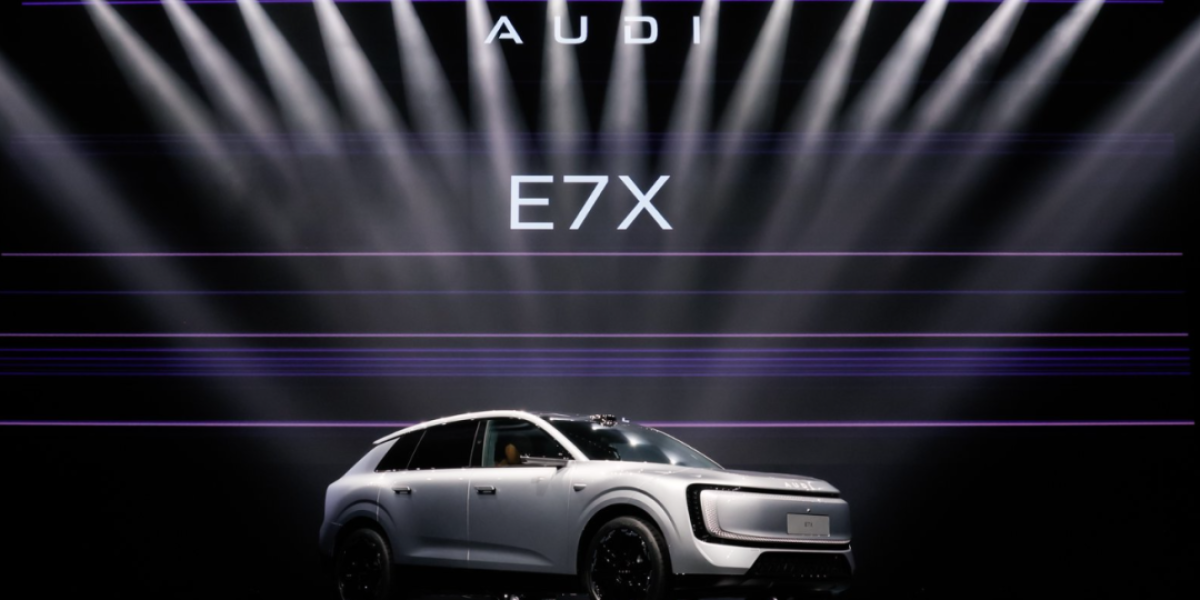
What happens when a traditional German luxury marque finally learns how to confront China’s electric upstarts head-on — not merely with heritage, but with pricing, technology and equipment? The answer may well reshape the balance of power in the premium EV market. And Audi’s new E7X has now placed that question squarely before the industry.
China’s luxury electric vehicle market in 2026 stands at a delicate turning point. The latest quarterly earnings from Germany’s automotive giants reveal the scale of the pressure. BMW Group reported a 23.1% drop in net profit and an 8.1% fall in revenue, with Chinese sales declining by 10%, becoming the single largest drag on global performance. Volkswagen and Mercedes-Benz have fared little better. Volkswagen’s sales in China slipped 14.9% year-on-year, while Mercedes-Benz passenger car deliveries in the market plunged by 27%.
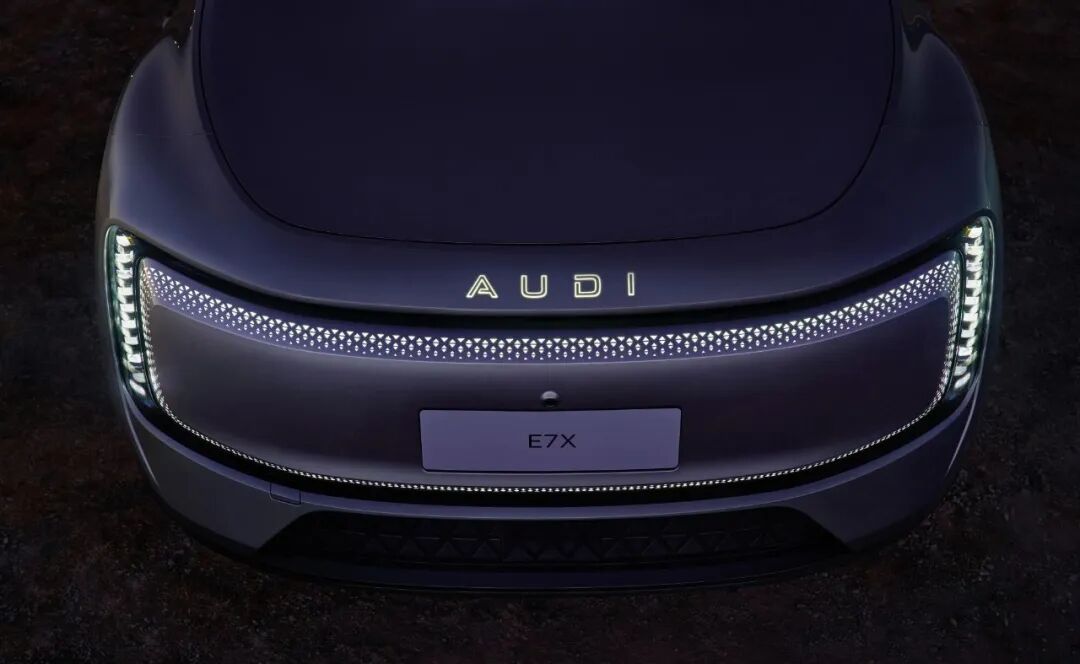
In a country where new-energy vehicles now account for more than half of annual car sales, traditional luxury manufacturers are facing their sternest challenge in decades. Among China’s top-selling premium electric models priced above 300,000 yuan in 2025, the familiar names of BMW, Mercedes-Benz and Audi are increasingly absent.
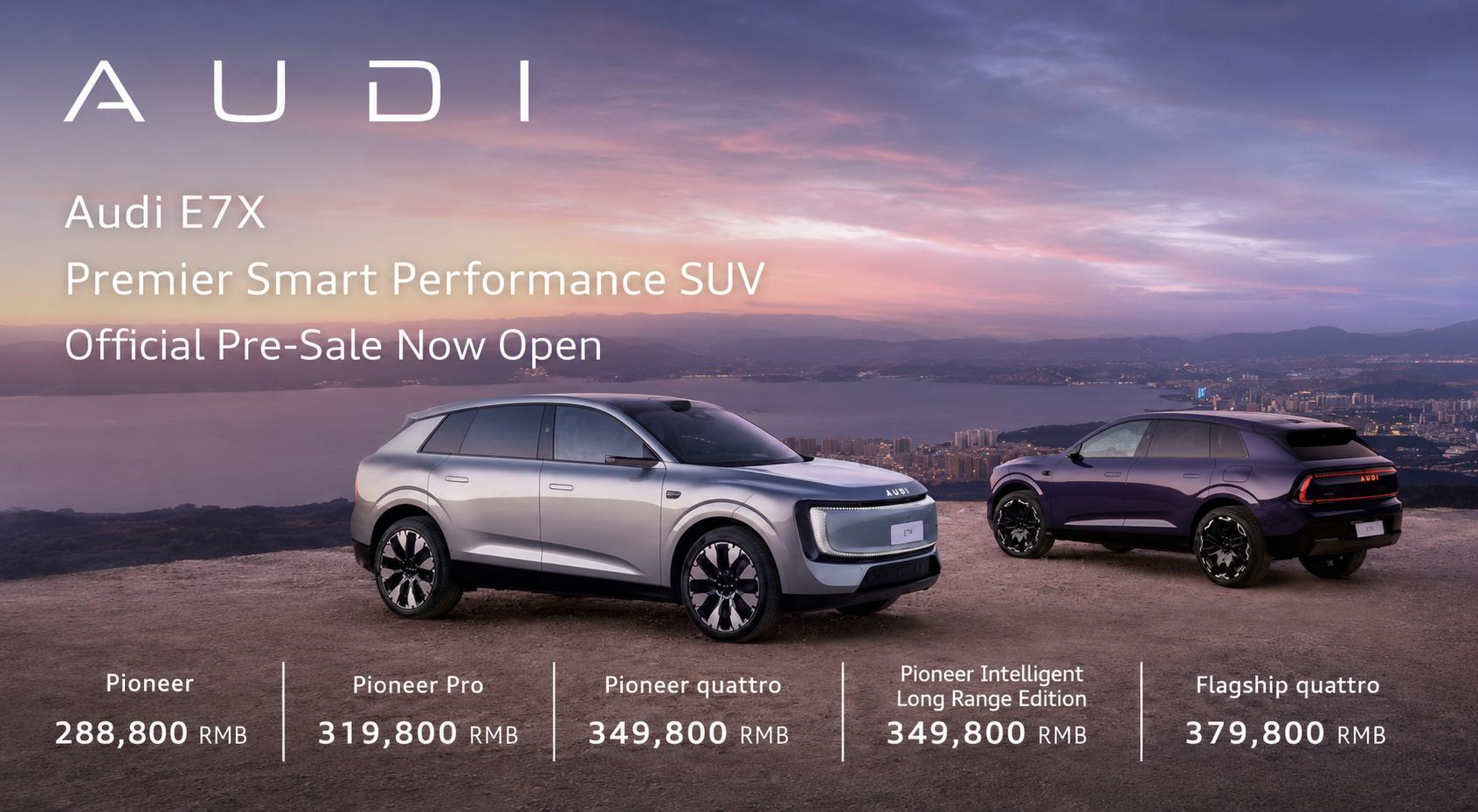
Against this backdrop, SAIC Audi officially opened pre-sales for the all-new Audi E7X in Chengdu on May 8. Offered in five trim levels and priced from 289,800 yuan to 379,800 yuan during the launch period, the large electric SUV arrives with a bold proposition: “fully equipped from entry level”. Measuring 5,049 mm in length with a wheelbase of 3,060 mm, the E7X enters China’s fiercely competitive 300,000-yuan EV segment armed with a 900V ultra-fast charging platform, 14-degree rear-wheel steering, the Momenta R7 assisted driving system and a driving range of up to 751 kilometres.
Whether viewed as a pricing offensive or a strategic breakthrough, the E7X sends a clear message: German luxury brands are no longer relying solely on the badge. They are finally learning to compete through product strength.
Rewriting the Value Equation
At first glance, a starting price of 289,800 yuan and a fully loaded version below 380,000 yuan may not appear revolutionary. Yet compared with rival German electric SUVs of similar size, the E7X undercuts many competitors by between 50,000 and 100,000 yuan. Its top-spec model is priced close to what some luxury brands charge merely for entry-level midsize EVs.
Audi has also attached an aggressive package of launch incentives. Customers placing a 2,000-yuan deposit receive a 7,000-yuan reduction, while owners trading in German vehicles can receive subsidies of up to 12,000 yuan. In practical terms, that means buyers can acquire a full-size premium electric SUV carrying the Audi nameplate for little more than 270,000 yuan.
Yet the E7X’s true weapon is not low pricing alone. More significant is Audi’s attempt to overturn one of the most familiar criticisms levelled at German luxury brands: the practice of offering stripped-down entry-level models while reserving meaningful equipment for expensive upgrades.
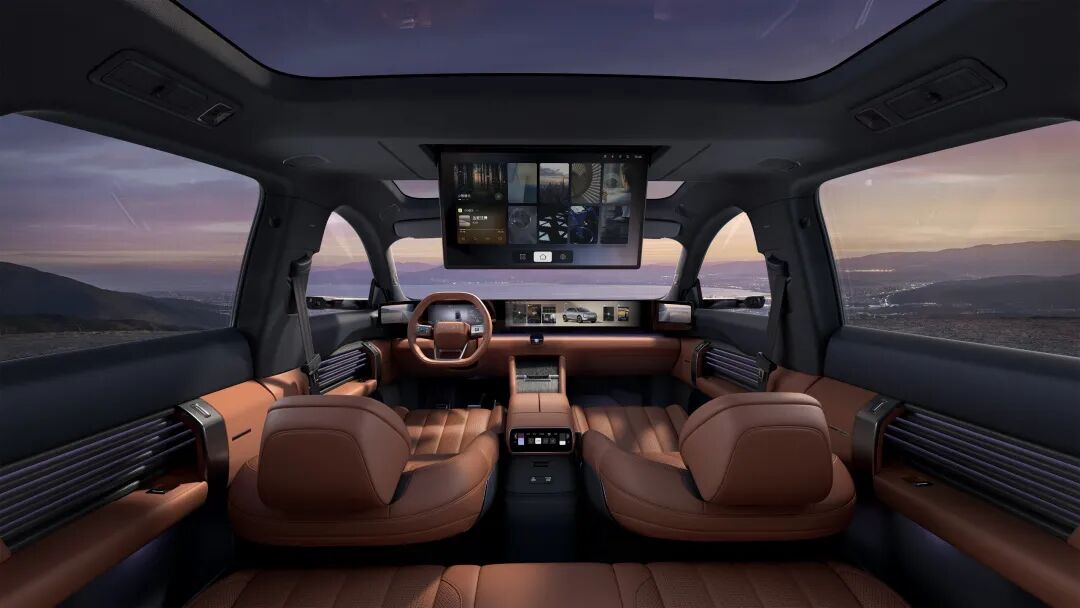
The base Pioneer edition of the E7X includes more than 70,000 yuan worth of advanced features at no extra cost during the pre-sale period. These are not cosmetic add-ons. They include Audi’s panoramic intelligent driving assistance suite, a 21.4-inch QD Mini LED display, an intelligent dimming panoramic roof and the rare dual-direction 14-degree rear-wheel steering system. Moving up each trim level requires roughly another 30,000 yuan, but adds equipment packages said to be worth approximately 75,000 yuan.
Part of the confidence behind such pricing stems from Audi’s supply-chain leverage. Every E7X uses a customised 109kWh ternary lithium battery supplied by CATL, combined with a 900V high-voltage architecture and CTP integration technology. Supported by 4C ultra-fast charging, the vehicle can add up to 429 kilometres of range in just ten minutes. Even in temperatures as low as minus 20 degrees Celsius, battery capacity retention reportedly remains above 93%.
At a time when battery costs remain stubbornly high, this is not an inexpensive technical package. Yet Audi has still managed to bring the starting price below the psychologically important 300,000-yuan threshold. It underlines an often-overlooked advantage traditional manufacturers still possess in the electric era: scale and supply-chain control.
The more relevant question may no longer be whether Audi can maintain margins on the E7X. In China’s current market, brands that fail to win share first may soon lose the opportunity to discuss profitability at all.
German Driving DNA Meets Chinese Intelligence
If pricing serves as the E7X’s entry ticket, its broader product strategy may prove more important. Rather than chasing extremes, Audi appears determined to combine two strengths rarely seen together in today’s market: traditional German driving dynamics and cutting-edge Chinese intelligent systems.
Performance figures alone no longer impress in the electric age. Many EVs can accelerate from zero to 100 km/h in under four seconds. What matters increasingly is whether a large SUV can still feel composed, agile and confidence-inspiring.
The dual-motor all-wheel-drive version of the E7X produces 500kW of combined output and 800Nm of torque, enabling a 0–100 km/h time of 3.9 seconds. Braking distance from 100 km/h is claimed at just 33.7 metres. More importantly, Audi insists these numbers come from production vehicles rather than specially prepared prototypes.
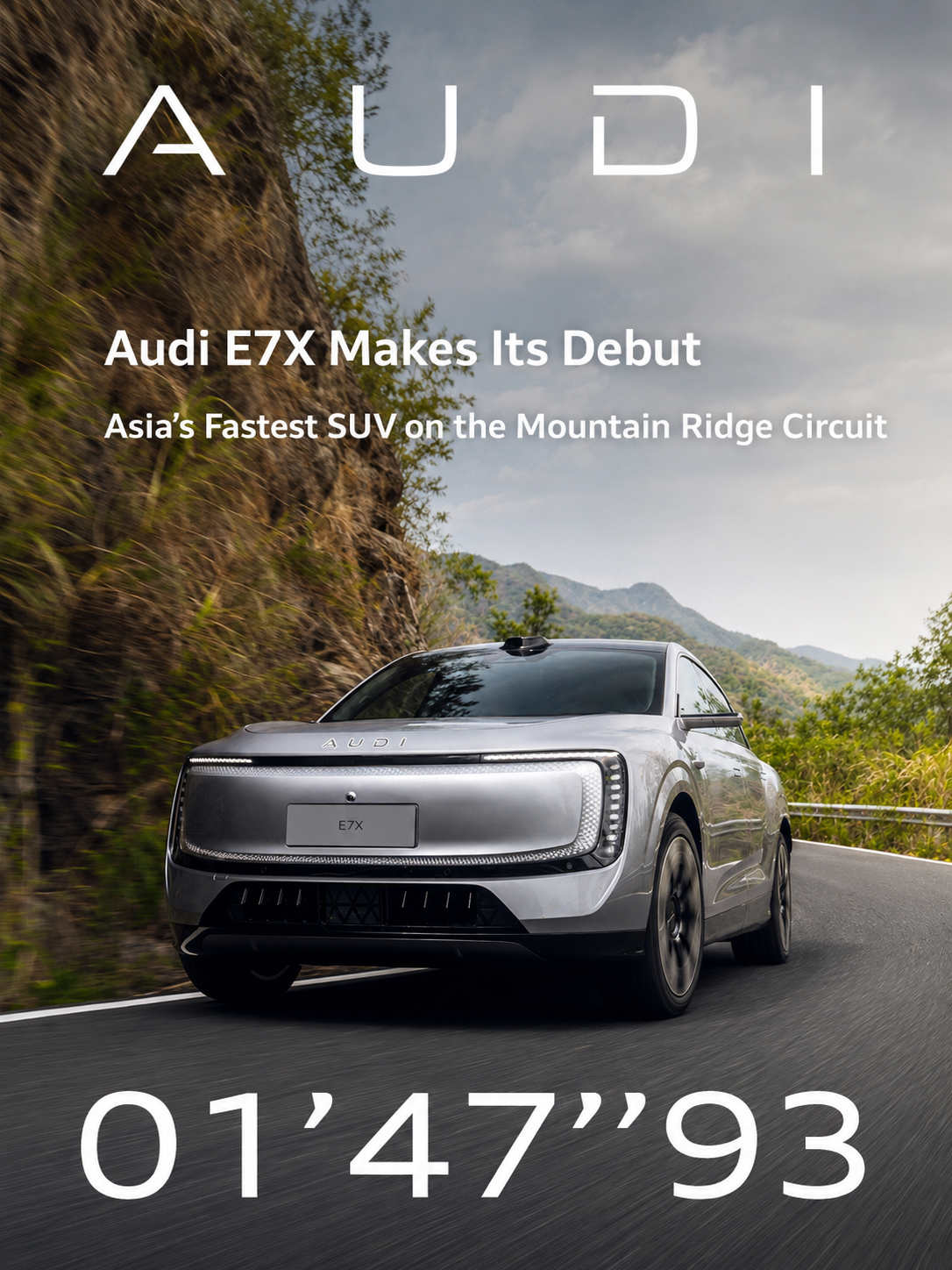
At the launch event, SAIC Audi executive Xie Shiqi openly criticised the growing industry practice of using heavily modified “special-tune” cars to achieve record lap times. He stressed that the E7X’s circuit performance had been set using a standard production-spec vehicle. Ahead of the Beijing Auto Show, the SUV reportedly completed Zhejiang’s challenging Xinchang mountain circuit in 1 minute 47.93 seconds, becoming the fastest SUV ever recorded there.
Yet it is perhaps in intelligent technology where Audi has faced its harshest criticism in recent years. Buyers increasingly complained that German luxury EVs offered infotainment systems that felt outdated, navigation systems dependent on smartphones and driver-assistance features trailing well behind Chinese rivals.
The E7X is Audi’s answer to those complaints. The vehicle uses a jointly developed intelligent driving system created with Chinese autonomous driving specialist Momenta, making Audi the first brand to introduce Momenta’s production-ready L3 capability.
The hardware package includes 28 high-precision sensing components, while the software architecture is built on Momenta’s reinforcement-learning world model. Supported by more than 100 million high-quality driving data points accumulated across billions of production kilometres, the system continuously refines itself through AI-based simulation and learning.
In practical terms, Audi is moving beyond the traditional “road testing plus manual rules” development model favoured by established manufacturers. Instead, the E7X adopts the data-driven self-evolution approach pioneered by China’s technology-focused EV companies.
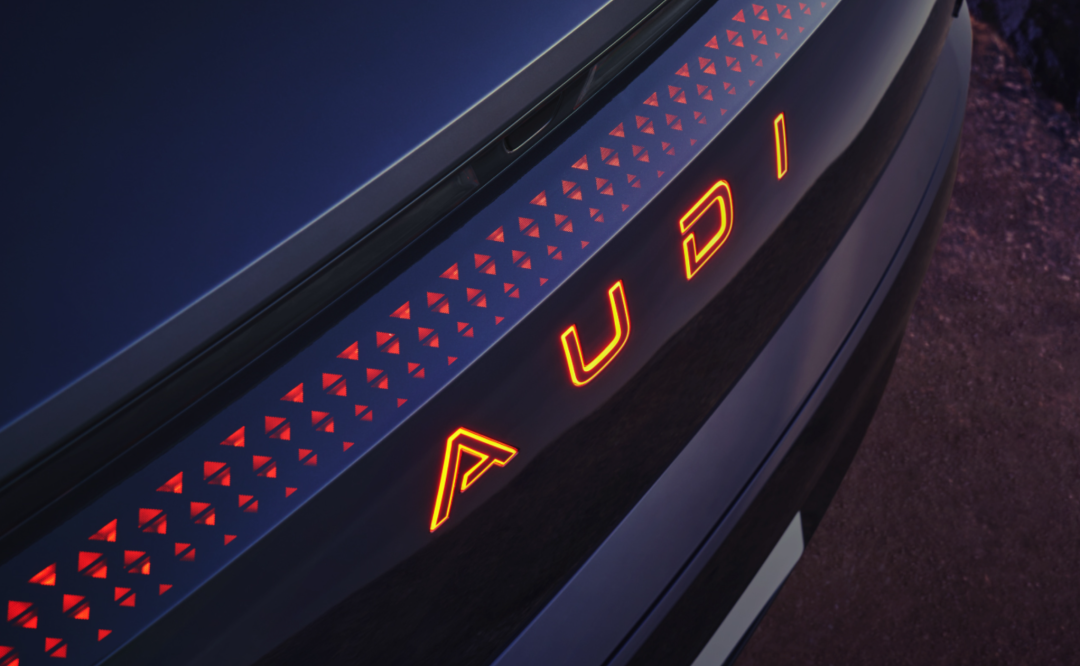
Audi claims the system improves safety performance against sudden lane-cutting incidents by five times, while reducing unreasonable lane changes and false braking events by a factor of two. Future over-the-air updates are expected to unlock higher-level autonomous functions, with redundant safety systems already integrated into sensors and computing architecture.
For perhaps the first time in years, Audi appears to have addressed the criticism that its electric vehicles were technologically behind the market.
Audi’s Billion-Dollar Counteroffensive
The E7X is not merely another new model. It forms part of Audi’s broader strategic counterattack in China.
At the end of 2024, SAIC Audi formally launched the new AUDI brand, a separate electric-focused marque that notably abandoned the traditional four-ring logo. Under the dual-brand structure, the classic Audi identity continues to serve combustion-engine and conventional luxury electric products, while the new AUDI line concentrates on intelligent pure-electric vehicles.
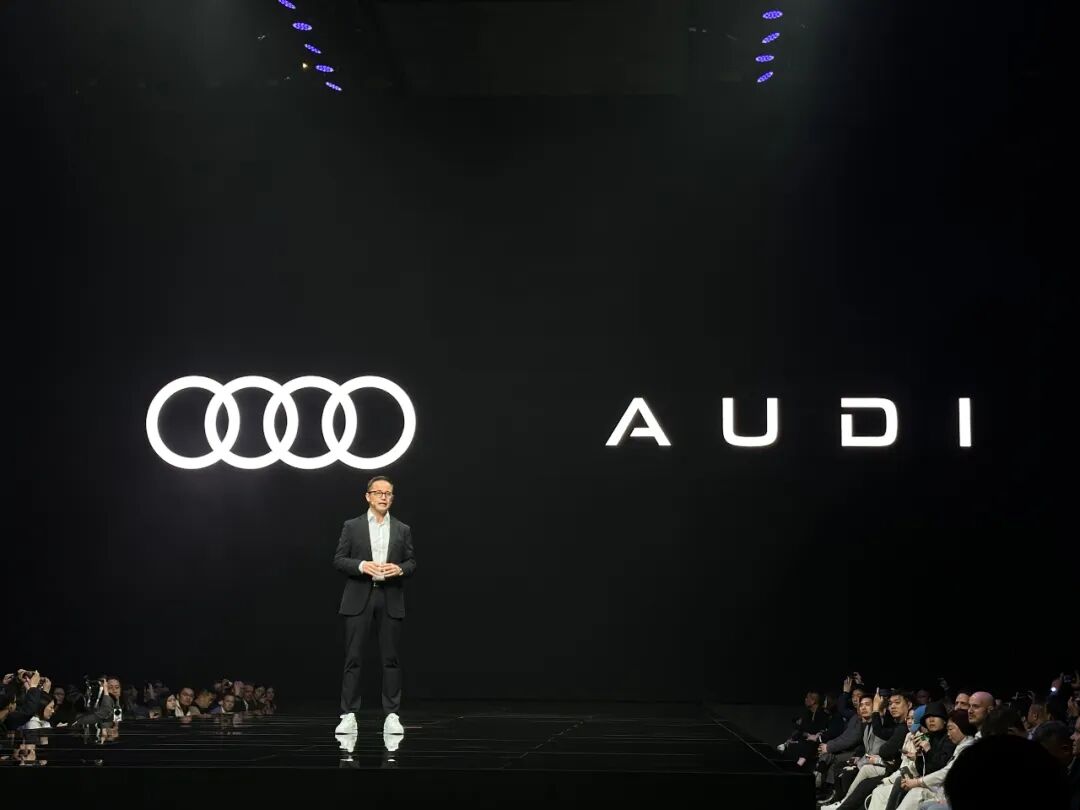
The E5 Sportback, launched last September, became the first model under the new brand. The E7X now follows as the second, positioned higher and equipped more aggressively, signalling Audi’s determination to accelerate its local EV portfolio.
Audi chief executive Gernot Döllner has previously described 2026 as the company’s largest-ever product offensive in China. The development of the dedicated ADP platform and the establishment of Audi’s Shanghai innovation centre demonstrate how seriously the company is shifting key research resources into the Chinese market.
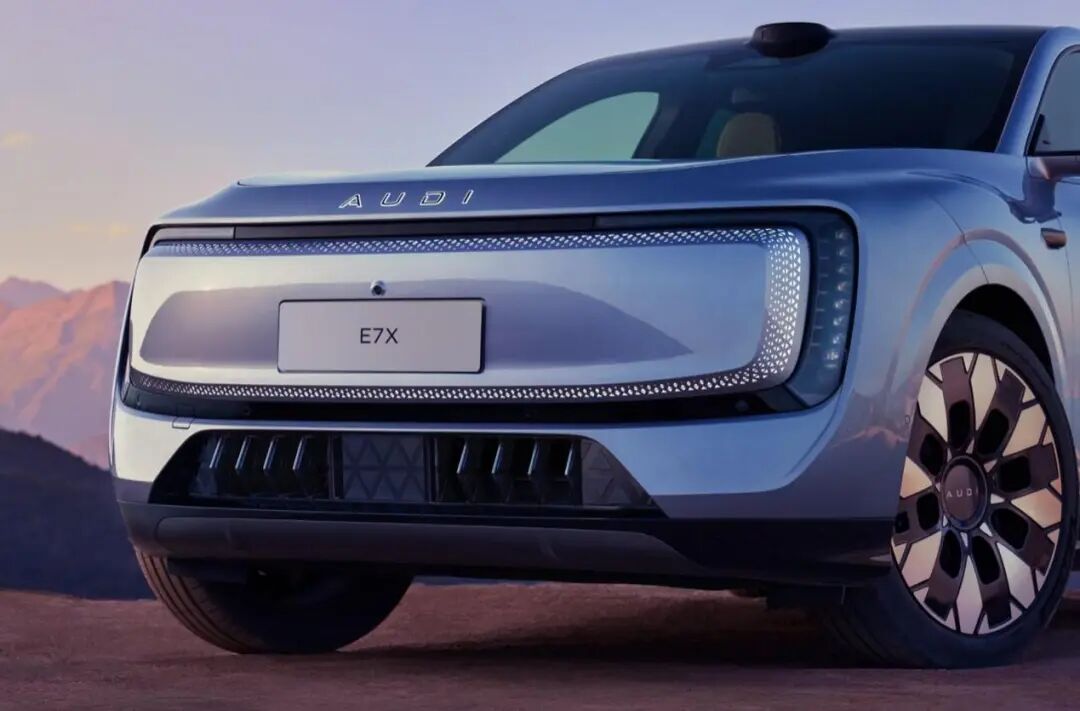
Its partnership with Momenta is also expected to extend far beyond a single vehicle. Both companies have indicated that future intelligent digital platforms and additional locally tailored models are already under development.
Still, Audi’s early attempts to establish the new AUDI brand have not been entirely smooth. The E7X therefore carries unusually high expectations. Unlike some earlier projects criticised as little more than “rebadged” products, Audi insists the E7X sits on a fully independent electric architecture created specifically for the AUDI brand, rather than sharing core technology with SAIC’s IM Motors platform.
The E7X’s specification sheet reinforces that positioning. A standard 900V platform across the range, rear-wheel steering, a 751-kilometre range and debut access to Momenta’s L3-level intelligent driving collectively create a more substantial differentiation strategy than previous efforts.
Equally striking is the shift in tone. Traditional German luxury EV launches often relied heavily on narratives of refinement and prestige. The E7X launch, by contrast, focused directly on lap times, technical specifications and competitive benchmarking — precisely the language China’s domestic EV start-ups have used for years.
That change reveals something important: Germany’s premium brands no longer see themselves as untouchable incumbents. They are now willing to enter China’s EV battlefield on local terms.
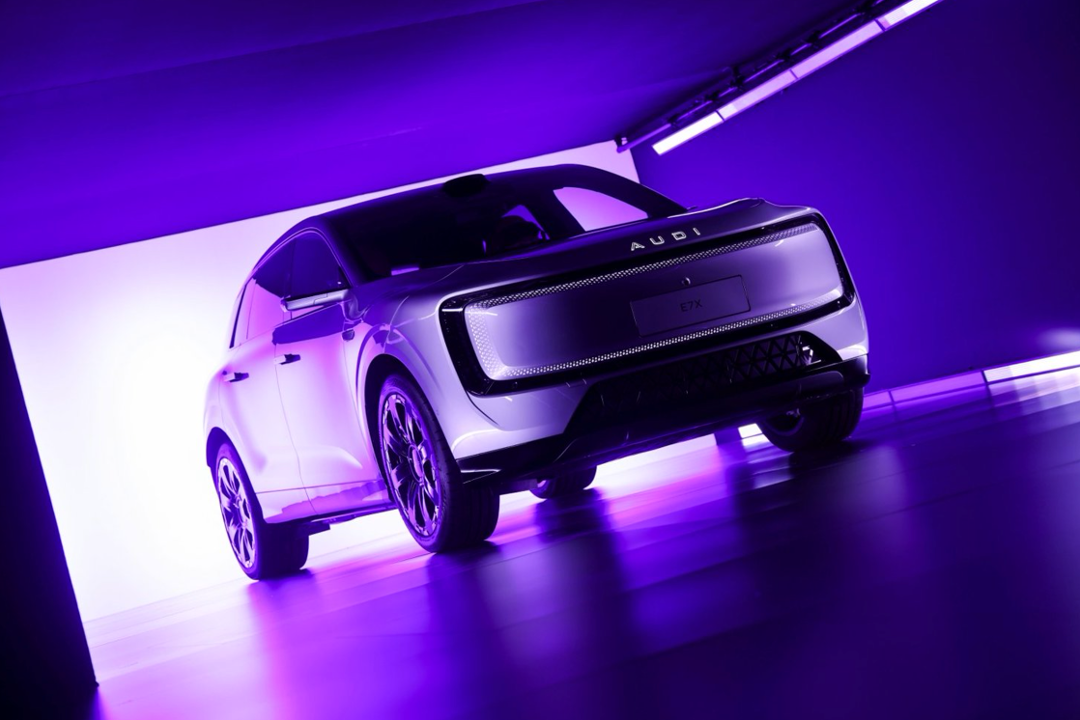
From a wider perspective, the E7X represents more than Audi’s own transformation. It symbolises a broader attempt by traditional luxury manufacturers to reclaim relevance in a trillion-yuan electric market increasingly dominated by Chinese players.
Whether the E7X ultimately succeeds will depend on more than a strong launch. Delivery quality, software consistency, after-sales service and the long-term sustainability of Audi’s premium positioning will all prove critical.
Yet perhaps the larger question extends beyond a single model. If Germany’s luxury carmakers have finally learned how to confront China’s electric challengers through both pricing and technology, the competitive landscape of the global automotive industry may be entering an entirely new phase.