
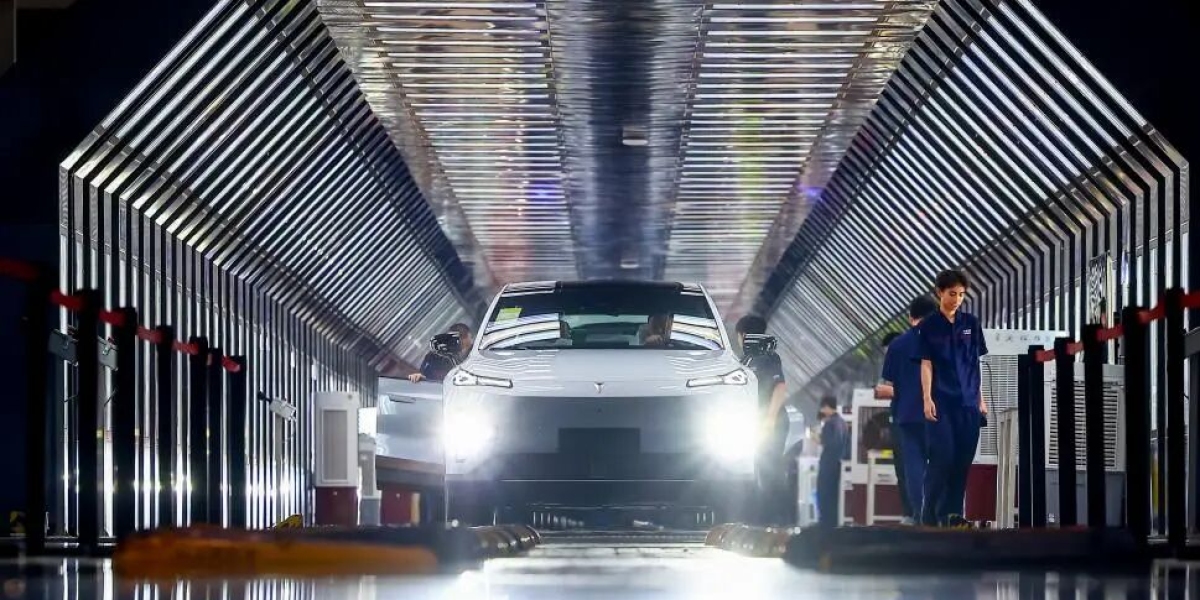
China Changan Automobile Group was officially established in Chongqing on July 29, 2025, with registered capital of about $2.8bn.
A new central auto group arrives with big promises
Its creation makes Changan the third central state-owned auto group in China after FAW and Dongfeng, completing a new three-way structure among national automotive champions.
Chairman Zhu Huarong has set an ambitious target: invest about $27.8bn over the next decade and reach 5mn annual vehicle sales by 2030. The scale of the plan has raised expectations, but it also exposes the pressure facing the newly formed group.
China Changan must address two immediate tasks before its larger ambitions can be credible. It needs to stop financial bleeding in new-energy brands, and it needs to focus resources more sharply across a complex brand and subsidiary structure.
New-energy volume is rising, but profits are falling
Changan's new-energy sales reached about 450,000 vehicles in the first half of 2025, up 49 per cent. On the surface, that suggests the group is moving with the market as China's new-energy penetration exceeds 40 per cent.
The earnings picture is weaker. Changan's 2024 net profit fell 35.37 per cent from about $1.6bn to roughly $1.0bn. Deepal lost about $218mn for the year, while premium brand Avatr lost roughly $558mn. Together, the two brands lost about $776mn, consuming much of the profit generated by Changan's petrol-vehicle business.
Cash flow has also weakened. Net operating cash flow fell from about $2.6bn in 2023 to roughly $632mn in 2024, a decline of 75.58 per cent. That raises concerns over the group's internal cash generation at a time when electrification requires heavy investment.
The core problem is that Changan may not yet have a sustainable new-energy profit model. Deepal has said it can become profitable above 30,000 monthly sales, but it still lost money in 2024. Avatr remains more expensive to scale. Changan's battery self-supply rate is below 30 per cent, while BYD's vertical integration gives it about 95 per cent self-supply, according to the article.
The risk of selling more and earning less
Changan's transition illustrates a common legacy-automaker problem: price-for-volume growth can erode profitability. Petrol profits are offset by new-energy losses. New-energy brands cut prices to chase volume. The group then risks selling more vehicles while making less money.
Petrol vehicles still account for more than 70 per cent of Changan's sales, showing that the actual transition remains behind the headline ambition. Zhu's plan for about $27.8bn in research spending over 10 years is meant to solve this, but it is also financially demanding.
Changan spent roughly $1.7bn on research and development in 2024. To meet the 10-year target, annual spending would need to rise to about $2.8bn, nearly three times current annual net profit. Without stronger barriers in core technologies such as batteries, motors and electric-drive systems, heavier spending could increase rather than reduce financial strain.
A large group can become a coordination problem
China Changan now integrates 117 branches and subsidiaries across vehicle production, components, auto finance and mobility services. That full-chain structure gives the group breadth, but it also raises efficiency risks.
The vehicle brand matrix includes Changan passenger cars, Kaicene, Deepal, Avatr and Qiyuan. Each has its own research, production and sales teams. The group plans to use shared coordination platforms and brand clusters to integrate resources, but overlap remains a danger.
New-energy brand positioning is the clearest issue. Multiple brands can duplicate research work, especially in areas such as smart cockpits and software. Shared technology platforms could reduce waste, but only if the group can impose clear boundaries and common development standards.
Decision speed is another concern. Changan has left its military-industry structure, simplifying some processes, but central-SOE habits may still slow approvals for major projects such as overseas plants. In a new-energy market where technology cycles move by the month, slow decisions can mean missed windows.
Ambition is stretching beyond cars
Zhu has also described plans around new productive forces, including flying cars and humanoid robots. Changan aims to launch its first humanoid robot in 2028 and commercialise flying cars in 2030. These areas are being framed as potential leapfrog opportunities.
The industry is divided on whether such moves are visionary or premature. For a group already facing EV losses, cash-flow pressure and brand overlap, cross-sector expansion increases the need for discipline.
Globalisation is another large target. Changan wants overseas sales to reach 30 per cent of total volume by 2030. In 2024, the share was about 18.8 per cent. In the first half of 2025, overseas sales reached about 299,000 vehicles, mainly in the Middle East and south-east Asia.
Europe remains at an early stage for Changan, with limited new-model sales, brand recognition and dealer coverage compared with more established players. To reach its overseas target, the group must build channels, improve brand awareness and manage tighter policy restrictions in key markets.
The reform test is focus
China Changan now sits at the intersection of state-owned-enterprise responsibility, market profitability and long-term technology investment. Those goals can conflict. Sales targets clash with new-energy losses. Research spending strains cash flow. Global expansion is limited by brand weakness.
The group's future will depend less on grand targets than on execution. It needs to stop losses, concentrate resources, reduce internal duplication and invest in core technologies that can produce measurable returns.
If China Changan cannot focus, the restructuring may become another defensive adjustment in a fast-changing industry. If it can, the new central auto group could still turn scale into a stronger platform for China's next stage of automotive competition.