
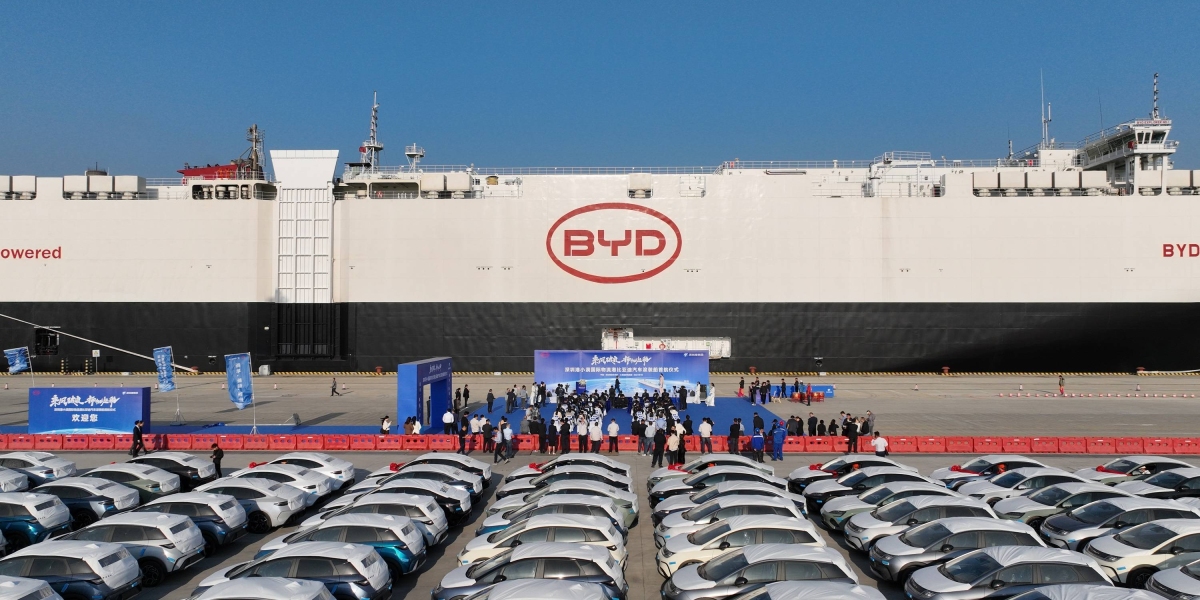
China’s auto market slipped into its traditional summer slowdown in July, but exports and new-energy vehicles continued to move in the opposite direction, underscoring how overseas demand and electrification are reshaping the industry’s growth profile.
According to data released on August 12 by the China Association of Automobile Manufacturers, or CAAM, vehicle production reached 2.573 million units in July, while sales totaled 2.584 million. The figures were down 6.8% and 8.0% from June respectively, and edged 0.7% and 0.3% lower from a year earlier.
For the first seven months of 2026, China produced 17.567 million vehicles and sold 17.602 million, both down 3.7% year on year. The decline nevertheless narrowed from the first-half pace, suggesting that the domestic market remains under pressure but is no longer deteriorating as quickly.
Exports Break Through the 1 Million Mark Again
The clearest source of momentum came from overseas shipments. China exported 1.043 million vehicles in July, up 0.6% from June and 81.3% from a year earlier.
New-energy vehicle exports were especially strong, rising to 553,000 units. That was 5.7% higher than in June and 145.5% above the level recorded a year earlier.
The latest figures mark a significant step up in China’s export trajectory. Vehicle exports exceeded 900,000 units in both April and May, before crossing the 1 million threshold in June and remaining above that level in July. It was the first time China had exported more than 1 million vehicles for two consecutive months.
The composition of those exports is changing just as quickly. New-energy vehicles accounted for more than half of total vehicle exports for a second consecutive month, reinforcing the shift away from China’s earlier export model, which was more heavily dependent on conventional internal-combustion vehicles.
Among the ten largest vehicle exporters in July, Chery remained the standout performer. The automaker shipped 202,000 vehicles overseas, up 69.7% from a year earlier and equivalent to 19.4% of China’s total vehicle exports for the month.
China’s Supply Chain Remains a Core Export Advantage
CAAM officials attributed the continued export growth in large part to the depth of China’s automotive supply chain. The country has built an unusually integrated industrial system spanning lithium processing, battery manufacturing, electric motors, power electronics and final vehicle assembly.
That structure gives Chinese automakers substantial advantages in production capacity, cost control and supply-chain resilience at a time when many global manufacturers are still restructuring their electric-vehicle sourcing strategies.
Software and vehicle intelligence are becoming another part of the competitive equation. Chinese manufacturers have accelerated development in areas such as advanced driver-assistance systems and digital cockpit technology, allowing them to update features rapidly and tailor products more closely to overseas consumers.
New-Energy Vehicles Pass 60% of Monthly Sales for the First Time
The domestic market also reached a symbolic milestone in July. New-energy vehicles accounted for 60.4% of all new-vehicle sales in China, the first time their monthly share had exceeded 60%.
NEV production reached 1.576 million units during the month, while sales totaled 1.561 million. Those figures were up 26.8% and 23.7% year on year respectively, a sharp contrast with the slight contraction in the broader vehicle market.
From January through July, China produced 9.014 million new-energy vehicles and sold 9.007 million. Both totals were up by nearly 10% from the same period a year earlier.
NEVs accounted for 51.2% of all new vehicles sold in China during the first seven months of 2026, putting electrified models firmly above the halfway mark on a year-to-date basis.
China’s Auto Growth Story Is Moving Overseas
The July data point to an increasingly clear split in China’s auto industry. Domestic demand remains relatively weak, but exports and new-energy vehicles are expanding fast enough to offset part of that pressure.
For global automakers, the implications extend beyond China itself. Chinese manufacturers are exporting at record volumes while simultaneously shifting toward higher-value electric, plug-in hybrid and software-defined vehicles. That combination is giving them greater reach in markets from Latin America and Southeast Asia to Europe, the Middle East and Australia.
The industry’s next challenge will be whether that export growth can be converted into durable market share abroad. As Chinese brands invest in local manufacturing, dealer networks, logistics and after-sales operations, the contest is moving from simply shipping cars overseas to building long-term positions in some of the world’s largest automotive markets.