
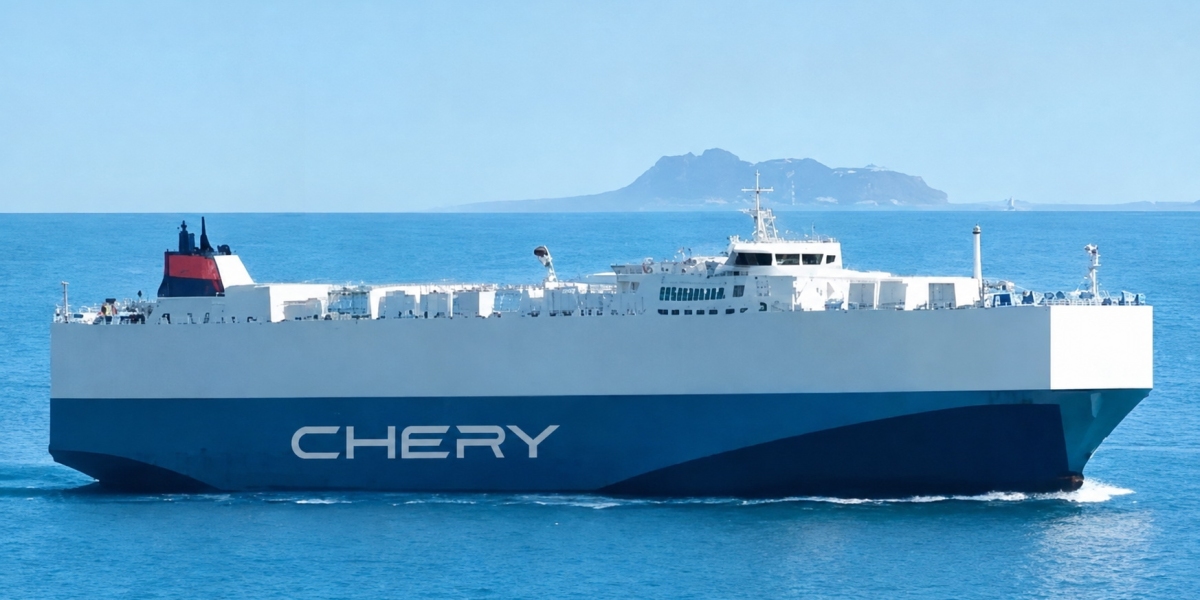
Citi has reiterated its buy rating on Chery Automobile, arguing that investors are assigning too little value to the Chinese carmaker's overseas earnings and long-term growth prospects.
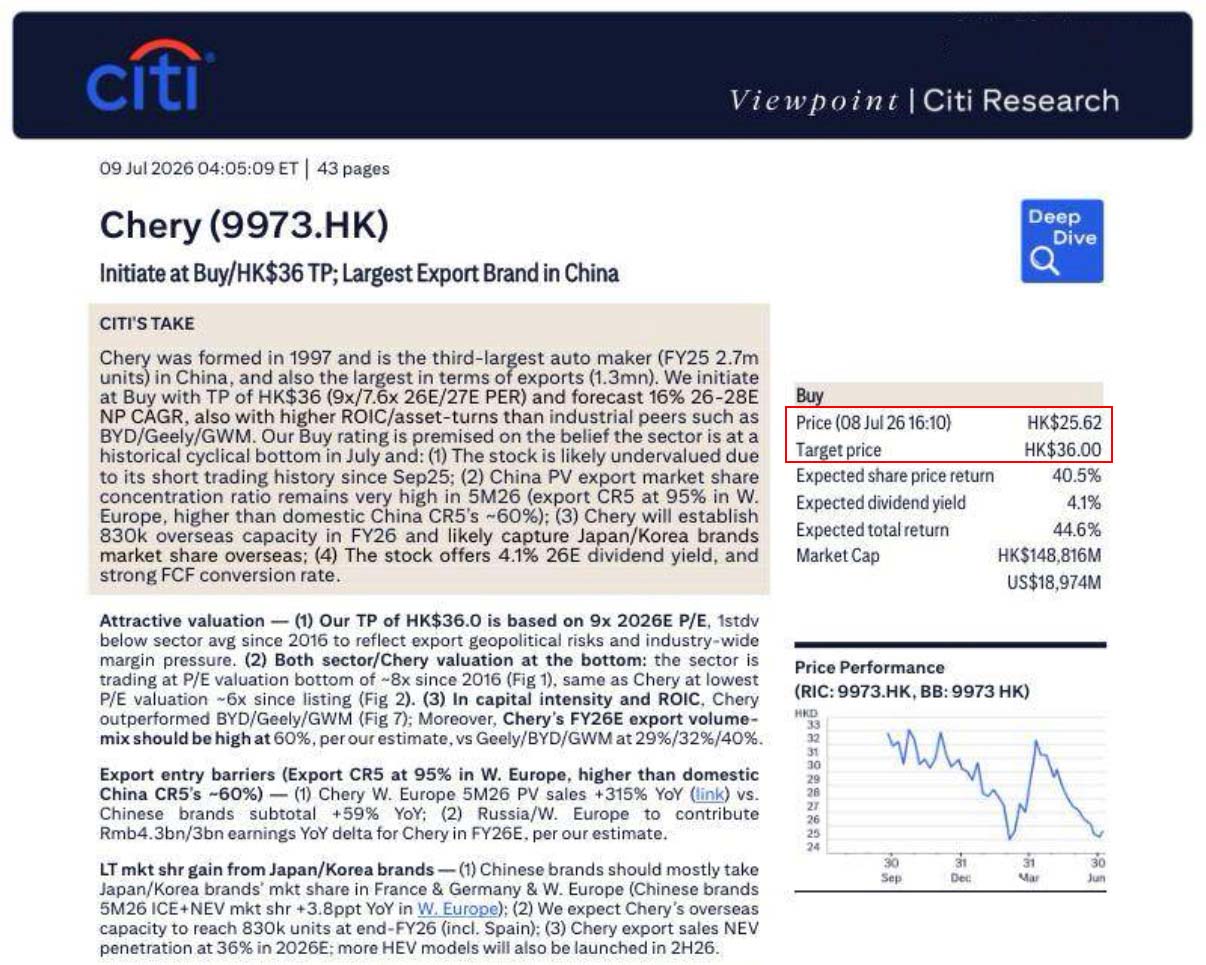
The bank set a target price of US$4.59 a share for Chery, which trades in Hong Kong under the ticker 9973. That represents 41.4% upside from the US$3.25 reference price used in the research note. Citi said weak market sentiment and the prolonged price war in China have overshadowed the company's more durable strengths, particularly its international business.
The call comes as Chery's shares remain below their US$3.92 initial public offering price. The gap suggests that the market is still treating the company largely as another participant in China's fiercely competitive car market, rather than as an automaker whose growth and profitability increasingly depend on markets beyond China.
A Discounted Valuation With Risks Already Priced In
Citi based its target on nine times Chery's forecast 2026 earnings. According to the bank, that multiple is one standard deviation below the auto industry's average since 2016, leaving room for concerns over trade friction, geopolitical risk and volatility in raw-material costs.
Measured against projected 2027 earnings, the valuation falls to 7.6 times. Citi regards that as a substantial cushion relative to other leading Chinese carmakers, especially for a company with a long operating history, strong cash generation and what the bank considers a healthy balance sheet.
Citi's quantitative framework still places Chery in a higher-risk category. The bank has not applied a deeper valuation discount, though, because it believes the company's financial resilience and nearly three decades of operating experience offset part of that risk. Its central argument is not that Chery is insulated from the industry's pressures, but that the share price already reflects more of those pressures than the company's earnings outlook warrants.
Overseas Operations Are Chery's Strongest Defence
The most important part of Citi's investment case is Chery's international footprint. The company has ranked among China's largest passenger-vehicle exporters for years, but its overseas strategy now extends well beyond shipping finished cars from Chinese ports.
Chery has established local production, regional research operations and an extensive retail network across Southeast Asia, the Middle East, Europe and South America. That infrastructure gives the group a degree of local presence that many newer Chinese exporters have yet to build.
Overseas markets now account for more than half of Chery's revenue, according to the research note. Citi also said the international business is more profitable than the company's operations in China's price-sensitive domestic market. If that advantage holds, overseas earnings can act as a buffer against discounting at home and make group margins less dependent on the next turn in China's sales cycle.
Localised production in Europe and faster growth in right-hand-drive markets could expand that buffer. These regions also bring new regulatory, tariff and execution risks, but they offer Chery a route to higher volumes without relying solely on an increasingly crowded home market.
A Broad Technology Strategy Adds Another Layer
Chery has avoided placing its future on a single powertrain. Its product strategy spans hybrids, battery-electric vehicles and hydrogen technology, with the company's own hybrid systems playing a growing role in its new-energy vehicle line-up.
Citi expects the continued rollout of higher-end models and new electrified vehicles to support average selling prices and profit margins. That would be important for a manufacturer traditionally associated with value-oriented vehicles and now seeking to move further up the market in both China and overseas territories.
The group is also investing in solid-state batteries, advanced driving systems and embodied artificial intelligence. Those programmes may take years to produce commercial returns, and some may not do so at all. For the valuation case, their immediate significance is that Chery is funding technologies that could shape its next generation of vehicles rather than relying only on its established export and combustion-engine businesses.
What Could Break the Investment Case
Citi identified several risks that could prevent the shares from reaching its target. Overseas trade disputes or geopolitical restrictions could raise costs and complicate Chery's expansion. New models could miss sales expectations, while a sharper-than-expected increase in battery materials or other input costs could erode margins.
The upside case depends on the opposite outcomes. Better-than-forecast margins on electrified vehicles, exports running ahead of company plans or a strong reception for major new models could bring forward earnings growth and narrow the valuation gap more quickly.
The Market Has Yet to Price Chery as a Global Carmaker
Chery's post-listing performance shows why Citi's argument remains contested. The shares have spent much of their listed life below the IPO price, as investors have focused on the cyclical risks facing Chinese automakers and the pressure created by repeated domestic price cuts.
Citi's US$4.59 target does not dismiss those concerns. It assumes a valuation below the industry's long-term average and still leaves room for geopolitical and cost risks. What it challenges is the market's apparent reluctance to give Chery much credit for the scale, profitability and durability of its overseas operations.
The question for investors is therefore less whether Chery can export cars. It has already demonstrated that capacity. The harder test is whether its international manufacturing, distribution and product strategy can produce earnings resilient enough to justify treating the company as a global automaker rather than a discounted Chinese exporter. Citi believes the answer is yes; the share price suggests the market is not yet convinced.