

Geely's assisted-driving strategy is moving from internal ambition to formal structure. Zeekr, Geely Afari Smart Driving Smart Driving and other shareholders have established Geely Afari Smart Driving with registered capital of about $1 million.
A new company for a bigger technology push
Wang Jun, former president of Huawei's automotive business unit, has been named legal representative.
The move is part of Geely Holding's effort to run assisted driving as one coordinated group strategy rather than a set of scattered brand-level projects.
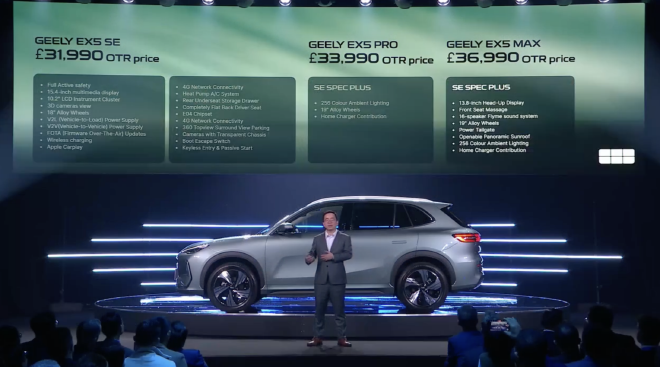
It comes as Geely is also accelerating overseas. The launch of the all-electric EX5 SUV in the UK gives the company a more visible global product push, while the assisted-driving integration gives it a technology platform that could support future international competition.
Assisted driving has become a core dimension of differentiation in China. But the cost of development, long investment cycle and uncertainty around commercial deployment have made isolated exploration harder to sustain.
The "one Geely game" strategy
In March, Geely Holding president and Zeekr Technology chief executive An Conghui said the group had moved toward a single assisted-driving strategy, fully integrating Geely Afari Smart Driving Technology and Haohan assisted-driving resources.
The logic is to combine Geely Afari Smart Driving's computing reserves and large-model capability with Haohan's algorithm development, engineering deployment and user-experience work. An has also described himself as a chief tester for the system, underscoring how closely the group's leadership is watching the project.
Ningbo Geely Afari Smart Driving Haohan is therefore not an isolated corporate registration. It is the operating expression of Geely's attempt to break down the fragmented R&D structure created by multiple brands and teams.
Geely Auto chief executive Gan Jiayue previously said the group would create a company under Geely Afari Smart Driving Smart Driving to provide assisted-driving services specifically for Geely. That defines the new entity's role: take Geely Afari Smart Driving's technology work and deliver dedicated solutions across Geely's brand portfolio.
Why Wang Jun matters
Wang Jun's appointment is significant because of his Huawei background. As a founder of Huawei's automotive business unit, he helped build Huawei's intelligent-vehicle solutions from the ground up and promoted the development and commercial deployment of Huawei's HI full-stack assisted-driving system.
He joined Geely Afari Smart Driving Technology in 2025 as co-president responsible for the technology business. His new role at Ningbo Geely Afari Smart Driving Haohan suggests Geely wants the operating discipline and ecosystem-building experience he developed at Huawei.
That experience matters because assisted driving is not only an algorithm problem. It requires R&D systems, supplier coordination, vehicle integration, safety validation and mass-production discipline.
Integrating people and technology
The new company follows a larger internal reorganisation. In August, Geely began a major assisted-driving integration, with about 1,300 people from Zeekr's assisted-driving team moving into Geely Afari Smart Driving Technology, according to public reports cited in the article.
The transition was designed to minimise disruption. After a company-wide meeting on July 30, the employees signed directly with Geely Afari Smart Driving Technology without new interviews, while workplaces and compensation were kept unchanged.
The Zeekr team brings experience in high-level assisted-driving algorithms and engineering deployment. Geely Afari Smart Driving Technology, supported by Megvii's technology background, has depth in large-model development and computer vision. Its available computing power has grown nearly 30-fold to 23.5 EFLOPS, a scale the article describes as leading among Chinese automakers.
The two sides are complementary. Geely Afari Smart Driving adds AI and computing depth, while Zeekr adds vehicle-manufacturing knowledge and a closer understanding of user needs.
The challenge is integration. Teams from different brands may have different development cultures and processes. Zeekr's work has focused on premium-brand needs, while Geely Afari Smart Driving Haohan must serve Geely models across different price bands and positions. Standardised development and differentiated product experience will need to coexist.
From H1 to H9
Geely Afari Smart Driving Haohan has already formed five levels of assisted-driving solutions, from H1 to H9, covering entry-level applications through L3-level requirements.
The H1 configuration starts with more than 100 TOPS of computing power. The H9 solution uses dual NVIDIA DRIVE Thor-U chips with total computing power above 1,400 TOPS. It also includes eight layers of safety redundancy across chips, perception hardware, algorithms, steering, braking, power distribution, communications and human-machine interaction.
Those achievements are still mainly technical. The harder test will come after mass production, when users judge smoothness, safety, reliability and everyday usefulness.
The consolidation window
Many analysts expect the next three years to be a consolidation period for assisted driving. Technology routes will become less scattered, resources will concentrate around stronger players and competition will shift from single features to ecosystem capability.
Suppliers such as Horizon Robotics have forecast that L3 assisted driving will reach wider deployment by 2028, moving the industry toward a contest based on experience and safety rather than isolated functions.
For Geely, consolidation offers opportunity. It has a large annual sales base above three million vehicles, mature manufacturing capability, 23.5 EFLOPS of computing power, the Xingrui large model and shareholder support from partners including Chongqing industrial funds and Megvii.
The risks are also substantial. Geely faces traditional automakers, full-stack technology players and companies with mature user ecosystems. The industry must also resolve data security, privacy compliance and liability questions for L3 and higher systems.
Geely's new company is a strategic attempt to balance self-development and ecosystem coordination. Whether it becomes an advantage will depend on execution: unifying resources without slowing product delivery, and turning computing power into assisted driving that users trust.