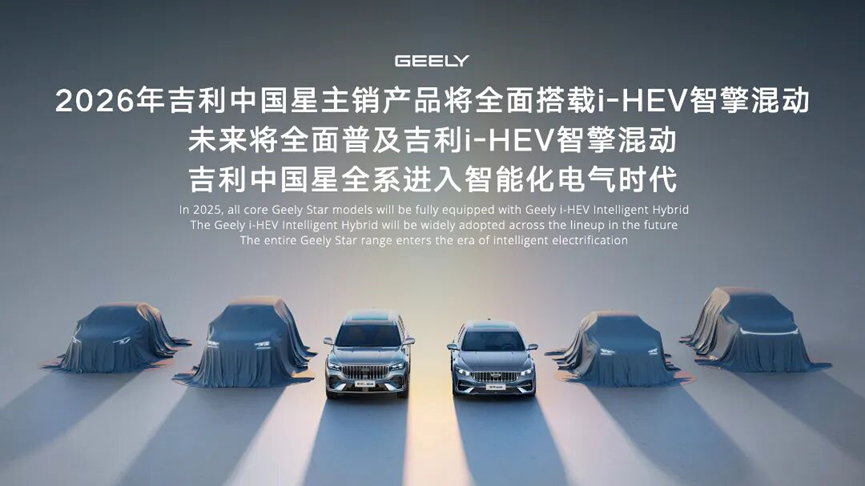
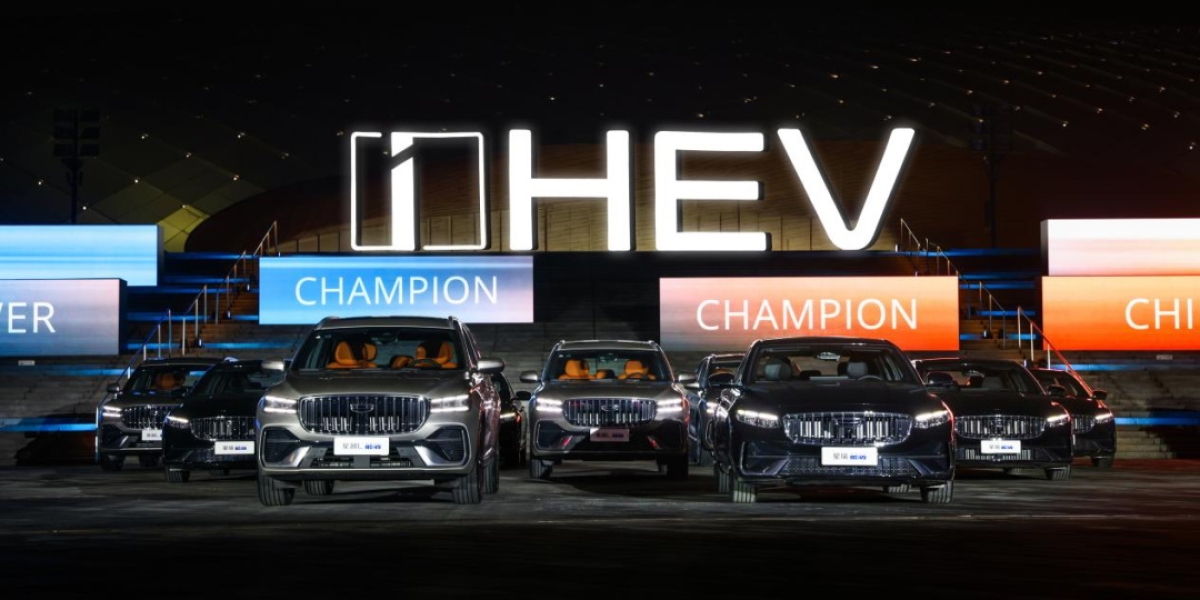
Geely has launched its i-HEV intelligent hybrid system at a moment when much of China's auto industry is focused on pure EVs and plug-in hybrids.
A Hybrid Bet for a Multi-Energy World
The decision looks less like a retreat to old technology than a recognition that the global market is still far from fully electric.
Li Chuanhai, vice-president of Geely Auto Group and president of its research institute, offered the company's clearest explanation: petrol vehicles still have a long life cycle, and Geely's multi-energy strategy is better aligned with the real market.
The numbers support that view. In 2025, petrol vehicles still accounted for 52% of the Chinese market. Globally, they represented 76.5% of the 96.47 million vehicles sold. That is a huge installed base and a major barrier for Chinese brands seeking overseas growth.
Geely's i-HEV is therefore not just another efficiency upgrade. It is an attempt to challenge a hybrid market long shaped by Japanese brands and to offer a Chinese answer for buyers who still need petrol convenience but want a more electric driving experience.
Moving Beyond the Japanese Template
Fan Junyi, general manager of Geely's sales company, said Geely's petrol vehicles already carry strong consumer trust. The task now is to support that reputation with a more advanced hybrid system.
The weakness of traditional hybrids has been clear: they save fuel but often lack the immediacy of electric driving. Japanese hybrids, led by sophisticated planetary-gear power-split systems, set the benchmark for more than two decades. Their logic was petrol-led and electricity-assisted, delivering excellent economy but less forceful response.
Ren Xiangfei, Geely's chief engineering scientist, described that older model as one grown out of petrol technology. In many systems, the motor and engine are not fully decoupled and must work together like a lever. That architecture favours efficiency but limits electric feel and power delivery.
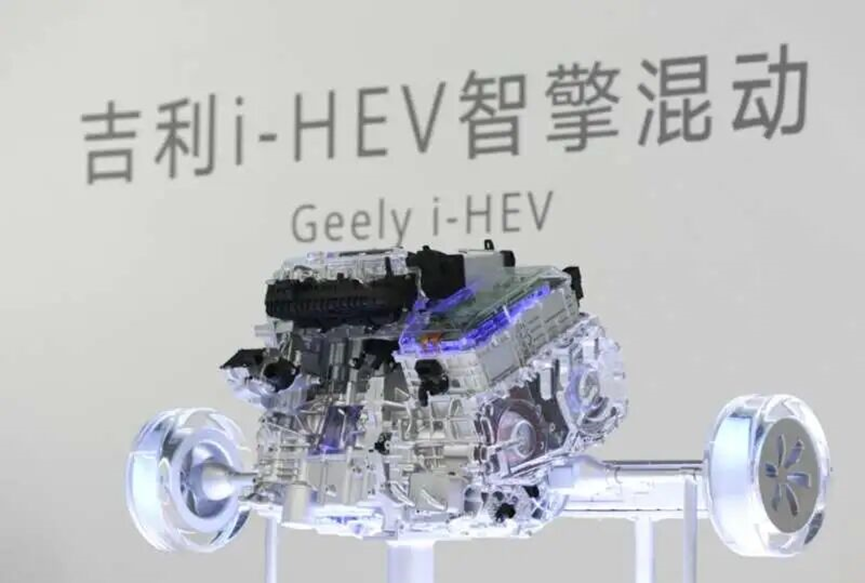
Geely says i-HEV rewrites that base logic. Ren argues that the system comes from electric-hybrid technology, sharing safety standards, design thinking and intelligent-control logic with new-energy vehicles and plug-in hybrids. In simple terms, Geely presents it as a plug-in hybrid without an external charging port.
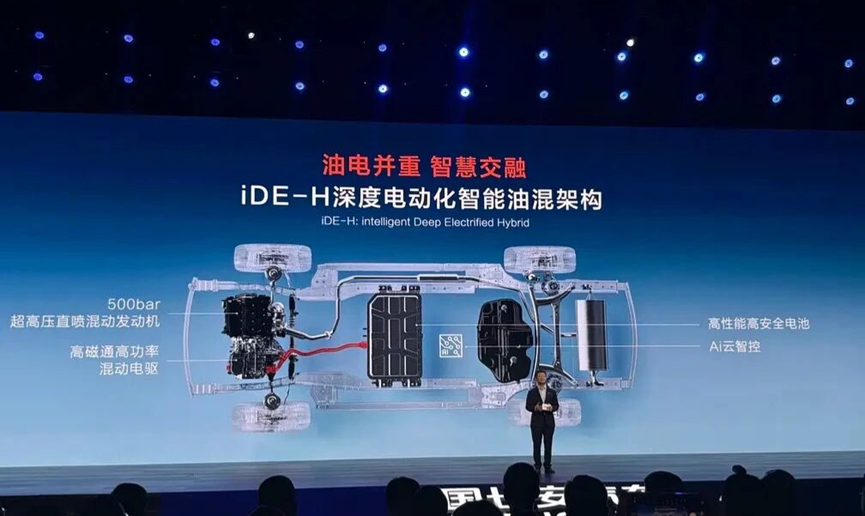
The system uses a P1+P3 series-parallel architecture, fully decoupling the engine, P1 motor and P3 motor. Geely says that solves limitations seen in Toyota-style THS systems at higher speeds and makes electric drive the leading source of response.
Electric Feel Without Charging
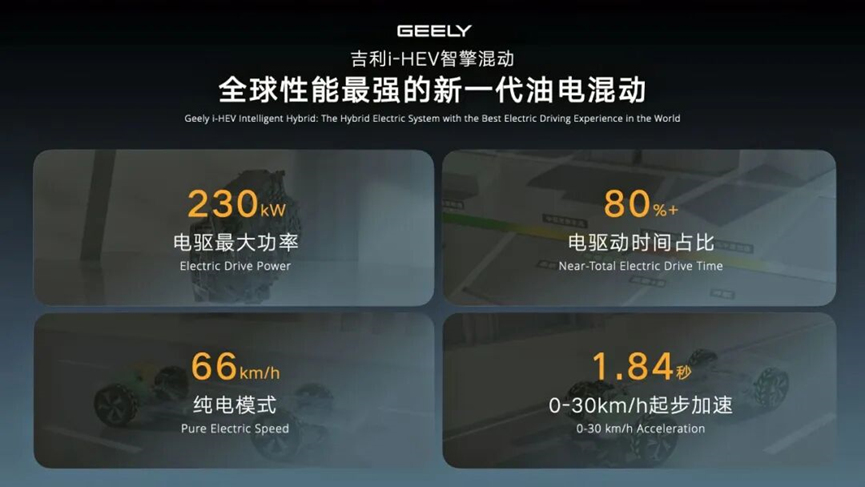
The headline figures are ambitious. The i-HEV drive motor produces up to 230kW, which Geely says is 1.72 times the output of comparable Japanese hybrids. Under WLTC conditions, the vehicle delivers an electric-drive experience for more than 80% of driving, while engine operating time is reduced by more than 27% compared with traditional hybrids.
Acceleration from zero to 30kph takes 1.84 seconds, 18% quicker than Japanese hybrid benchmarks cited by Geely, and power response has been reduced to 10 milliseconds. For daily commuting, the company wants the car to feel much closer to an EV than a conventional hybrid.
Refinement is part of the same pitch. Through intelligent engine-stop position prediction and active control of engine-order noise, Geely says start-up vibration has been cut by 32.7%, while cabin noise is only 1dB higher than in pure-electric operation.
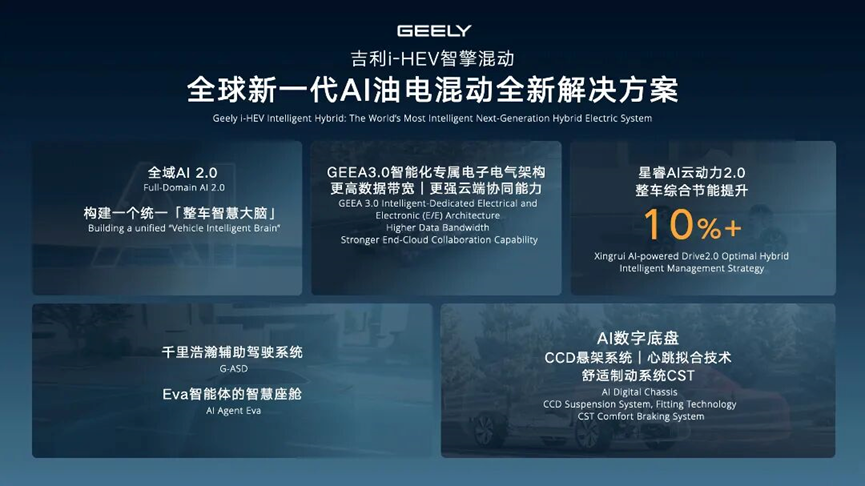
The system also uses what Geely calls full-domain AI. i-HEV is the first petrol-electric hybrid system to run the Xingrui AI Cloud Power 2.0 large model. Instead of relying on passive energy management, it can consider outside temperature, humidity, altitude and gradient to plan the most efficient operating strategy.
Li said that apart from external charging, the AI models used in Geely's plug-in systems can be reused fully. The company claims the approach improves total vehicle energy saving by more than 10%.
Efficiency Claims and Durability Tests
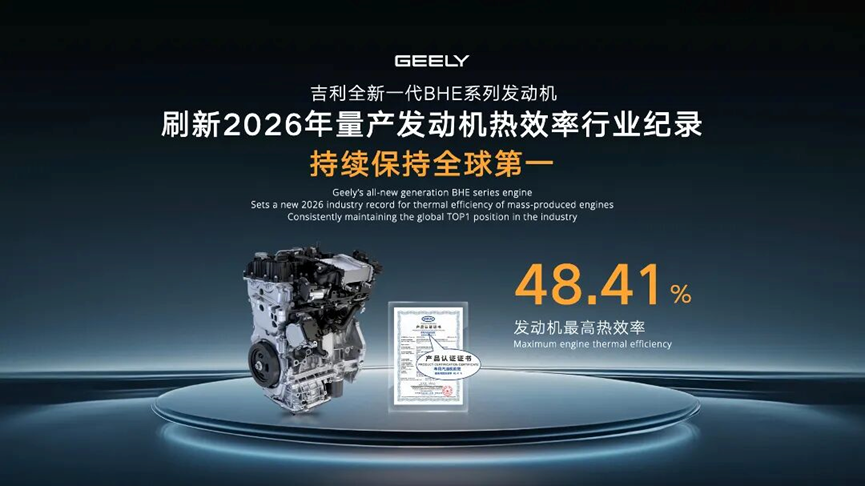
Geely is also making a direct efficiency claim. The i-HEV engine reaches a thermal efficiency of 48.41%, certified by the China Automotive Technology and Research Center as the highest among mass-produced engines. In a real-world highway test around Hainan, the fifth-generation Emgrand i-HEV achieved fuel consumption of 2.22 litres per 100km, breaking the Toyota Prius record cited by Geely and setting a Guinness World Record.
For hybrid buyers, reliability can matter even more than consumption. Geely says i-HEV's fully decoupled three-source power system gives it power redundancy: if the engine, P1 motor or P3 motor fails, the remaining two can still drive the vehicle. Oil, electrical, water and exhaust routes are separated from the beginning of vehicle development to reduce interference risk.
The battery system is also different from the air-cooled packs common in Japanese hybrids. Geely uses a flat liquid-cooled dedicated hybrid battery across the i-HEV range. The pack weighs just over 30kg but can deliver 110kW of discharge power and support 60C high-rate energy recovery.
The Xingyue L i-HEV has completed what Geely describes as the world's first seven-extreme-environment serial reliability test for an HEV model. The programme used conditions drawn from Norwegian fjords, Siberian snowstorms, the Amazon rainforest and California heat, spanning five continents and seven typical operating regions. Over 120 hours, the vehicle experienced nearly 100C of temperature variation and altitude changes from 4,650 metres to 1,200 metres.
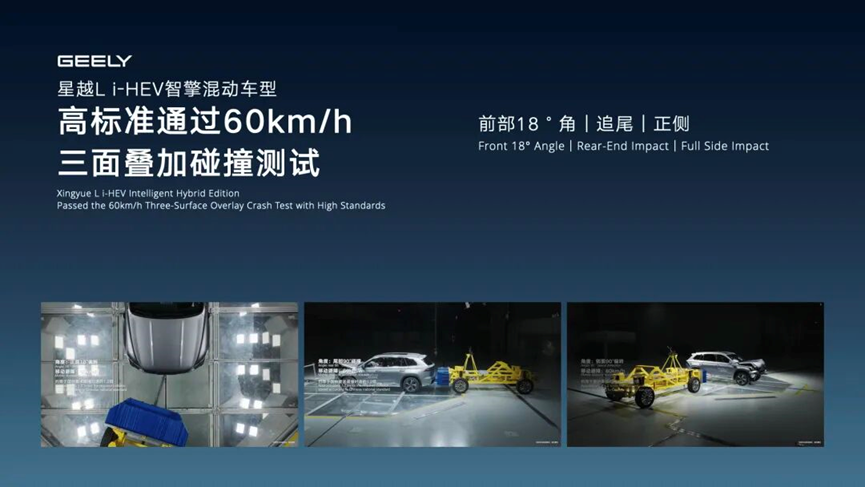
Geely also tested crash safety against more realistic accident patterns. The Xingyue L i-HEV passed a three-direction overlap crash test at 60kph, combining an 18-degree front offset impact with rear and side impacts.
China Star Carries the Technology
For a technology to matter commercially, it needs volume products. Geely is putting i-HEV into its China Star range, a family of models that sold more than 1.21 million units in 2025 and has led Chinese-brand petrol passenger-car sales for nine consecutive years.
The strategy is not to create a new product island, but to add an "AI intelligent heart" to established models. The Xingrui, Xingyue L, fifth-generation Emgrand and fourth-generation Boyue L are among the first to receive the system, with presales scheduled to begin in Karamay on April 19. Geely plans to roll i-HEV across the China Star line.
The domestic target is clear: a large number of Chinese petrol-car users want lower running costs and smarter functions, but may still worry about charging access or changing their driving habits. i-HEV offers a way to gain electric-like response and AI energy management without plugging in.
A Global Export Tool
The larger ambition is overseas. Li said he believes i-HEV will soon break through market boundaries, and Geely has reason to treat hybrid technology as a global product.
Geely's HORSE Powertrain joint venture with Renault supplies more than 8 million powertrain systems a year to 25 global carmakers, including Mercedes-Benz and Volvo. That gives Geely a mature base for exporting powertrain technology, not only finished vehicles.
i-HEV's combination of efficiency, reliability and petrol convenience may fit markets where charging infrastructure remains uneven and where consumers still need long-distance flexibility. It also gives Geely a different message from pure-EV competitors: China's automotive technology is not limited to batteries and charging speed.
Geely is supporting the launch with a China Star long-distance cultural and travel programme, heading west from Hangzhou along the Silk Road toward Central Asia and Europe. Fan described the effort as a way to export Chinese culture through vehicles.
The i-HEV launch is the result of five generations of Geely powertrain development and a sign that China's hybrid industry wants to move from follower to challenger. In a global energy transition that will not move at the same speed everywhere, Geely is betting that the winner will not be a single technology path, but a company able to combine in-house engineering, AI control and market flexibility.