
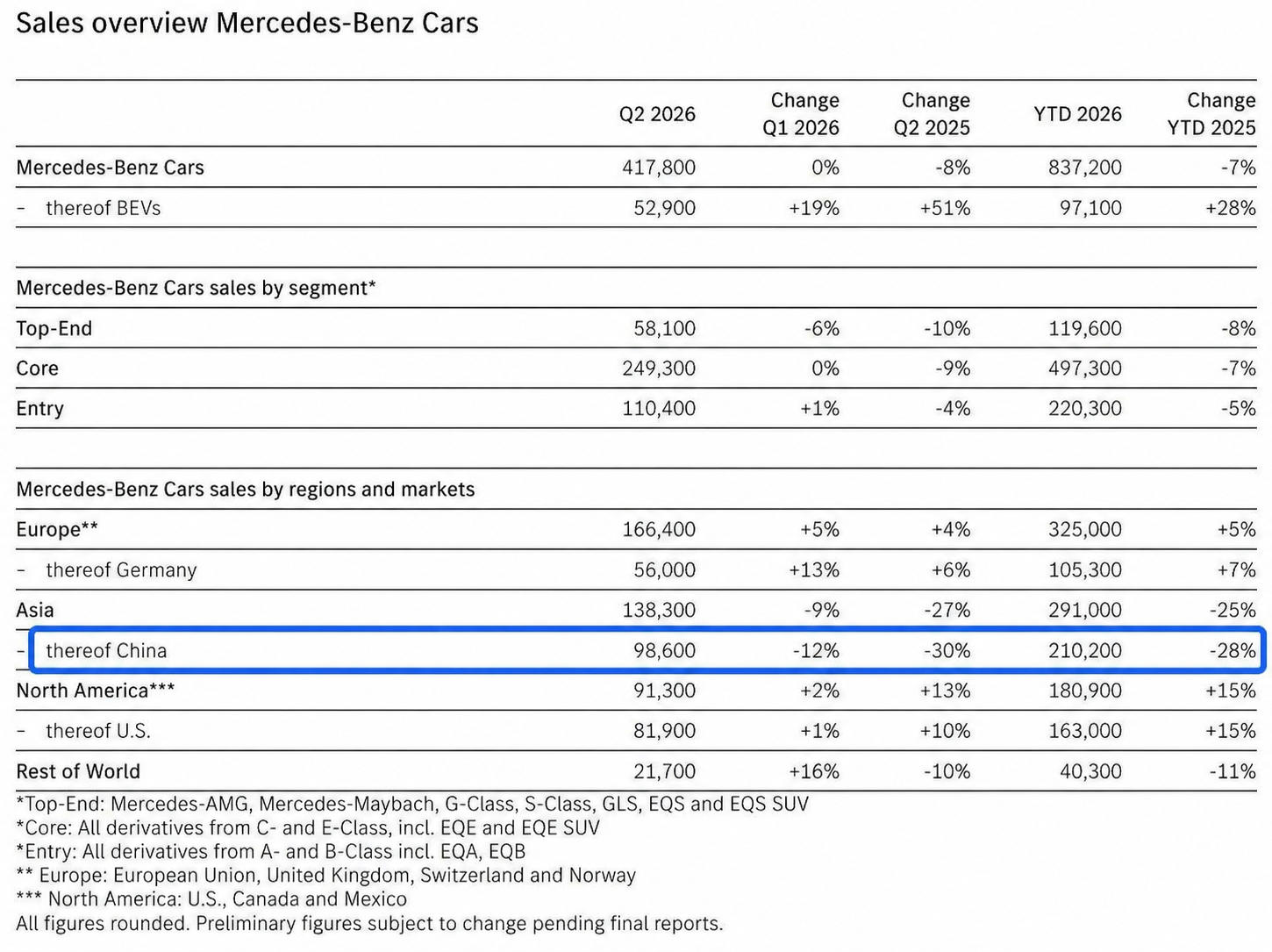
Mercedes-Benz delivered 417,800 passenger cars worldwide in the second quarter, but the headline figure concealed a widening divide between its major markets. Sales rose in Germany and North America, while deliveries in China fell 30% from a year earlier.
Europe and North America Offset a Sharp China Decline
European deliveries reached 166,400 vehicles in the quarter, up 4% year on year. Germany, the company’s home market, recorded sales of 56,000 units, an increase of 6%.
North America performed more strongly, with deliveries rising 13% to 91,300 vehicles. The United States accounted for 81,900 units, up 10%, supported by demand for core sport utility vehicles. Sales of the GLE and GLE Coupe increased 21% in the US market.
China moved in the opposite direction. Mercedes delivered 98,600 vehicles in the country during the second quarter, a decline of 30%. First-half sales fell 28% to 210,200 units.
The company attributed the weakness to more intense competition, cautious consumer sentiment, production ramp-ups for new models and tighter control over the pace of sales. The result underlines how quickly China has become a more difficult market for established global luxury brands.
A Costly Product Transition in China
Mercedes is navigating a transition between ageing and replacement products in China. Some established combustion-engine models are being cleared from dealer inventories, newer vehicles have yet to reach full production volumes, and the brand’s electric line-up has struggled to build momentum.
According to the figures cited in the original report, locally produced electric CLA sales stood at 127 units in February, 196 in March, 131 in April and 311 in May. Those volumes remain modest in a market where domestic premium-EV makers are competing aggressively on software, cabin technology and pricing.
Electric Vehicles Provide the Global Bright Spot
Battery-electric vehicles were the strongest part of Mercedes’ global performance. Second-quarter electric-car sales rose 51% to 52,900 units, taking first-half deliveries to 97,100, an increase of 28%.
Electric-vehicle sales in Europe climbed 87%, while deliveries in Germany doubled. The new electric CLA, electric GLB and recently launched electric GLC were among the main contributors.
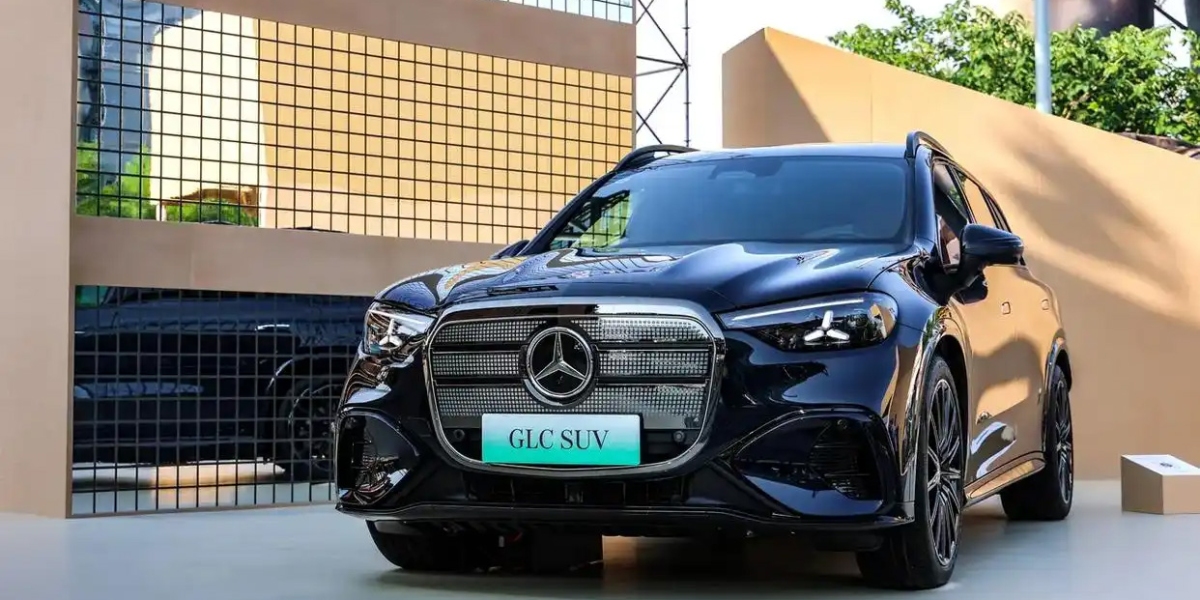
The picture in China was less encouraging. Mercedes priced the electric GLC from about $43,000, roughly $29,000 below the former EQC’s starting price, but the model enters a crowded field that includes Aito, Li Auto, Nio and Tesla. Price alone may not be enough to overcome the technology and brand momentum accumulated by local competitors.
China Slowdown Reaches the Organisation
Pressure on sales is also feeding into the company’s cost structure. The report said Mercedes’ German headquarters would withhold annual bonuses from about 90,000 employees and extend the working week from 35 to 40 hours without a corresponding pay rise.
In China, the Beijing Mercedes-Benz Sales Service operation reportedly plans to reduce headcount from about 900 employees to fewer than 600 through two rounds of cuts. The research and development organisation is also expected to reduce staffing by about 10%.
Mercedes has retained a leading position in China’s ultra-luxury segment above $143,000. The second half will bring updated versions of the S-Class, Maybach S-Class and GLE, giving the company several high-margin models that could help stabilise its full-year performance.
China Is No Longer a Market Won by Prestige Alone
The quarterly figures do not point to a global collapse. Growth in Europe and North America suggests the Mercedes brand continues to command strong demand in mature markets, while the rapid increase in electric sales offers evidence that its new product cycle is beginning to gain traction.
China is the more serious test. The market no longer rewards global luxury marques simply for their heritage or badge value. Mercedes’ lower pricing for the electric GLC is an acknowledgement of that shift, but recovering share will depend on whether its new models can match Chinese rivals in software, intelligent driving features and the speed of product updates.