
Leapmotor delivered the kind of first-half results that would normally satisfy investors: record revenue, industry-leading sales among China's electric-vehicle start-ups and a sixfold increase in net profit. The market's response was less enthusiastic.
Shares in the Stellantis-backed carmaker fell as much as 7.3% in Hong Kong after the results, as investors focused on weakening margins and a sharp reduction in the company's full-year profit target. The reaction exposed the central question surrounding Leapmotor's rapid rise: can a business built on affordable vehicles and relentless scale generate returns that justify a technology-company valuation?
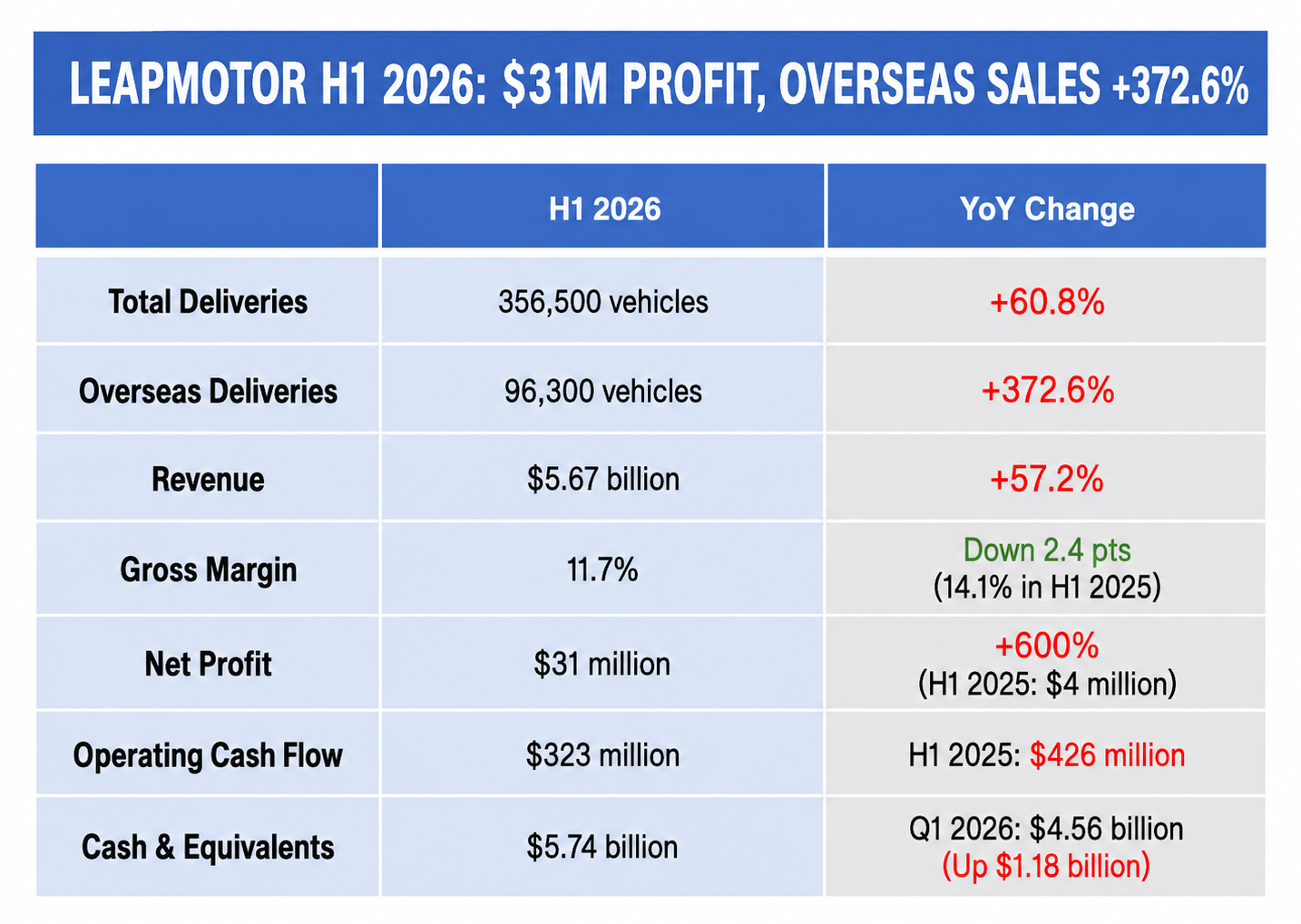
Revenue rose 57.2% year on year to about $5.67 billion in the first six months of 2026, the highest first-half total in the company's history. Deliveries climbed 60.8% to 356,487 vehicles, placing Leapmotor ahead of China's other emerging EV manufacturers by volume.
Momentum accelerated in July, when deliveries reached a record 101,267 vehicles. That made Leapmotor the first Chinese EV start-up to cross the 100,000-unit threshold in a single month.
Net profit increased about sixfold to roughly $31 million, marking the company's third consecutive profitable half-year period. Yet those headline figures tell only part of the story.
Adjusted net profit, which excludes share-based payments, fell 18.2% to about $40 million. The divergence suggests that lower employee share-based expenses contributed to the increase in reported earnings.
A Profit of About $88 for Every Vehicle Delivered
Dividing Leapmotor's reported net profit by its first-half deliveries produces a figure of only about $88 per vehicle. It is not a precise measure of vehicle-level profitability, because group earnings include revenue from services and carbon credits, but it illustrates how little room the company has for cost shocks.
Leapmotor's net margin was about 0.55%. For a manufacturer whose average vehicle selling price was slightly above $16,000, that leaves a narrow buffer between rapid growth and a return to losses.
The pressure is clearest in gross margin, which fell to 11.7% from 14.1% a year earlier. The company attributed the decline to higher raw-material costs and a product mix increasingly weighted towards lower-priced vehicles. Cost of sales rose 61.7%, faster than revenue.
Models such as the A05, starting at about $9,500, and the A10, priced from around $9,000, have helped Leapmotor reach a much larger market. They have also pulled down the average selling price. This is the bargain at the heart of the company's strategy: lower prices create scale, but scale does not automatically produce strong earnings.
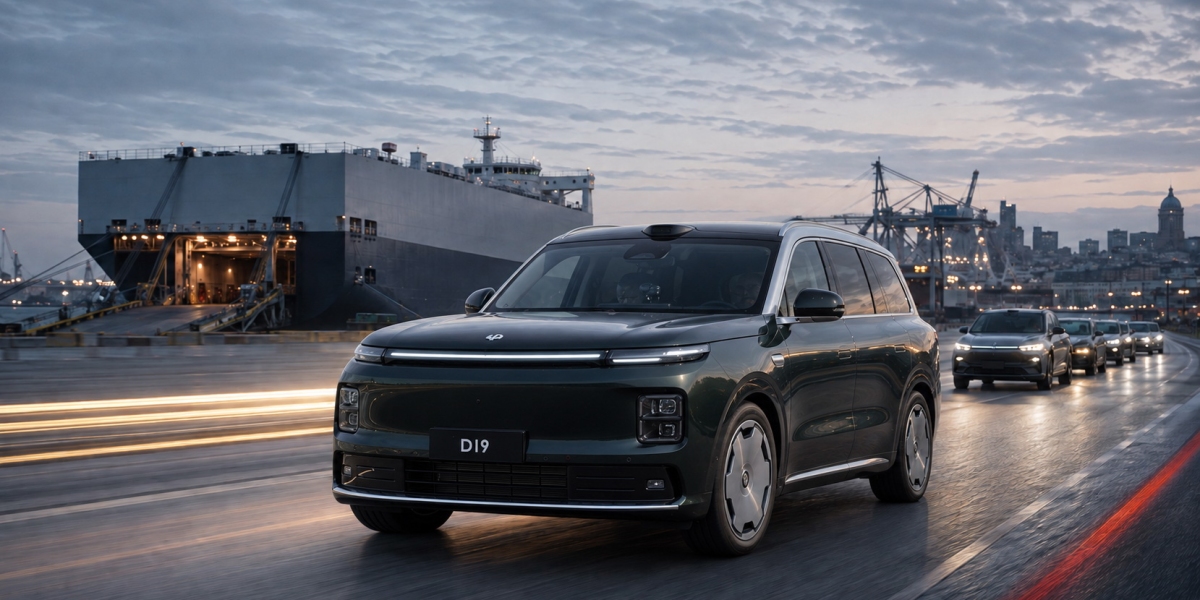
There are signs of sequential improvement. Gross margin recovered to 12.6% in the second quarter as production expanded and higher-positioned D-series models began contributing. The D19 recorded more than 10,000 deliveries in July and ranked among the strongest-selling large SUVs below roughly $60,000, according to company data.
Even so, management expects vehicle gross margin of only about 10% to 11% for the full year. That guidance suggests the ceiling on Leapmotor's volume-led model remains low unless product mix, pricing power or overseas economics improve.
Carbon Credits Are Doing More Work Than Car Sales
Leapmotor's earnings also reveal that the vehicles themselves are not yet the only source of profit. Service and other revenue more than doubled to approximately $374 million in the first half, with carbon-credit transactions contributing an estimated $119 million to $134 million.
Carbon-credit income carries little of the manufacturing cost associated with building a car, giving it an outsized effect on the bottom line. Without that contribution, Leapmotor's already thin profitability would look considerably weaker.
This does not make the profit unreal. Regulatory-credit income has long supported electric-vehicle manufacturers in markets including the United States and Europe. It does mean that investors should distinguish between reported earnings and the underlying economics of Leapmotor's vehicle business.
Overseas Sales Have Become the Strongest Part of the Story
The most convincing growth in Leapmotor's first-half report came from outside China. Overseas sales reached 96,294 vehicles, up 372.6% from a year earlier. Exports accounted for 27% of total deliveries and had already exceeded the company's full-year 2025 volume.
Europe is becoming the centre of that expansion. Leapmotor said it captured more than a quarter of Italy's battery-electric market during the first half, ranked as the best-selling Chinese car brand in Germany in June and placed third among Chinese battery-electric brands in the UK. Revenue attributed to Europe reached about $1.32 billion, equivalent to 23.3% of group revenue.
Stellantis has given Leapmotor something most Chinese EV challengers have had to build market by market: an established international distribution system. The partnership now spans 45 markets and more than 1,000 sales and service outlets.
The relationship is also moving beyond exports. Production of the B10 is expected to begin at Stellantis's Zaragoza plant in Spain in October. The C10 is already being assembled in Malaysia, while production in Brazil is scheduled to start in 2027.
A planned Opel model will also use Leapmotor's electric-vehicle architecture. That arrangement is more strategically significant than another export programme: it places Chinese-developed technology inside a European mass-market brand and turns Leapmotor from a low-cost vehicle supplier into an engineering partner.
Growth Comes Before Overseas Profit
Management has made its immediate priorities clear. Chief Financial Officer Li Tengfei said Leapmotor is placing greater emphasis on overseas sales growth than near-term profitability. The company now expects international sales to reach about 200,000 vehicles in 2026, above its previous range of 100,000 to 150,000.
Local production should eventually improve the economics by reducing tariff exposure and shortening supply chains. Management has cautioned that the benefit will not be immediate because locally sourced parts can cost more than components purchased in China.
At group level, the near-term outlook has become less ambitious. Leapmotor cut its 2026 net-profit target from approximately $744 million to about $446 million, citing pressure from raw-material prices. That 40% reduction explains why investors looked past the strong first-half growth.
A Lean Cost Base Sets Leapmotor Apart
Leapmotor's defence against low margins is a tightly controlled cost structure built around in-house development. Research and development spending rose 22.8% to about $345 million in the first half, showing that the company did not produce its profit simply by cutting investment.
The comparison with XPeng is striking. XPeng generated roughly $4.88 billion in first-half revenue, not far below Leapmotor's total, but spent about $866 million on research and development and recorded a loss of approximately $464 million.
Leapmotor's ability to develop core components, share architectures across models and keep operating expenses under control has allowed it to turn high volume into a small profit while several rivals continue to lose money. The question is whether that discipline can survive a more complex global footprint and a push into higher-priced products.
Investors Still Value the Story as Manufacturing, Not Technology
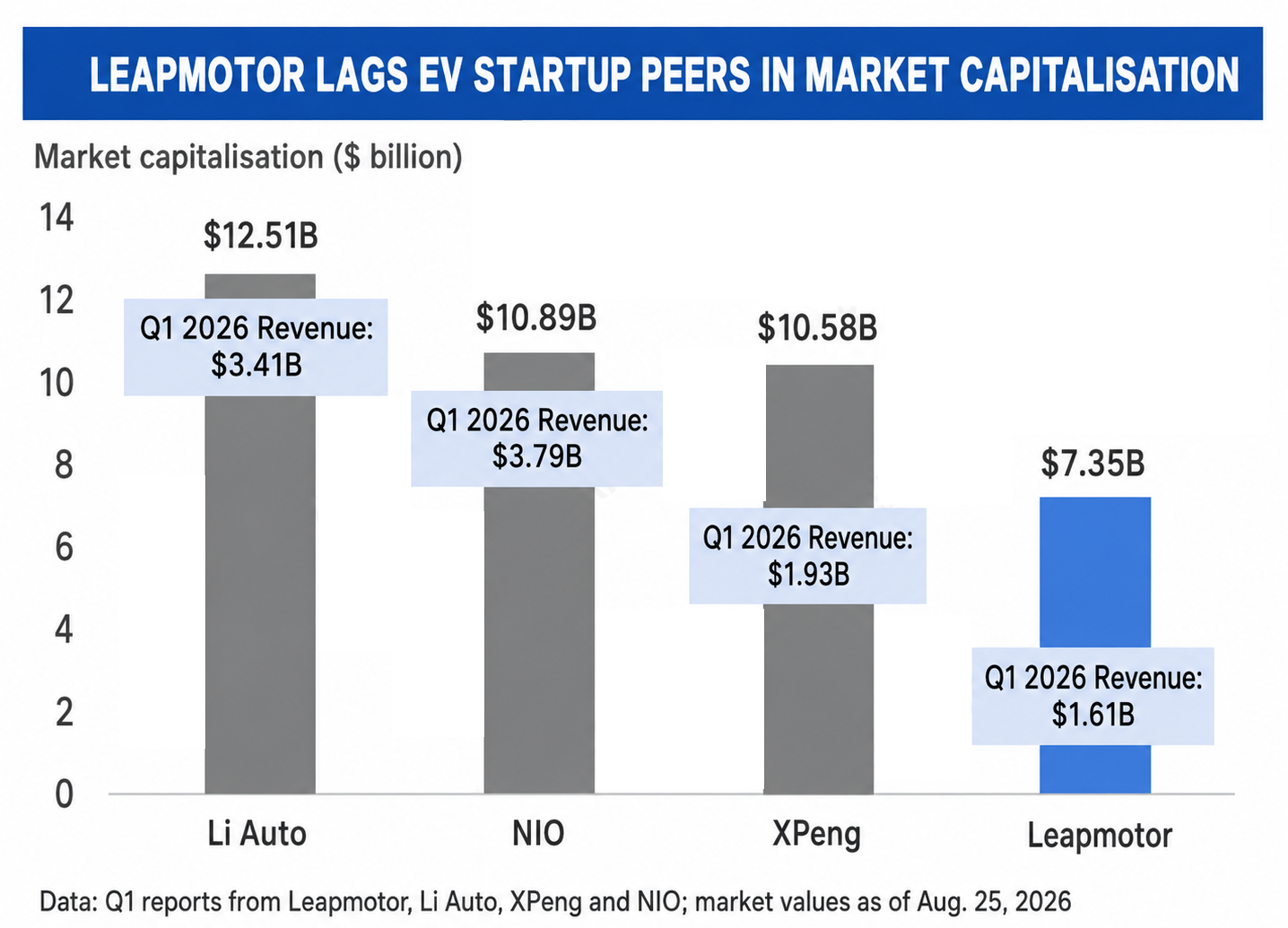
Leapmotor's sales leadership has not translated into a comparable market valuation. As of August 25, its market capitalisation was about $7.35 billion, below XPeng at roughly $10.58 billion, Nio at $10.89 billion and Li Auto at $12.51 billion. None of those three had recently matched even half of Leapmotor's quarterly delivery volume.
Founder and Chief Executive Zhu Jiangming has argued that the company is substantially undervalued. He has bought approximately $242.466 million of Leapmotor shares over the past year, while CICC has retained an outperform rating.
The valuation gap reflects more than current earnings. Investors tend to assign higher multiples to businesses that can sell a credible narrative around artificial intelligence, autonomous driving, robotics or software revenue. Leapmotor is still viewed primarily as an efficient manufacturer of affordable cars.
The company attempted to widen that narrative on the day of its results by announcing a deeper partnership with FAW that will include embodied-intelligence robotics. No meaningful details have yet been disclosed, leaving investors without enough information to decide whether robotics represents a real new business or simply a more fashionable label.
Cash Provides Time, but Better Economics Must Follow
Leapmotor is at least entering this next phase with a relatively strong balance sheet. It held about $5.74 billion in cash, restricted cash, deposits and selected financial assets at the end of June, against borrowings of roughly $356 million. That liquidity gives it room to fund product development, overseas localisation and a broader technology programme.
Yet the balance sheet does not remove the central challenge. Leapmotor has proved that a Chinese EV start-up can sell affordable vehicles at scale and remain profitable. It has not yet proved that those volumes can support durable margins.
The next test will be whether overseas expansion and higher-positioned models can lift earnings per vehicle without weakening the cost discipline that created its advantage. If they can, Leapmotor may begin to close the valuation gap with its peers. If they cannot, the company risks remaining a successful manufacturer that the market refuses to price as a technology business.