
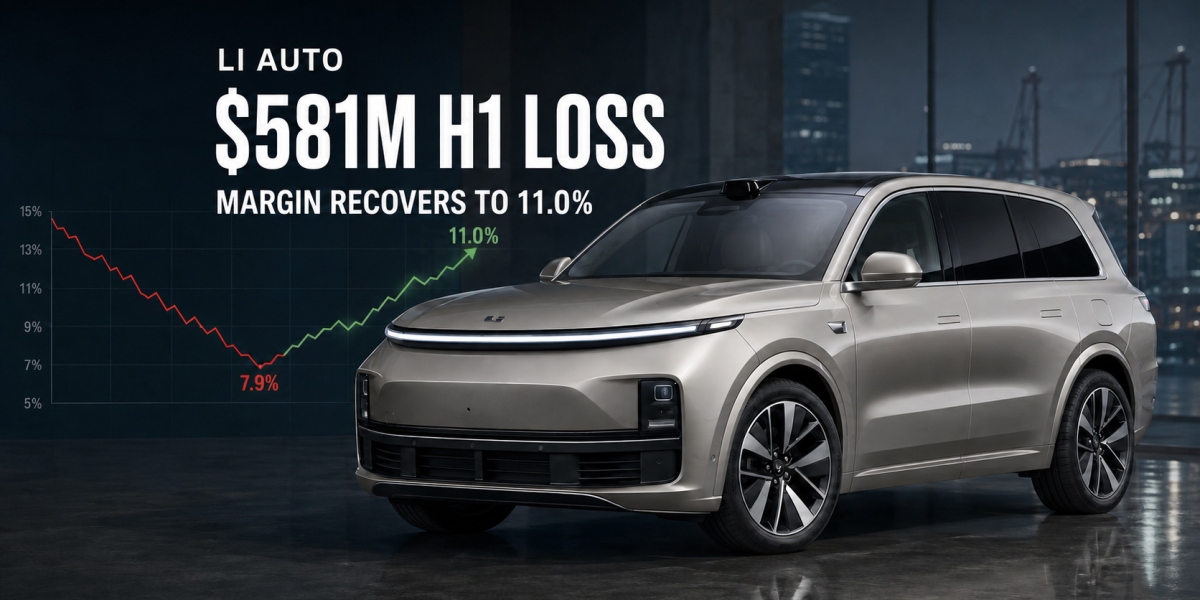
Li Auto’s second-quarter results offered investors two versions of the same company. One is beginning to recover from a bruising start to the year, helped by a richer product mix and the arrival of a new flagship.
The other is still selling fewer cars than it did a year ago, earning barely half its former margin and absorbing the cost of a difficult model transition.
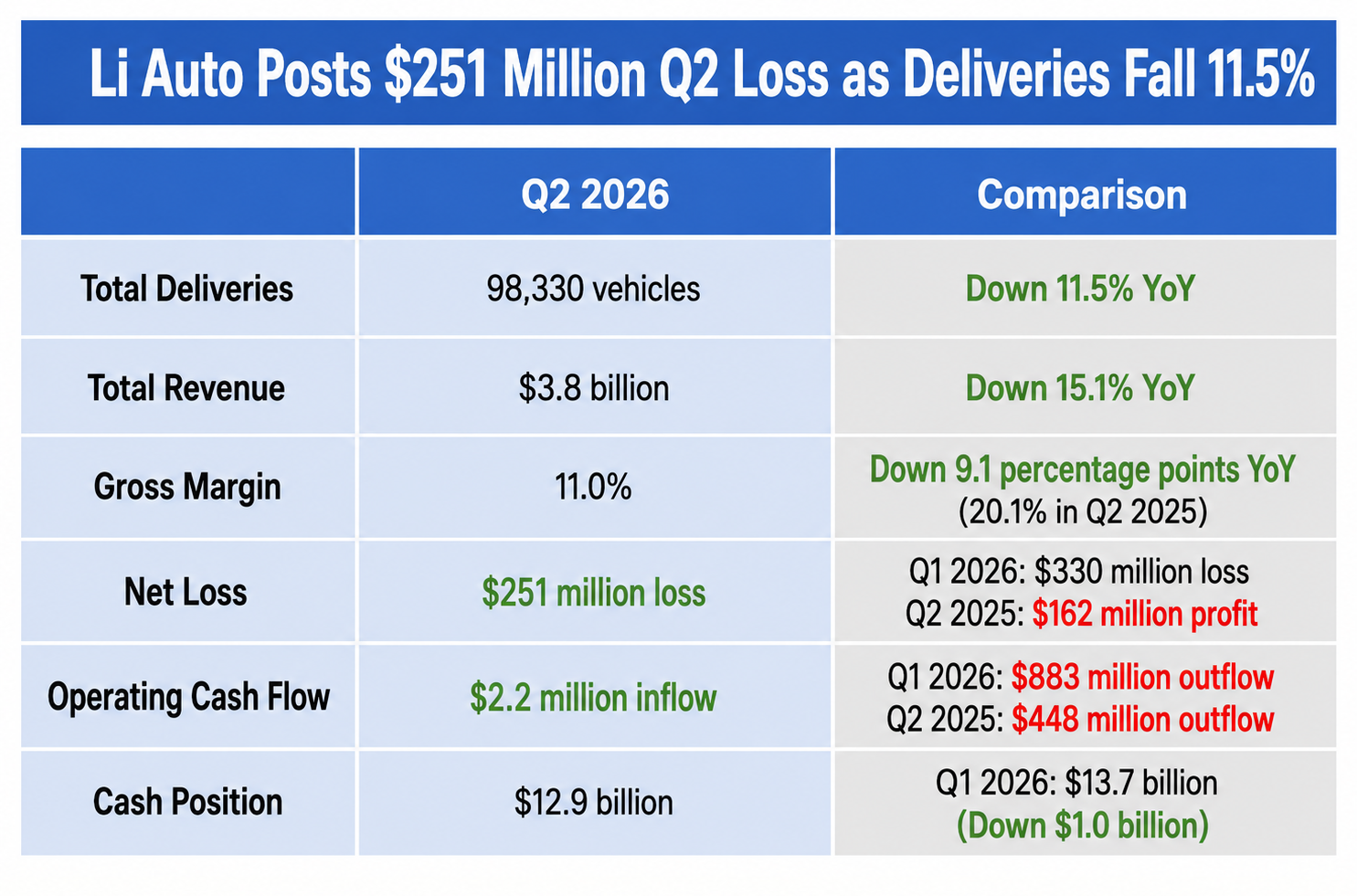
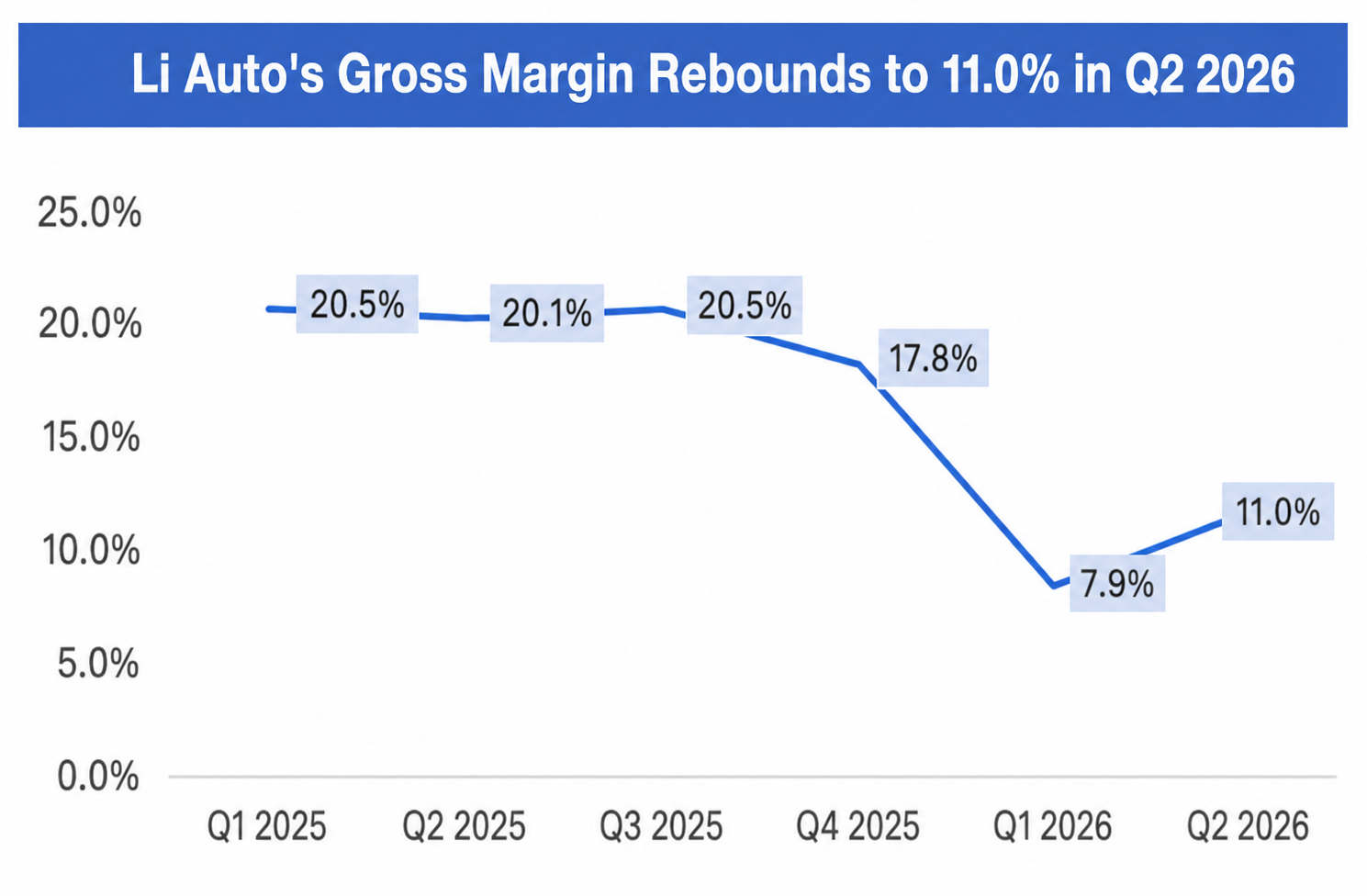
The Chinese electric-vehicle maker delivered 98,330 vehicles in the three months to June, down 11.5% from a year earlier. Revenue fell 15.1% to $3.8 billion, while gross margin dropped to 11% from 20.1% in the same period of 2025.
Li Auto recorded a net loss of about $251 million for the quarter, reversing a profit of roughly $162 million a year earlier. Combined with its $330 million first-quarter loss, the company lost approximately $581 million in the first half of 2026. It had earned about $255 million in the comparable period of 2025.
That reversal captures the price of Li Auto’s product reset. The latest quarter was better than the first, but the business remains far from the profitability that once distinguished it from most of China’s younger EV manufacturers.
A Product Transition That Crushed Margins
The decline did not arrive without warning. Li Auto entered 2026 with its sales mix shifting towards the lower-priced L6 range-extended SUV and i6 battery-electric SUV, reducing the contribution from the more profitable L8 and L9. Aggressive pricing across China’s car market added further pressure, while the expansion of Li Auto’s battery-electric platform brought costs that had to be absorbed before volume reached a more efficient level.
The effect was stark in the first quarter. Vehicle margin collapsed to 6.1%, from 19.8% a year earlier, and gross margin fell to 7.9%. Revenue declined 11.4% to $3.3 billion, while a profit of about $94 million in the first quarter of 2025 became a $330 million loss.
Li Auto had built a reputation as one of the few Chinese EV start-ups capable of combining growth with disciplined spending. The first-quarter numbers showed that this advantage was not immune to a weaker product mix, price competition or the cost of moving into pure-electric vehicles.
The New L9 Begins to Repair the Mix
The second quarter marked a partial recovery. Revenue rose 11.7% from the first quarter and deliveries increased 3.4%. Gross margin improved by 3.1 percentage points to 11%, while vehicle margin climbed to 9.4% from 6.1%.
The all-new Li L9, launched in May, was central to that improvement. Its Ultra version starts at about $68,000, while the higher-specification Livis version is priced at roughly $75,000. The return of a high-value flagship lifted Li Auto’s product mix after several quarters in which more affordable models had taken a larger share of deliveries.
Vehicle revenue per delivery rose from roughly $33,000 in the first quarter to about $36,000 in the second. The increase is a useful sign that the company can still improve its economics through model mix rather than relying entirely on higher volume.
The recovery needs perspective. Li Auto’s second-quarter vehicle margin remained 10 percentage points below its year-earlier level. Gross profit rose 56.9% from the first quarter to $418 million, yet it was still down 53.3% year on year. A better quarter was not the same as a return to normal.
Cost Control Helps, but the Gap Remains Wide
Li Auto narrowed its quarterly net loss by almost $79 million from the first quarter. Spending discipline played a role. Selling, general and administrative expenses fell 16.2% from a year earlier to about $336 million, largely because of lower employee compensation. Research and development spending remained broadly stable at approximately $409 million.
The company did not make its results look better by sharply cutting the technology budget. That matters as it tries to renew its vehicles, develop proprietary chips and compete in assisted driving. It also leaves a substantial earnings gap: total operating expenses of about $757 million were far above quarterly gross profit of $418 million.
There was another complication inside the expense numbers. Administrative and selling costs rose 11.2% from the first quarter as marketing and promotional activity increased. Li Auto is cutting some structural costs, but launching refreshed vehicles in one of the world’s most competitive car markets is not cheap.
Operating Cash Flow Turns Positive, Free Cash Flow Does Not
Cash flow improved sharply. Li Auto generated about $2.2 million from operating activities in the second quarter, compared with an outflow of $883 million in the first. The change suggests that the most immediate pressure from inventory purchases and customer receipts has eased.
Free cash flow remained negative at roughly $192 million. That distinction is important. The company has stopped burning cash through day-to-day operations for now, but capital expenditure means the wider cash drain has not ended.
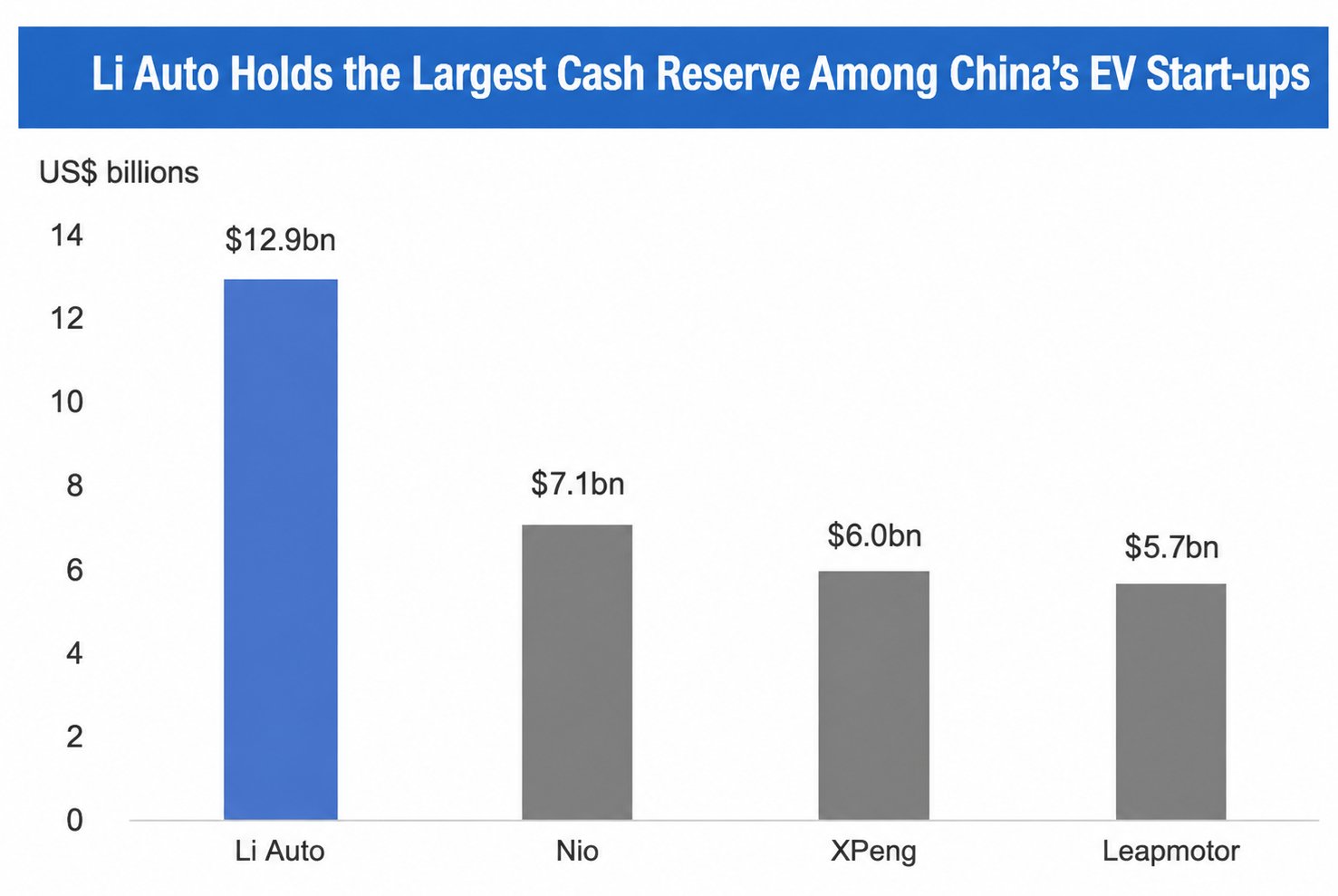
Li Auto still has one of the strongest balance sheets among China’s EV challengers. Cash, cash equivalents and related investments stood at $12.9 billion at the end of June. That reserve gives management time to rebuild the product line and continue investing through a period of weak profitability.
It has also allowed the company to support its shares. By late August, Li Auto had spent about $632 million under a $1 billion repurchase programme, completing roughly 63% of the plan. The scale of the buyback signals management’s confidence, though it does not remove the need for the vehicle business to recover.
A Fuller Line-up for the Second Half
Li Auto’s case for a stronger second half rests on a more complete product cycle. The company has renewed the L9 and L8, while a redesigned L6 went on sale in July at about $37,000. Management expects the higher-priced Livis trims to make a larger contribution and has said further margin expansion should follow as the mix improves.
The battery-electric line-up is also due for another test. The flagship i9 is planned for the second half of the year, alongside refreshed pure-electric models and an updated MEGA. These launches will show whether Li Auto can extend its success beyond range-extended SUVs without sacrificing too much profitability to gain scale.
International expansion adds a second route to growth, though it is unlikely to transform earnings immediately. Li Auto has entered Macao and signed distribution agreements with Al Fahim Motors in the United Arab Emirates and Mohamed Yousuf Naghi Motors in Saudi Arabia. Its L-series SUVs will lead the push into the Middle East, where large premium vehicles and long driving range could fit local demand.
Li Auto Is Selling an AI Future as Well as Cars
The product renewal is tied to a much larger strategic claim. Li Auto increasingly describes itself as an embodied-intelligence company rather than simply an EV manufacturer.
Its in-house MACH M100 assisted-driving chip is now fitted to new L-series vehicles. Built on a 5-nanometre automotive process, the chip is rated at 1,280 TOPS, while the Livis versions use a dual-chip configuration. The hardware works with Li Auto’s vision-language-action model and is intended to reduce dependence on external suppliers while tightening the link between software and vehicle systems.
The company has extended the same AI branding to its Livis smart glasses. Founder Li Xiang has framed autonomous driving as the first half of embodied intelligence and general-purpose humanoid robots as the second. It is an ambitious narrative at a time when the core car business is under pressure.
For investors, the difficulty is timing. Proprietary chips and large AI models may strengthen Li Auto’s long-term position, but they cannot quickly restore deliveries or double vehicle margin. The technology strategy will be judged first through conventional automotive measures: demand, pricing power, product quality and manufacturing economics.
Investors Remain Divided
Analysts are split over whether the recovery is already reflected in Li Auto’s valuation. Sinolink Securities has maintained a buy rating, forecasting a loss of roughly $396 million in 2026 followed by a profit of about $616 million in 2027. Its case rests on a product-led rebound and a valuation that could fall to about 9.5 times projected 2028 earnings.
JPMorgan has taken the other side. The bank kept a sell rating in July and cut its US-listed share-price target to $10. Li Auto’s American depositary receipts were recently trading near $12, leaving the target around 15% below the market price.
The caution is understandable. Li Auto’s shares have lost close to half their value over the past year, reflecting doubts that extend beyond one weak quarter. Investors still need evidence that the renewed range-extended line-up can restore volume, that the company’s battery-electric models can break through in a crowded market and that its embodied-intelligence investment can eventually produce returns.
A Recovery Has Started. The Proof Has Not Arrived
Li Auto’s second-quarter results suggest that the first quarter may have marked the low point for margins. Revenue, deliveries, gross profit, vehicle margin and operating cash flow all improved sequentially. The new L9 has shown that a richer mix can repair some of the damage.
The year-on-year comparison remains severe. Sales are lower, gross margin has nearly halved and the company lost $581 million in six months after being profitable a year earlier. Its $12.9 billion cash position gives management room to wait for the product cycle to turn. It does not guarantee that the turn will come.
The next test is no longer whether Li Auto can tell a convincing story about premium vehicles, proprietary AI or embodied intelligence. It is whether refreshed models can convert that story into higher deliveries and sustainable margins before China’s EV competition moves on again.