
XPeng’s second-quarter results offered two sharply different readings of the Chinese electric-vehicle maker. Profitability at the gross-margin level reached a new high, helped by technology income and overseas expansion.
Yet vehicle growth stalled, first-half revenue declined and losses widened as the company poured more money into artificial intelligence, robotaxis and humanoid robots.
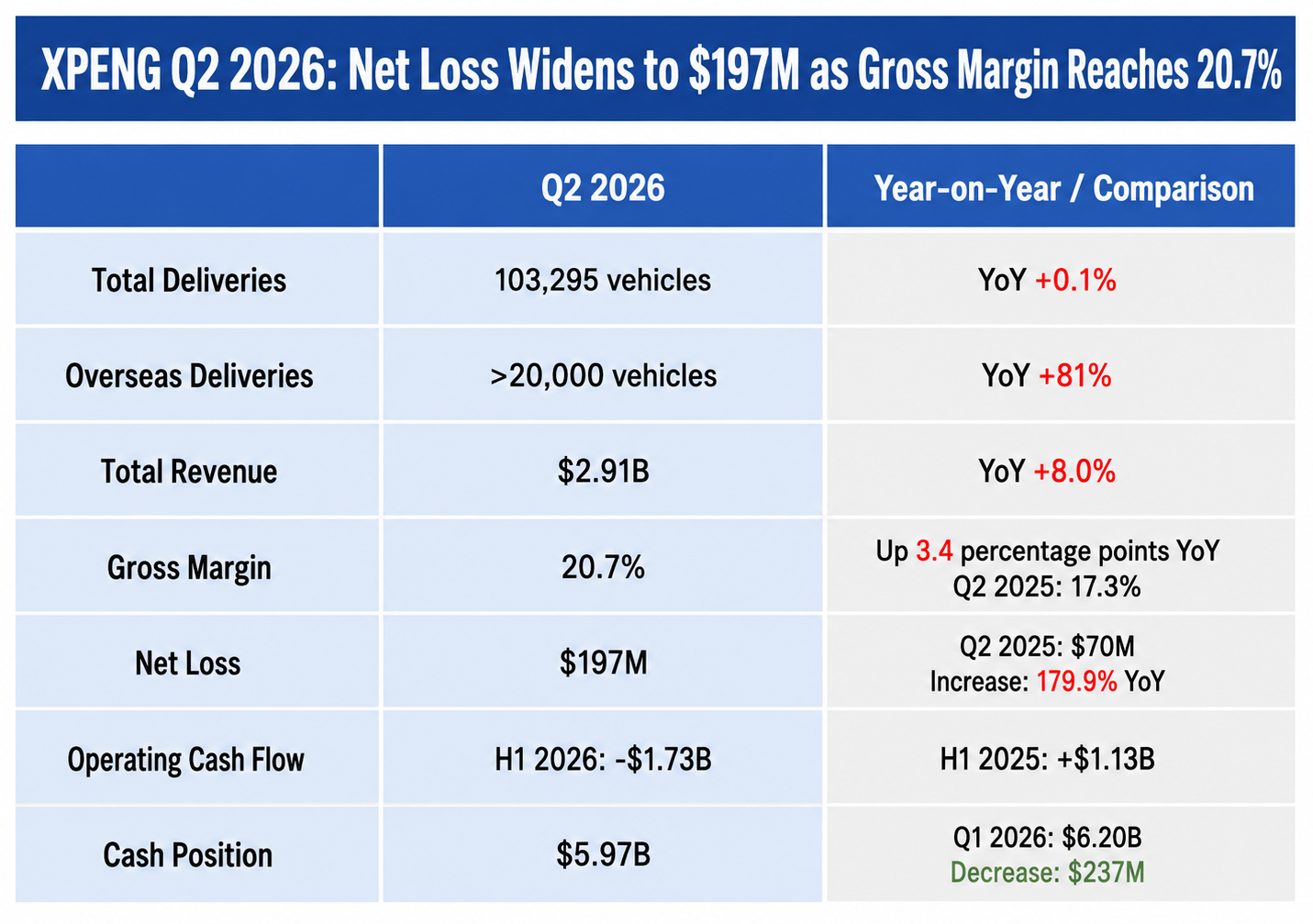
The Guangzhou-based group delivered 103,295 vehicles in the second quarter, virtually unchanged from a year earlier, while revenue rose 8% to $2.91 billion. Across the first six months of 2026, deliveries fell 15.8% to 165,977 vehicles and revenue declined 3.8% to about $4.83 billion.
The headline margin told a more encouraging story. XPeng’s gross margin rose to 20.7% in the second quarter from 17.3% a year earlier, extending its recent improvement and placing the company above the level reached by many of its loss-making Chinese EV peers.
That progress did not translate into a profit. XPeng recorded a second-quarter net loss of about $197 million, nearly three times the loss reported a year earlier. Its first-half net loss widened to approximately $460 million from about $168 million in the same period of 2025.
The tension at the centre of the results is increasingly clear: XPeng is generating more gross profit from software and engineering services, but the cost of its wider transformation is rising faster.
Technology Income Is Reshaping the Margin
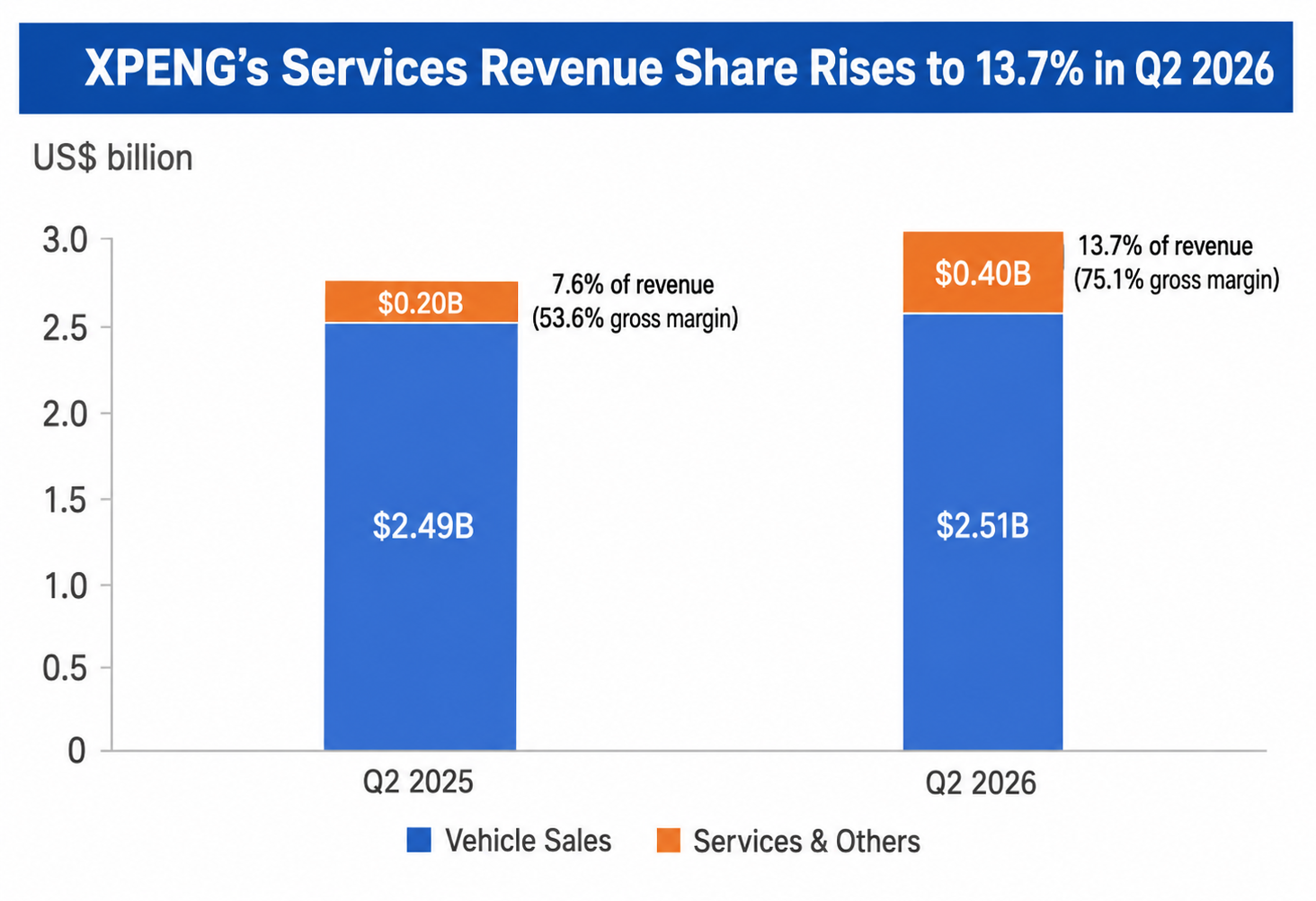
XPeng still makes most of its money from cars. Vehicle revenue reached $2.51 billion in the second quarter, up just 1% year on year, and accounted for more than 86% of total sales. The vehicle margin was 12.1%, down from 14.3% a year earlier as the company moved between product generations.
The more consequential change came from services and other revenue. That business generated about $397 million in the quarter, an increase of 93.9%, while its margin climbed to 75.1% from 53.6% a year earlier.
Services and other activities represented only 13.7% of quarterly revenue but produced close to half of XPeng’s gross profit. That explains why the group-level margin rose even as profitability in the core vehicle operation weakened.
XPeng said the increase reflected the achievement of technical research and development milestones under an agreement with another carmaker, as well as higher parts and accessories sales. The unnamed manufacturer is widely understood to be Volkswagen, which agreed in 2023 to work with XPeng on electric-vehicle platforms, software and electronic architecture.
The commercial structure matters. Earlier payments were linked largely to development milestones; later income is expected to become more closely tied to vehicles using the jointly developed technology. The second-quarter figures offer an early indication of how intellectual property could become a meaningful earnings stream rather than simply a cost centre.
It would be premature to describe XPeng as a technology company that also sells cars. Vehicle sales remain the foundation of the business, and licensing income can be uneven when it depends on project milestones. Even so, the results show that the economics of XPeng’s partnership model are beginning to influence the group’s financial profile.
AI Investment Is Delaying the Profit Story
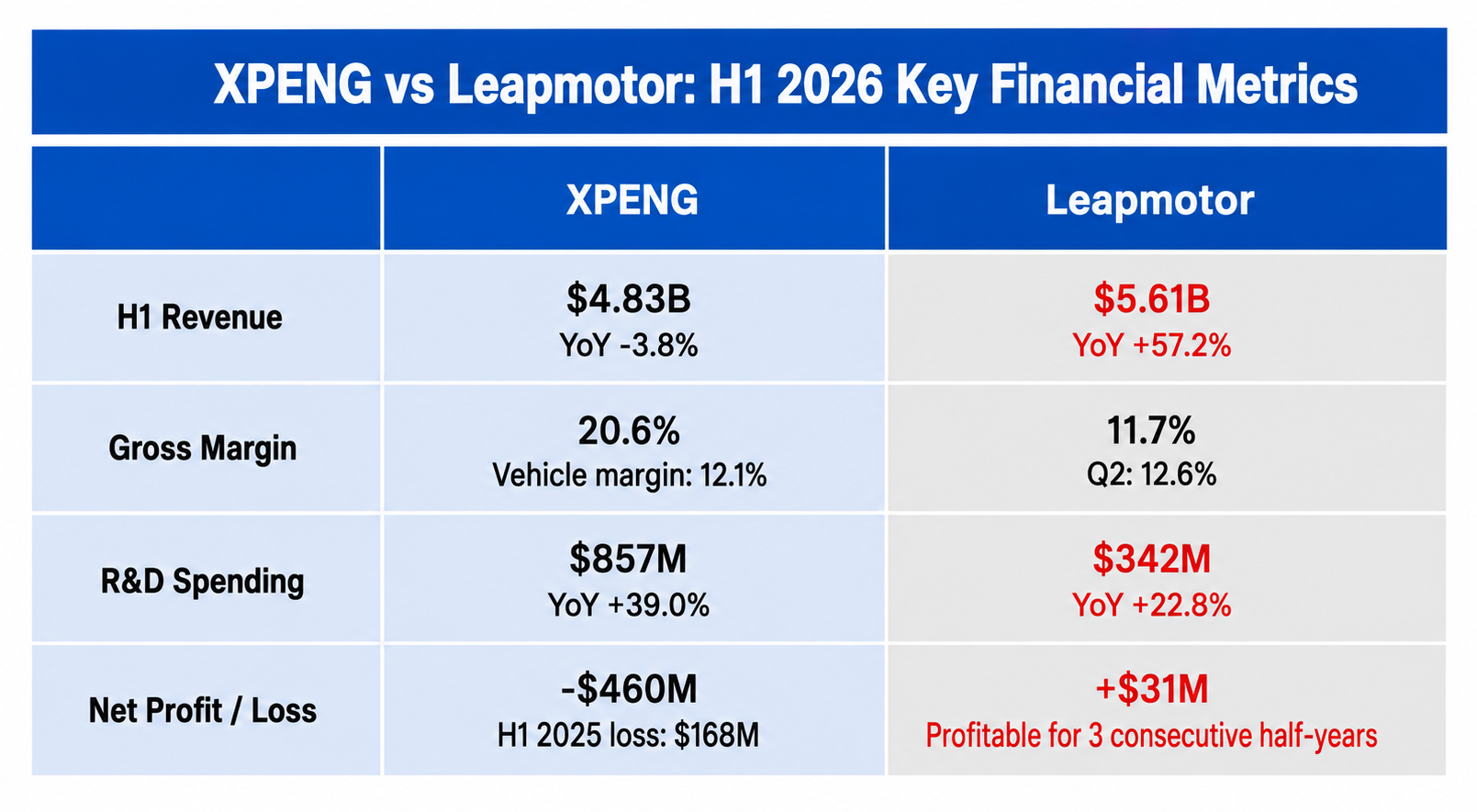
The improvement in gross profit was absorbed by a rapid increase in operating spending. Research and development expenses reached about $429 million in the second quarter and approximately $857 million for the first half, up roughly 39% from a year earlier.
XPeng is funding several capital-intensive programmes at the same time: its vision-language-action driving model, the Turing AI chip, robotaxi operations and the IRON humanoid robot. It is also developing new vehicle models and expanding production, sales and service operations beyond China.
This is where the comparison with Leapmotor becomes instructive. The two companies generated revenue on a broadly similar scale in the first half, but XPeng spent close to $857 million on research and development, compared with roughly $345 million at Leapmotor. XPeng lost about $460 million, while Leapmotor reported a modest profit of approximately $31 million.
The contrast does not prove that one strategy is superior. Leapmotor has built its case around vertical integration, common vehicle architectures and strict cost control. XPeng is attempting something broader: to use the same AI stack across passenger cars, autonomous taxis and robots. That strategy may create more valuable businesses over time, but it carries a much heavier near-term bill.
Robotics Turns From Side Project to Corporate Strategy
XPeng’s ambitions now extend well beyond electric cars. Chairman and chief executive He Xiaopeng has argued that the company can become a global leader in “physical AI”, using software, chips and real-world machines as a single technology platform.
The company reinforced that message when its robotics subsidiary agreed a funding round of more than $900 million at a post-money valuation above $6.3 billion. IDG Capital led the financing, with Tencent and Alibaba among the strategic investors.
XPeng plans to move IRON towards large-scale commercial production, initially targeting retail, service and industrial applications. Management has said the revenue and gross profit generated by each robot could eventually be substantially higher than for a car, though the market for general-purpose humanoid robots remains at an early and uncertain stage.
The group’s corporate identity has shifted with that ambition. Its Chinese name was changed from “XPeng Motors” to “XPeng Group” in April, a symbolic move that reflects management’s desire to be valued as a physical-AI company rather than solely as an EV manufacturer.
Investors will still judge that transformation through the cash it consumes. The robotics financing gives the unit greater room to develop independently and brings external validation to its valuation. It does not remove the execution risk involved in turning prototypes into reliable, mass-produced products.
Cash Gives XPeng Time, but Less Room for Error
XPeng used about $1.73 billion of cash in operating activities during the first half, reversing an operating cash inflow of roughly $1.13 billion a year earlier. Its cash position stood at $5.97 billion at the end of June, down by about $1.06 billion from the end of 2025.
The balance sheet remains substantial, and the robotics funding adds another source of capital. The direction of travel is less comfortable. Vehicle production, overseas expansion, autonomous-driving development and robotics are all demanding investment at the same time.
That leaves XPeng with enough liquidity to pursue its strategy, but less tolerance for delays. If new models ramp more slowly than planned or technology projects take longer to commercialise, the company may need to choose more carefully where it concentrates spending.
Overseas Markets Offer a Higher-Value Route
International expansion was one of the stronger parts of the quarter. XPeng’s overseas deliveries exceeded 20,000 vehicles for the first time, rising 81% year on year. Markets outside China contributed more than 25% of first-half revenue.
The average selling price of XPeng vehicles overseas exceeded €40,000, according to the company. That is important in an industry where price competition in China has compressed margins and forced manufacturers to search for more profitable growth abroad.
Overseas markets are not a simple escape from domestic pressure. Tariffs, local homologation, distribution costs and brand-building expenses can offset higher sticker prices. XPeng must also compete with established European, Japanese and Korean brands while managing a growing list of local partners.
Still, the international business could become a valuable counterweight to China. Higher average prices and a broader geographic mix offer a route to better unit economics, particularly if XPeng can spread its software and engineering costs across a larger global fleet.
Weak Guidance Shifts Attention Back to Manufacturing
XPeng’s third-quarter outlook brought the debate back to its car business. The company expects to deliver between 115,000 and 121,000 vehicles and generate revenue of $3.20 billion to $3.45 billion. Both ranges were below earlier market expectations.
The MONA L03 has attracted strong orders, but production and supply-chain constraints have limited the speed of its ramp-up. For a company trying to support a large technology portfolio with automotive cash flow, unfilled demand is more than a manufacturing problem: it delays revenue, weakens operating leverage and places greater pressure on liquidity.
Investors responded quickly. XPeng’s US-listed shares fell after the results, while the Hong Kong stock dropped more than 8% in early trading the following day. The reaction suggested that the market gave more weight to the cautious outlook than to the record gross margin or the robotics valuation.
XPeng’s Real Constraint Is Time
XPeng has no shortage of technology narratives. It has a major partnership with Volkswagen, proprietary AI chips, an advanced driving model, robotaxi trials, a humanoid-robot programme and a growing overseas business. Few Chinese carmakers are attempting to commercialise so many related technologies under one group.
The challenge is sequencing. The company must ramp new cars, increase factory output, expand abroad and move robotics towards production without allowing cash consumption to outrun the returns from those investments.
The second-quarter results show why that balance is difficult. Software and engineering income lifted the gross margin above 20%, offering evidence that XPeng’s technology can generate high-margin revenue. At the same time, vehicle margins declined and first-half losses widened sharply.
XPeng’s strategy may ultimately produce a business worth more than a conventional carmaker. The next several quarters will determine whether its automotive operation can finance that ambition long enough for the technology portfolio to begin paying for itself.