
China’s Passenger Vehicle Export Market Strengthens as Structural Shifts Accelerate in May 2026
China’s passenger vehicle export sector continued to expand in May 2026, with the latest Top 20 manufacturer ranking revealing both consolidation at the top and intensifying competition across the mid-tier landscape. According to CPCA export data compiled by Yiche, including both complete vehicles and CKD shipments, the market remains highly concentrated among a small number of dominant players, while NEV-driven exporters continue to reshape the industry structure.
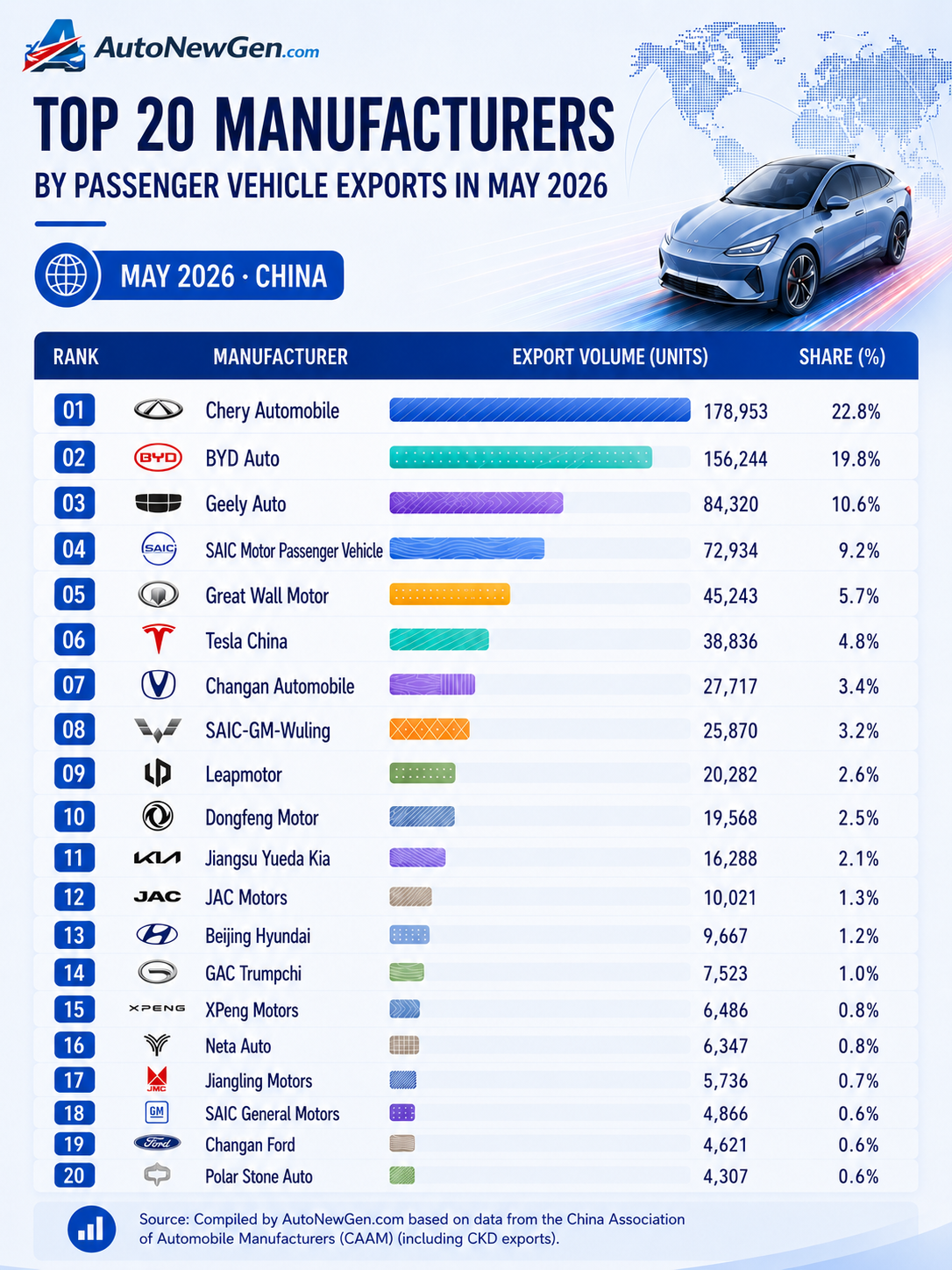
The accompanying chart on this page highlights the evolving export hierarchy, where traditional scale leaders coexist with rapidly growing electrified vehicle specialists, signaling a transition phase in China’s global automotive strategy.
Chery Leads Overall Exports, While BYD Establishes NEV Dominance
In May 2026, Chery Automobile retained its position as the largest passenger vehicle exporter, achieving 179,285 units. Its continued strength is driven by a broad international footprint and consistent demand across emerging markets, particularly in Latin America and the Middle East.
BYD followed closely with 155,944 units, reinforcing its position as the most influential NEV exporter. Notably, the company’s NEV export volume matches its total export figure, confirming a near-complete electrification of its overseas shipments.
Geely ranked third with 84,152 units, maintaining stable export performance across both internal combustion and new energy product lines.
NEV Segment Reveals a Distinct Competitive Order
A closer look at NEV export rankings reveals a different competitive structure compared to total passenger vehicle exports. BYD leads the NEV segment with 155,944 units, followed by Chery at 62,398 units, and Geely at 39,811 units.
This divergence highlights a key structural trend: while Chery leads in total exports, BYD dominates the electrification segment, effectively defining the new competitive benchmark for China’s global automotive presence.
The chart visualizes this dual-track system clearly, separating volume-driven leadership from technology-driven export strength.
High-Growth Exporters Signal the Rise of a New Competitive Layer
Beyond the top three exporters, several manufacturers demonstrated exceptional year-on-year growth among companies exceeding 5,000 units in monthly exports.
Leapmotor recorded the highest growth rate at 451.3%, adding 16,510 units. Ruilan followed with 356.5% growth and 4,898 units, while Dongfeng Motor increased by 197.5% with 13,014 units in additional exports.
In the NEV export segment, Dongfeng Motor surged 516.0%, Leapmotor grew 451.3%, and Geely expanded 429.0%, reflecting rapid electrification momentum across both emerging and established manufacturers.
Industry Structure Shifts from Scale Leadership to Electrification Leadership
The divergence between total export leaders and high-growth NEV exporters reflects a broader structural transformation in China’s automotive export ecosystem.
Chery’s sustained leadership underscores the importance of scale, legacy platforms, and diversified overseas operations. However, BYD’s NEV dominance highlights the growing importance of electrification as a core competitive advantage in global markets.
At the same time, the rapid expansion of Leapmotor and Dongfeng indicates that both private NEV startups and state-owned manufacturers are actively reshaping the mid-tier global competition landscape.
Chart Analysis: A Fragmented Yet Rapidly Electrifying Export Landscape
The infographic accompanying this article illustrates a fragmented but rapidly evolving export hierarchy. While the top positions remain relatively stable, the middle segment shows significant volatility, with sharp differences in growth rates and shifting market shares.
The separation between total exports and NEV exports highlights a dual-structure industry model: one driven by established export scale, and another driven by electrification-led expansion.
This dual structure is likely to persist as global markets continue to diverge in EV adoption speed and regulatory frameworks.
Conclusion: China’s Auto Export Model Enters a New Electrification-Driven Phase
May 2026 marks a clear inflection point in China’s automotive export evolution. Growth is increasingly driven by electrified vehicles rather than traditional export scale expansion.
While Chery maintains leadership in total exports, BYD’s dominance in NEVs and the rapid rise of Leapmotor and Dongfeng suggest a structural shift toward technology-driven competitiveness.
The Top 20 ranking is no longer just a volume leaderboard—it is becoming a reflection of how China’s automotive industry is repositioning itself in the global transition toward electrification.