
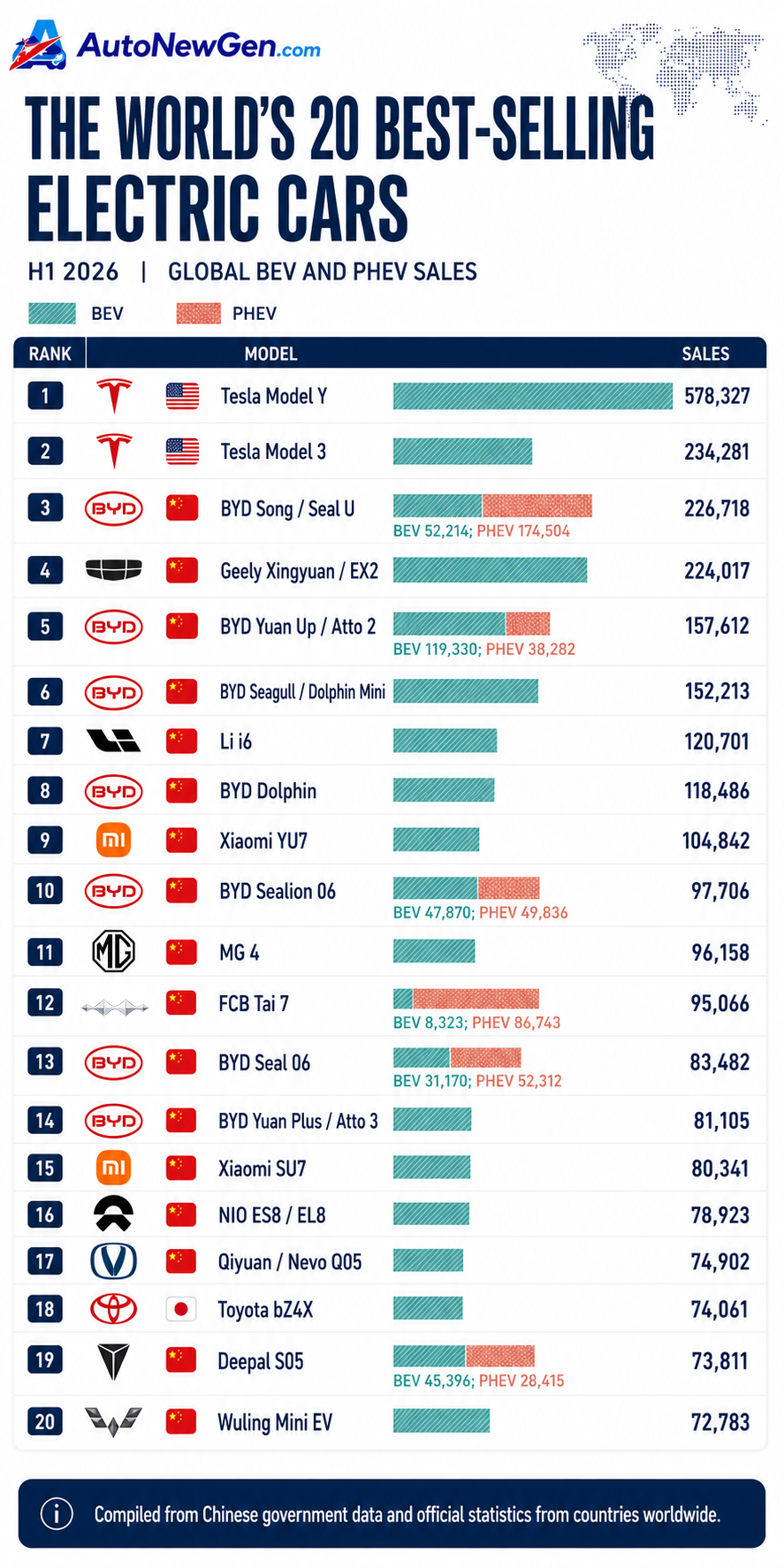
Tesla Leads at the Top, but Chinese Carmakers Control the Field
Tesla’s Model Y remained the world’s best-selling electric vehicle in the first half of 2026, with estimated global sales of 578,327 units. That was almost two and a half times the 234,281 units recorded by the Model 3, allowing Tesla to retain the top two positions despite intensifying competition across the global EV market.
The wider ranking tells a different story. Chinese models occupied 17 of the top 20 places, reflecting the growing depth of the country’s electric-vehicle industry. The BYD Song, sold in some overseas markets as the Seal U, ranked third with 226,718 units, narrowly ahead of the Geely Xingyuan, also known as the EX2, at 224,017 units.
BYD-branded vehicles secured seven positions in the top 20, spanning compact city cars, crossovers and larger plug-in hybrids. The Yuan Up/Atto 2 and Seagull/Dolphin Mini both exceeded 150,000 units, while the Dolphin, Sealion 06, Seal 06 and Yuan Plus/Atto 3 also appeared in the ranking. Fangchengbao, another BYD-controlled brand, placed 12th with the Tai 7.
The results also underline the importance of plug-in hybrids to Chinese manufacturers’ global strategy. PHEV versions accounted for most sales of the BYD Song/Seal U, FCB Tai 7 and BYD Seal 06, while the Sealion 06 recorded an almost even split between battery-electric and plug-in-hybrid variants. This broad powertrain mix allows Chinese carmakers to compete across markets with very different charging infrastructure and consumer preferences.
Newer Chinese brands are also reaching significant scale. Li Auto’s i6 ranked seventh, Xiaomi placed both the YU7 and SU7 in the top 15, and the NIO ES8/EL8 finished 16th. Toyota’s bZ4X, in 18th place, was the only non-Chinese model outside Tesla to enter the global top 20.
Tesla therefore retains a commanding lead at the individual-model level, but the competitive field beneath it is increasingly shaped by Chinese manufacturers. The next phase of the global EV contest will be defined less by a single blockbuster model and more by the ability to build broad product portfolios across multiple segments, price points and powertrain technologies.