
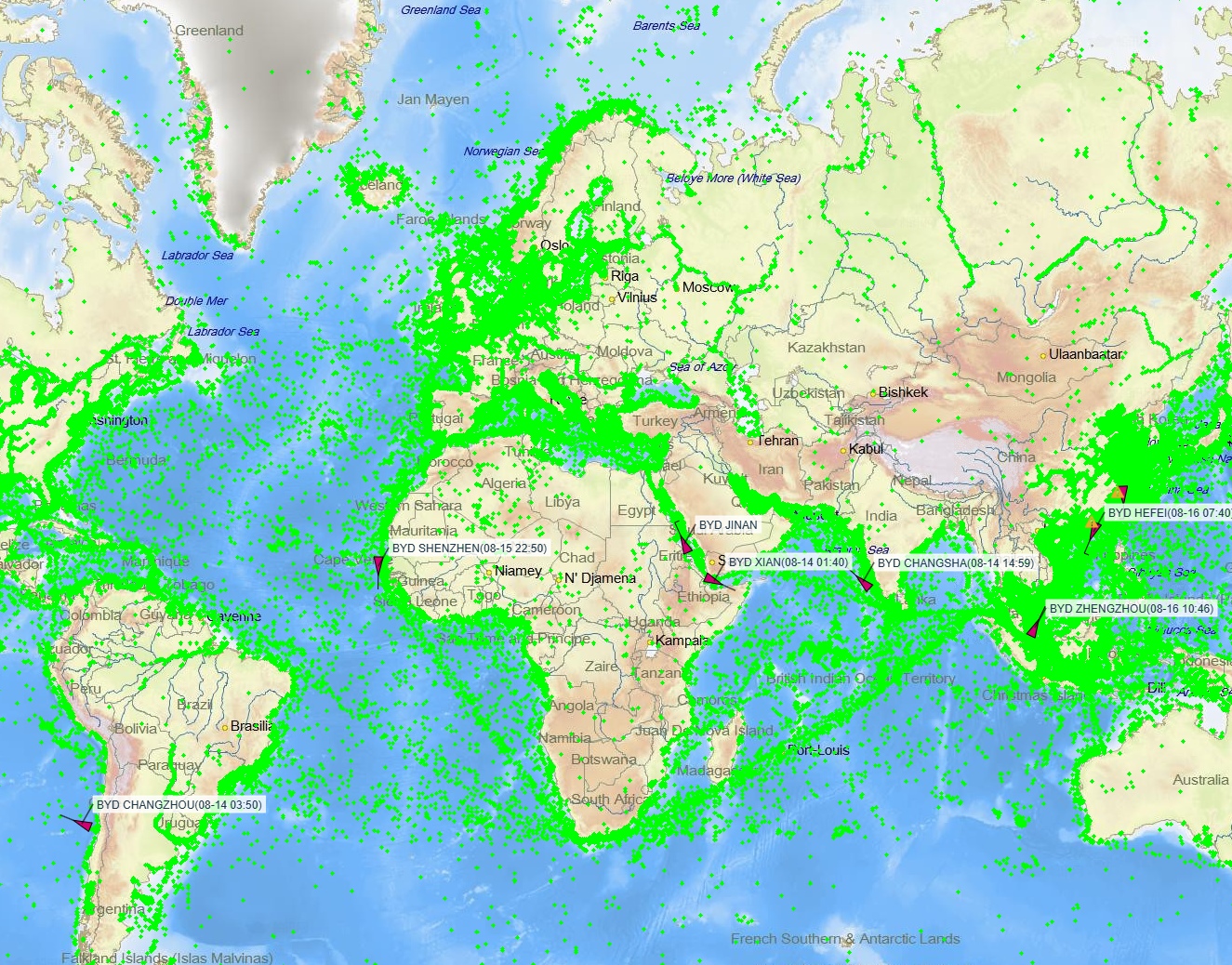
BYD’s eight-ship vehicle carrier fleet is no longer moving as a single export wave from China. The latest vessel positions show something more significant taking shape: a continuous global logistics cycle, with ships simultaneously departing China, crossing toward Europe and the Middle East, returning from overseas markets and preparing for another round of exports.
AIS data recorded late on August 16 shows BYD vessels spread from the South Pacific and North Atlantic to the Red Sea, Gulf of Aden, Indian Ocean and South China Sea.
The pattern marks a clear evolution from the fleet picture seen a week earlier.
Some ships that were delivering vehicles into Europe are now heading back toward Asia. Others have moved deeper into the Europe-bound corridor, while vessels that recently returned to China appear to have started new outbound voyages.
BYD’s maritime network is increasingly operating less like a collection of export ships and more like a permanently rotating logistics system.
BYD Shenzhen Leaves Europe and Turns Back Toward Asia
The most visible change involves BYD Shenzhen.
On August 10, the 219-meter vessel was sailing near the English Channel after calling at Wilhelmshaven, Germany, placing it directly inside BYD’s northern European distribution network.
By late August 16, BYD Shenzhen had moved far into the North Atlantic, sailing south at about 15.7 knots.
Its reported destination points toward Singapore, suggesting that its latest European deployment is largely complete and that the vessel is beginning the long return leg toward Asia.
That turnaround is important.
For a manufacturer-controlled fleet, the strategic value comes not simply from carrying vehicles from China to Europe, but from how quickly vessels can complete deliveries, reposition and return for their next loading cycle.
BYD Shenzhen is now providing a visible example of that process.
BYD Jinan and Xi’an Move in Opposite Directions Around the Red Sea
Two of BYD’s largest carriers are currently operating on opposite sides of the same strategic maritime corridor.
BYD Jinan, which was in the Laccadive Sea on August 10, has advanced into the Red Sea.
The 219-meter vessel was traveling northwest at around 16.7 knots late on August 16. Its reported voyage information references Suez, indicating that it is continuing toward the canal and potentially onward into the Mediterranean.
BYD Xi’an, by comparison, has already moved through the Suez region.
After being positioned near Port Said on August 10, the vessel is now in the Gulf of Aden, sailing east-southeast at approximately 16.2 knots.
The two ships effectively illustrate both directions of BYD’s Asia-Europe circulation.
One is advancing toward Suez from Asia. The other has passed through the corridor and is heading back toward the Indian Ocean.
This two-way traffic is a sign that the fleet is beginning to develop a more mature operating rhythm rather than relying on isolated export voyages.
BYD Changsha Pushes West Across the Indian Ocean
BYD Changsha has also made substantial progress since the previous fleet update.
A week ago, the vessel was crossing the Strait of Malacca after leaving Singapore.
It has now reached waters west of India and was sailing northwest at about 15.2 knots.
Its reported destination is Khalifa Port in the United Arab Emirates.
If maintained, the route would place BYD Changsha on a Middle East-bound deployment rather than a direct Europe run.
That is another indication of how BYD is using its vessels across multiple regional markets instead of concentrating the entire fleet on Europe.
The Middle East is becoming an increasingly important node between BYD’s Asian production system and its wider overseas distribution network.
BYD Zhengzhou Completes Its Westbound Cycle and Returns Toward China
BYD Zhengzhou has undergone one of the clearest changes in direction.
On August 10, the vessel was crossing the Arabian Sea after departing the Suez region.
By August 16, it had already reached the South China Sea, traveling northeast at approximately 16.2 knots.
Its reported destination is Fuzhou.
The position suggests BYD Zhengzhou is close to completing a long return voyage from the Mediterranean and Middle East corridor back toward China.
Once it reaches a Chinese port, the vessel could potentially begin another loading cycle.
That turnaround highlights one of the central advantages of BYD’s dedicated shipping model: vessels can be repositioned around the company’s own production and export timetable rather than depending entirely on capacity provided by third-party shipping lines.
BYD Explorer No.1 Starts Another Southbound Cycle
BYD Explorer No.1, the vessel that marked the beginning of BYD’s dedicated car-carrier strategy, appears to be entering another outbound cycle.
The ship was positioned off China’s eastern coast between the Wenzhou and Fuzhou port areas late on August 16.
Its previous port was Ningbo, while AIS destination information points toward Singapore.
The vessel was sailing south at around 16.5 knots.
That movement represents a notable change from August 10, when Explorer No.1 was operating in the South China Sea after an earlier Singapore call.
Rather than remaining on an extended overseas deployment, the ship appears to have returned to a Chinese loading point and is now moving south again.
This is the type of rapid recycling that ultimately determines the effective capacity of an automotive shipping fleet.
A vessel capable of carrying several thousand vehicles creates more value when it can repeatedly rotate between production hubs and overseas distribution centers with limited idle time.
BYD Hefei Also Heads Back Into Southeast Asia
BYD Hefei is following a similar pattern.
The vessel was previously sailing along China’s southeast coast after returning from Singapore.
The latest AIS data places it in the South China Sea, traveling at approximately 16.6 knots.
Its previous port is listed as Taicang, while its reported destination information includes Singapore.
Together, BYD Hefei and BYD Explorer No.1 suggest that at least two vessels have recently moved through Chinese ports and are now beginning fresh southbound deployments.
Singapore remains central to this network.
For BYD’s fleet, the city-state functions not only as a major maritime hub but also as a natural gateway linking Chinese ports with the Indian Ocean, Middle East, Europe and other Southeast Asian markets.
BYD Changzhou Turns Home After Its South American Run
BYD Changzhou remains the fleet’s most geographically isolated vessel.
After calling at San Antonio, Chile, it is still operating in the South Pacific close to the South American coast.
The latest AIS position places the vessel west of Chile, traveling northwest at a relatively high speed of about 18.3 knots.
Its reported destination is Shanghai, with an estimated arrival in early September.
That makes the direction of travel much clearer than in the previous update.
BYD Changzhou is no longer simply demonstrating BYD’s ability to reach Latin America. It is now on the return leg of a complete China-South America-China shipping cycle.
This matters because Latin American automotive logistics are fundamentally different from shorter Asian routes or the more heavily trafficked Asia-Europe corridor.
The distance involved requires vessels to remain away from Chinese loading ports for considerably longer periods.
BYD Changzhou’s voyage therefore provides an important test of how efficiently BYD can integrate Latin America into a manufacturer-controlled shipping network.
The Fleet Is Beginning to Operate as a Continuous System
The latest positions show four different stages of BYD’s maritime export cycle occurring simultaneously.
BYD Jinan and BYD Changsha are moving west from Asia.
BYD Explorer No.1 and BYD Hefei appear to be beginning new outbound rotations from Chinese ports.
BYD Shenzhen, BYD Xi’an and BYD Zhengzhou are returning east after deployments through Europe or the Mediterranean corridor.
BYD Changzhou is completing the much longer return journey from South America.
That distribution is strategically more important than the location of any single vessel.
A dedicated shipping fleet becomes most valuable when ships are continuously circulating rather than moving together in periodic export waves.
BYD now appears to be approaching that stage.
Its eight carriers are increasingly spread across different loading, delivery and repositioning phases, allowing vehicle exports to continue even while other ships are returning to China.
Europe Is Still Critical, but the Network Is Becoming More Global
The August 10 fleet picture placed heavy emphasis on Europe.
A week later, the deployment is more balanced.
The Suez-Red Sea corridor remains heavily represented through BYD Jinan and BYD Xi’an, while BYD Shenzhen is returning from Europe across the Atlantic.
At the same time, BYD Changsha appears to be targeting the Gulf, BYD Changzhou is returning from Chile, and multiple vessels are moving through Southeast Asian waters.
The shift illustrates why BYD’s shipping strategy should increasingly be viewed as infrastructure rather than simply transportation.
Europe may remain one of the company’s most strategically important overseas automotive markets, but the fleet must now support a much broader geography extending across the Middle East, Southeast Asia and Latin America.
The challenge is becoming one of orchestration.
Ships must arrive at Chinese factories and export terminals when vehicles are ready, reach overseas markets without excessive inventory delays, and then return quickly enough to maintain the next export cycle.
From Export Capacity to Fleet Utilization
The next phase of BYD’s shipping strategy will therefore be measured less by how many vessels it owns and more by how effectively those vessels are used.
Eight large vehicle carriers already give BYD substantial dedicated transport capacity.
But annual capacity is determined by more than the number of cars each ship can carry.
Voyage distance, port turnaround time, loading efficiency, return routing and vessel utilization all affect how many vehicles the fleet can actually move in a year.
The August 16 positions offer an early indication that BYD is beginning to optimize that system.
Ships are no longer concentrated around one corridor.
They are rotating between China, Southeast Asia, the Middle East, Europe and Latin America at different stages of their voyages.
For BYD, the competitive advantage may increasingly come not merely from owning the ships, but from keeping them moving.
BYD Global Fleet Status — August 16, 2026
| Vessel | Current Area | Previous Port | Speed | Direction / Reported Destination |
|---|---|---|---|---|
| BYD Shenzhen | North Atlantic | Wilhelmshaven | 15.7 knots | Southbound toward Asia / Singapore |
| BYD Xi’an | Gulf of Aden | Port Said | 16.2 knots | Eastbound |
| BYD Jinan | Red Sea | Singapore | 16.7 knots | Northwest toward Suez |
| BYD Changsha | West of India | Singapore | 15.2 knots | Northwest / Khalifa Port |
| BYD Zhengzhou | South China Sea | Port Said | 16.2 knots | Northeast / Fuzhou |
| BYD Explorer No.1 | East China coastal waters | Ningbo | 16.5 knots | Southbound / Singapore |
| BYD Hefei | South China Sea | Taicang | 16.6 knots | Southwest / Singapore corridor |
| BYD Changzhou | South Pacific | San Antonio, Chile | 18.3 knots | Return voyage / Shanghai |
Fleet positions are based on AIS data recorded late on August 16, 2026. Vessel destinations, routes and estimated arrival times may change during a voyage.