
BYD’s global expansion is no longer limited to factories, dealerships and battery supply chains. Its latest competitive advantage is moving offshore — through a dedicated fleet of vehicle carriers connecting Chinese production bases with overseas markets.
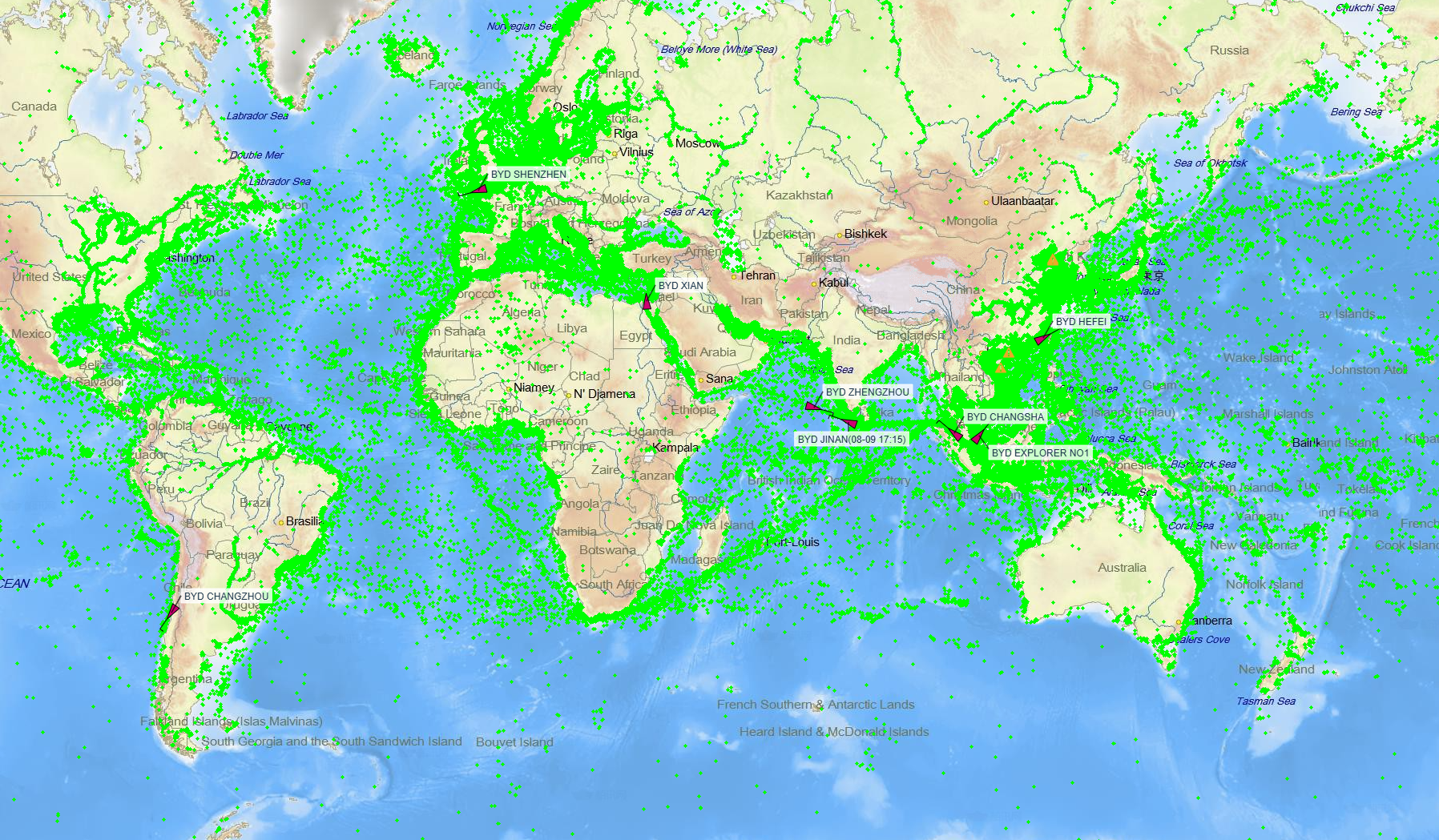
Real-time fleet tracking data shows that BYD’s eight automotive carriers are currently operating across some of the world’s most important maritime trade corridors, spanning the Strait of Malacca, the South China Sea, the Arabian Sea, the Suez Canal route and European waters.
The fleet includes BYD Changsha, BYD Changzhou, BYD Explorer No.1, BYD Hefei, BYD Jinan, BYD Shenzhen, BYD Xi’an and BYD Zhengzhou. Together, these vessels form the maritime backbone of BYD’s overseas vehicle delivery strategy.
Eight Vessels, One Global Automotive Logistics Network
Unlike traditional automakers that typically rely on third-party shipping companies, BYD is building a more vertically integrated export system. Its dedicated car carriers allow the company to gain greater control over shipping schedules, delivery reliability and overseas market expansion.
The latest fleet positions show a clear global footprint:
- BYD Shenzhen is operating near the English Channel, linking Asian production capacity with European markets.
- BYD Xi’an is positioned near Port Said, Egypt, a key gateway for vessels moving through the Suez Canal.
- BYD Jinan is sailing through the Laccadive Sea, another important segment of the Asia-Europe route.
- BYD Zhengzhou is crossing the Arabian Sea after departing from the Suez region.
- BYD Changsha is passing through the Strait of Malacca, one of the world's busiest maritime chokepoints.
- BYD Explorer No.1 is operating in the South China Sea after calling at Singapore.
- BYD Hefei is sailing along China's southeast coastal waters after departing from Singapore.
- BYD Changzhou is operating in the South Pacific, supporting long-distance export routes toward Latin America.
Europe Remains the Core Battlefield
The current fleet deployment highlights Europe as one of BYD’s most strategically important overseas markets.
BYD Shenzhen, with an IMO number of 9993963, is currently navigating near the English Channel at approximately 15 knots after previously calling at Wilhelmshaven, Germany. Its position reflects the importance of northern European ports in BYD’s export network.
BYD Xi’an is located near Port Said, Egypt, another critical point along the Asia-Europe shipping corridor. The vessel’s location demonstrates how Chinese EV exporters are increasingly relying on predictable maritime routes connecting Asian factories with European distribution networks.
For Chinese EV manufacturers, logistics capacity has become a strategic asset. As competition intensifies in Europe, controlling the final delivery chain becomes as important as developing competitive vehicles.
The Strait of Malacca: The Gateway of BYD’s Global Expansion
Several BYD vessels are currently positioned along the Indo-Pacific maritime corridor.
BYD Changsha is sailing through the Strait of Malacca at around 17 knots, following a previous stop in Singapore. The route is one of the most important maritime passages connecting China with Europe, the Middle East and Africa.
BYD Explorer No.1, the company’s first dedicated vehicle carrier, is also operating near Southeast Asia after departing Singapore, maintaining a speed of nearly 18 knots.
These routes highlight the strategic importance of Southeast Asian waters in BYD’s global logistics architecture.
BYD Zhengzhou and Changzhou Expand Beyond Europe
BYD’s maritime strategy is not limited to Europe.
BYD Zhengzhou is currently sailing through the Arabian Sea after departing from the Suez region, reflecting growing connectivity between China and Middle Eastern markets.
BYD Changzhou is operating in the South Pacific after previously calling at San Antonio, Chile, showing BYD’s increasing presence in Latin American markets.
Latin America has become an important growth region for Chinese EV manufacturers, with Brazil, Mexico and Chile emerging as key destinations for new energy vehicle exports.
A Fleet Designed for the EV Export Era
The eight BYD carriers share several characteristics:
- LNG dual-fuel propulsion systems designed to reduce emissions.
- Large vehicle capacity ranging from approximately 7,000 to more than 9,000 vehicles per vessel.
- Dedicated roll-on/roll-off vehicle transport capability.
- Ability to support long-distance intercontinental export routes.
The fleet represents more than transportation capacity. It reflects a broader transformation in the global automotive industry, where manufacturers increasingly compete not only through technology and products, but also through supply chain control.
From Car Manufacturer to Global Mobility Platform
BYD’s vessel network demonstrates a strategic shift: the company is moving from simply exporting vehicles to managing the infrastructure behind global vehicle distribution.
As Chinese automakers expand overseas, shipping capacity, port access and logistics reliability are becoming critical competitive factors. BYD’s fleet gives the company greater independence in an increasingly complex global automotive market.
The ocean has become the next arena of EV competition — and BYD is building its own route map.
BYD Global Fleet Status — August 10, 2026
| Vessel | Current Area | Previous Port | Speed | IMO |
|---|---|---|---|---|
| BYD Shenzhen | English Channel | Wilhelmshaven, Germany | 15.3 knots | 9993963 |
| BYD Xi'an | Port Said, Egypt | Port Said | 0 knots (port operation) | 9993975 |
| BYD Jinan | Laccadive Sea | Singapore | 15.9 knots | 9993951 |
| BYD Zhengzhou | Arabian Sea | Port Said | 16.6 knots | 9999577 |
| BYD Changsha | Strait of Malacca | Singapore | 17.3 knots | 9993949 |
| BYD Explorer No.1 | South China Sea | Singapore | 17.7 knots | 9955181 |
| BYD Hefei | China Southeast Coast | Singapore | 9.7 knots | 9999565 |
| BYD Changzhou | South Pacific | San Antonio, Chile | 6.4 knots | 9955076 |