
The debate over China’s so-called “fast-tracked cars” has never really been about whether a new model should take 18 months, 20 months or three years to reach the road.
The argument is about safety, not speed
At its heart is a more difficult question: how much engineering validation can an automaker compress before speed begins to come at the expense of safety?
The extraordinary growth phase of China’s auto industry has rewarded rapid product launches, faster software cycles and aggressive iteration. Yet as the market matures and Chinese brands expand overseas, the industry is being forced to confront a more traditional discipline of carmaking: engineering rules cannot be negotiated away simply because competition is intense.
Few phrases have generated more friction in China’s auto sector in 2026 than “fast-tracked cars”. From the China Auto Chongqing Forum in June to the China Automotive Forum in July and the Chengdu Motor Show in August, senior executives repeatedly returned to the subject.
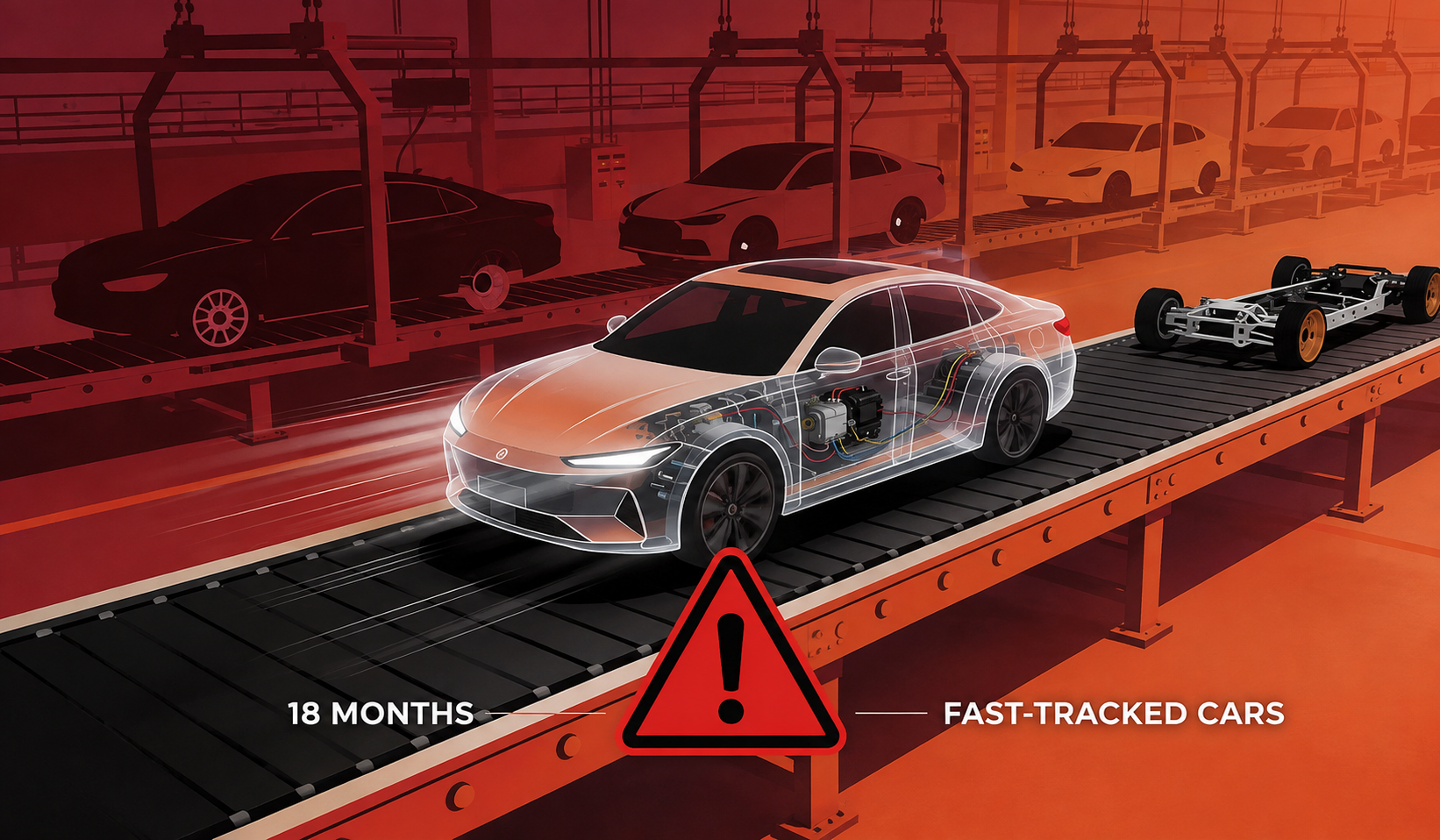
Geely chairman Li Shufu warned of the long-term consequences of taking shortcuts in vehicle development. Beijing Hyundai executive Li Fenggang argued that consumers were being turned into test drivers. Voyah chief executive Lu Fang pushed back against the idea that a shorter development cycle automatically meant a poorly developed car. Mercedes-Benz and BMW also released videos that appeared to satirise the industry’s rush to accelerate vehicle development.
The debate moved from industry rhetoric to regulatory action on August 26, when China’s Ministry of Industry and Information Technology, or MIIT, said products that had not undergone sufficient testing and verification must not be allowed onto the market. A day later, MIIT joined the Ministry of Public Security, the Ministry of Ecology and Environment and the State Administration for Market Regulation in launching a year-long campaign focused on vehicle production consistency and quality improvement.
The policy signal is clear. The more important question is what it means for an industry whose competitive model has increasingly been built around shorter development cycles, faster launches and relentless product replacement.

How China’s product race compressed the development clock
In the era of conventional combustion-engine vehicles, a completely new model would typically require more than 36 months from project approval through engineering, testing and final production validation. As competition in electric and electrified vehicles intensified, that timetable began to shrink. Development cycles of around 20 months, 18 months or even less became increasingly common.
The pressure to move faster has coincided with a sharp deterioration in industry profitability. During the first half of 2026, 630 new vehicle models were launched in China, equivalent to roughly 3.5 launches a day. At the same time, the average profit margin in vehicle manufacturing fell to 1.5%, its lowest level in nearly a decade.
That combination has created a difficult feedback loop. Automakers launch more vehicles to defend market share, product cycles become shorter, development spending is spread across more programmes and margins become thinner. The weaker the economics become, the stronger the pressure to accelerate the next launch.
Li Shufu’s comments in Chongqing were among the first high-profile warnings from a major Chinese automaker during the latest round of criticism. The argument became far more specific when Beijing Hyundai’s Li Fenggang said some manufacturers were compressing programmes by skipping parts of the validation process, including carrying out only one of the two core DV and PV stages.
That allegation shifted the debate away from vague criticism of “too much speed” and towards the mechanics of vehicle development itself. Design Verification and Production Validation are not marketing milestones. They are intended to expose engineering weaknesses before vehicles reach customers at scale.
Regulators had already begun to respond. On July 17, MIIT’s equipment-industry division convened a meeting with major vehicle manufacturers and asked companies to examine production-consistency issues across their own operations and supplier networks. During August, executives from Great Wall Motor, XPeng, SAIC-GM, Voyah and Chery publicly discussed their approaches to development and validation. By the Chengdu Motor Show, videos from BMW and Mercedes-Benz had pushed what was once an industry discussion into wider public view.
The reason the argument has persisted is that it touches the most valuable asset in the auto business: trust. A price war is visible. Buyers can see discounts and compare transaction prices. A shortened durability test, an omitted validation procedure or an inadequately proven component is largely invisible until a problem emerges in real-world use.
As launch cycles become faster, consumers are being asked to make judgments about engineering work they cannot see. That makes confidence in the manufacturer itself increasingly important.
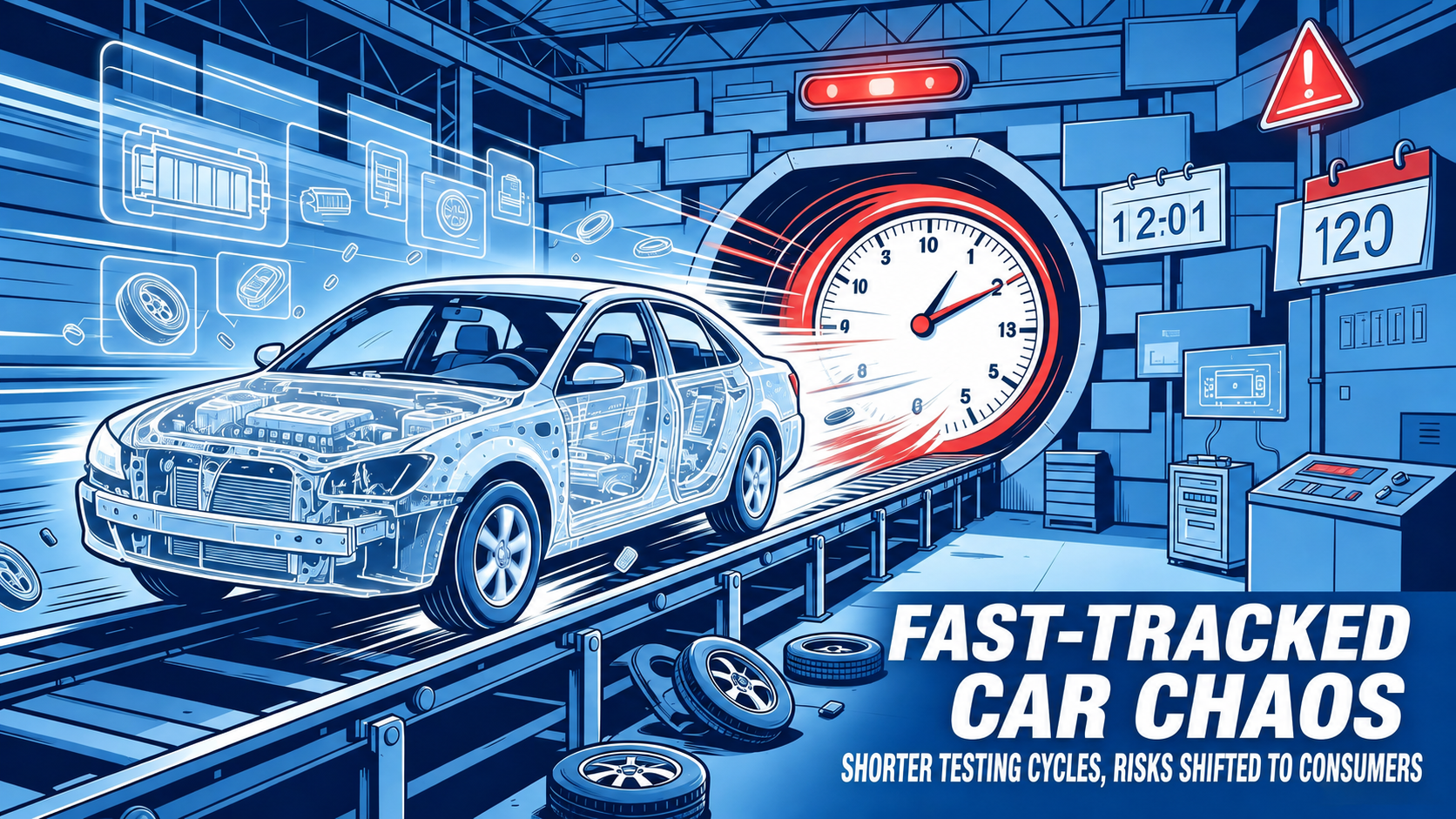
Everyone condemns “fast-tracked cars” — but nobody names one
There is an awkward feature to the debate. Almost every automaker insists it does not build “fast-tracked cars”, yet few are willing to identify which competitors supposedly do.
Part of the reason is definitional. “Fast-tracked car” is not a formal legal category, and the industry has no universally accepted threshold separating efficient development from reckless compression. Voyah’s Lu Fang has argued that it is unfair to use the term as a broad label for Chinese new-energy vehicle makers or newer entrants simply because they develop cars more quickly.
Without a clear boundary, almost any fast-moving company can be accused by implication, while proving the accusation is far harder.
The deeper problem resembles a prisoner’s dilemma. In an intensely competitive market, manufacturers fear that moving slowly means surrendering a product window to rivals. No company wants to admit that it shortened testing because doing so would raise immediate questions about product safety. At the same time, manufacturers are reluctant to accuse specific competitors, in part because few companies can claim that every programme has followed exactly the same development timetable.
The result is a strange public spectacle: every company says it rejects “fast-tracked cars”, while the identity of the supposed offenders remains largely undefined.
The label still carries considerable commercial risk. A company associated with a price war may be seen as aggressive. A company associated with inadequate validation can be seen as unsafe. The second accusation cuts directly into the trust on which vehicle brands depend.
Recall data have added to those concerns. In the first half of 2026, recalls involving Chinese domestic-brand vehicles reached 308,431 units, up 681.2% from the same period in 2025. Recalls can result from many different causes and the figures do not, by themselves, prove that shorter development cycles are responsible. They have nonetheless reinforced a broader anxiety among consumers that first-wave buyers of newly launched vehicles can sometimes end up discovering problems that should have been found earlier.
That perception is especially damaging in a market where software, advanced driver-assistance systems, high-voltage architectures and new electronic systems are becoming more complex at the same time that product cycles are becoming shorter.
Beijing is turning an industry argument into an enforcement issue
MIIT vice-minister Xin Guobin gave the debate an official direction on August 26. He said irrational competition remained a significant problem and warned that some aggressive innovations were being installed in vehicles before sufficient experimental verification had been completed. Strengthening review, testing and validation is expected to become a priority during China’s next five-year planning period.
The message from regulators was direct: products that have not been adequately tested should not enter the market.
The following day, MIIT, the Ministry of Public Security, the Ministry of Ecology and Environment and the State Administration for Market Regulation launched a year-long nationwide campaign covering production consistency and quality improvement for road vehicles.
The crackdown did not emerge from nowhere. On January 21, MIIT issued updated vehicle-market-access review rules requiring conventional vehicles to complete at least 30,000 kilometres of reliability validation, with the requirement scheduled to take effect on January 1, 2027.
Under the current type-approval testing framework cited in the original rules, new-energy vehicles are subject to 15,000 kilometres of reliability validation. In July, China’s automotive standards authorities sought public comment on a proposal to raise the requirement for battery-electric, plug-in hybrid and fuel-cell vehicles to a common 30,000 kilometres.
The significance of the latest campaign is that the regulatory focus is moving from written standards towards enforcement in actual production. The programme covers four broad areas: production consistency, reliability, durability and validation of new technologies.
Regulators are expected to conduct on-site inspections at vehicle manufacturers and testing organisations and to sample mass-produced vehicles already on the market. Companies found to have serious compliance problems could be publicly named and face measures including suspension of vehicle approvals or restrictions that prevent affected vehicles from being registered.
The enforcement chain extends beyond automakers to testing organisations and the component supply base, while vehicle-registration authorities provide another point of control.
Among the available penalties, suspension of a model’s official approval would be particularly significant. If an approval is withdrawn or suspended, the affected vehicle could no longer be legally produced and sold. For manufacturers accustomed to managing competition through rapid launch cycles, that threat carries more weight than an ordinary financial penalty.
The biggest change may be to the economics of speed
For companies that have become dependent on compressed validation programmes, tighter enforcement could create short-term product gaps. If an existing model is found to have compliance or reliability problems while its replacement is still moving through a longer testing programme, the manufacturer could lose the ability to maintain its planned launch cadence.
That may be exactly the point.
For years, China’s auto market has rewarded speed with visibility, dealer traffic and temporary product advantages. A system that makes inadequate testing more expensive — through delayed approvals, failed inspections or disrupted registrations — changes the calculation. The competitive advantage shifts away from simply launching first and towards proving that a fast development process is also a robust one.
Stricter supervision does not necessarily mean that every automaker must return to a three-year development cycle. The more important distinction is between companies that shorten programmes through better digital engineering, modular architectures, simulation, stronger supplier integration and more efficient management, and those that save time by eliminating validation work.
The industry has a useful principle for that distinction: innovation can be aggressive, but validation should be conservative.
MIIT has continued to pursue reforms intended to improve the structure of vehicle manufacturing and the management of production qualifications. That suggests regulators are not trying to freeze product development or penalise genuine engineering efficiency. The target is a different model of acceleration — one that trades consumer safety for launch speed.
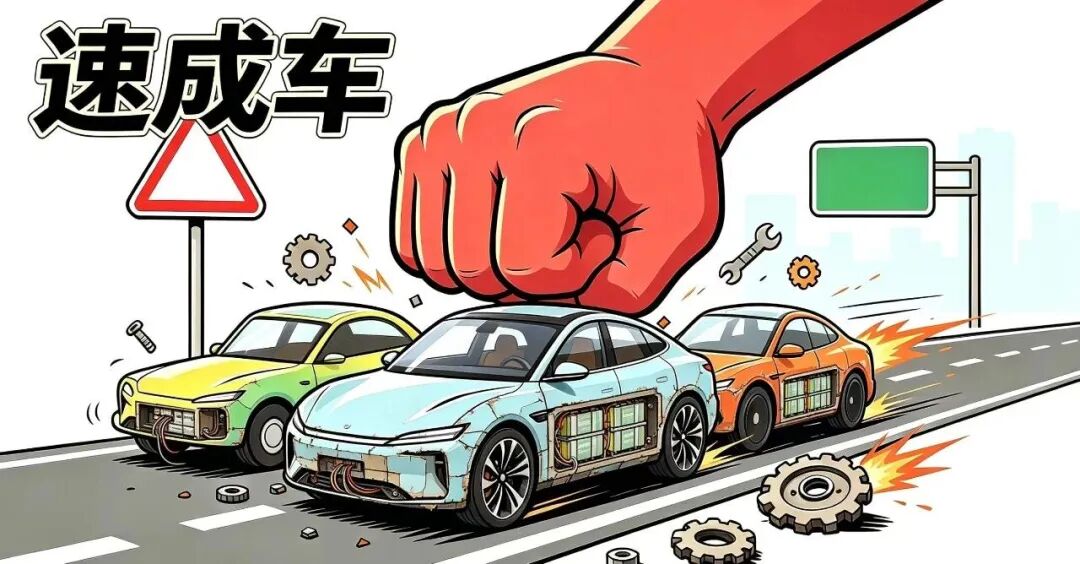
China’s global expansion raises the cost of getting it wrong
The controversy over “fast-tracked cars” reflects a broader anxiety inside China’s auto industry. Companies need speed to capture market share, but they also need engineering discipline to protect customers and preserve their brands. Those objectives are not always compatible when hundreds of models are competing for attention in a market with exceptionally thin margins.
Regulators now appear to be trying to redraw that balance. The question for automakers will no longer be simply how quickly a vehicle can be developed, but whether every required stage of testing and verification can be demonstrated when scrutiny arrives.
That matters beyond China. Chinese automakers are expanding rapidly into Europe, Latin America, Southeast Asia, the Middle East and other overseas markets. As their international presence grows, reliability and long-term durability will become as important to their global reputations as price, range, software or cabin technology.
A vehicle that reaches the market several months ahead of a rival may win an early sales window. A vehicle that performs reliably across different climates, road conditions and ownership cycles can build a brand.
China’s carmakers have already shown that they can compress product-development timelines and industrialise new technologies at remarkable speed. The next test is whether they can prove that faster engineering does not mean thinner engineering. If the latest regulatory campaign has a lasting effect, the country’s auto industry may find that the next phase of competition is less about who launches first and more about who can move quickly without compromising the work customers never see.