Mercedes-Benz is deepening its China technology strategy by buying into Qianli Technology, a Geely-linked assisted-driving company.
A stake in China's assisted-driving supply chain
Qianli Technology said Mercedes-Benz Shanghai Digital Technology would acquire a 3 per cent stake from Lifan Holdings at 9.87 yuan per share, for a total transaction value of about $186 million. After completion, Mercedes' digital unit will become Qianli's fifth-largest shareholder and has committed not to reduce its holding for 12 months.
The deal extends Mercedes' China cooperation from manufacturing and sales into one of the industry's most important technology fields: intelligent assisted driving. It also shows how Chinese smart-car technology is moving from being imported to being exported, licensed and embedded into global automakers' local strategies.
From Lifan to Qianli
Qianli Technology's background is unusual. It was once Lifan Technology, and before that Lifan Holdings, a company known for motorcycles before becoming one of China's early private-sector car stocks.
Lifan fell into debt trouble in 2020 and entered judicial restructuring. In 2021, with support from Chongqing Liangjiang New Area and Geely, the restructuring was completed. Geely became an important shareholder and began injecting management and business resources.
Geely and Lifan jointly established Livan Auto in January 2022. In February 2025, Lifan Technology was renamed Qianli Technology and adopted an "AI plus car" strategy focused on assisted driving and smart-cabin development.
The Mercedes investor, Mercedes-Benz Shanghai Digital Technology, is a wholly owned subsidiary of Mercedes-Benz China Investment. In September 2025, it was recognised as a foreign-invested R&D centre and is Mercedes' largest digital R&D centre globally. Its work covers advanced design, intelligent connectivity, electric mobility, automated driving, localisation and vehicle testing.
A wider Mercedes-Geely relationship
This is not the first connection between Mercedes and Geely. The two companies jointly developed smart, based on Geely's SEA architecture. Reports have also said Mercedes is working with ECARX, another Geely-linked technology supplier, on a facelifted long-wheelbase E-Class planned for 2027 that would become the first China-market Mercedes model using Flyme Auto.
The Qianli investment moves the relationship deeper into core technology. In June 2025, Qianli Technology, Geely Holding and other partners established Qianli Smart Driving, integrating teams from Geely Research Institute, Zeekr's assisted-driving unit and Maichi Zhixing. The platform is widely viewed as Geely's own version of an automotive technology unit.
Mercedes' capital entry gives that platform a global-brand endorsement and gives Mercedes another route into China-localised assisted driving.
Why Mercedes needs help
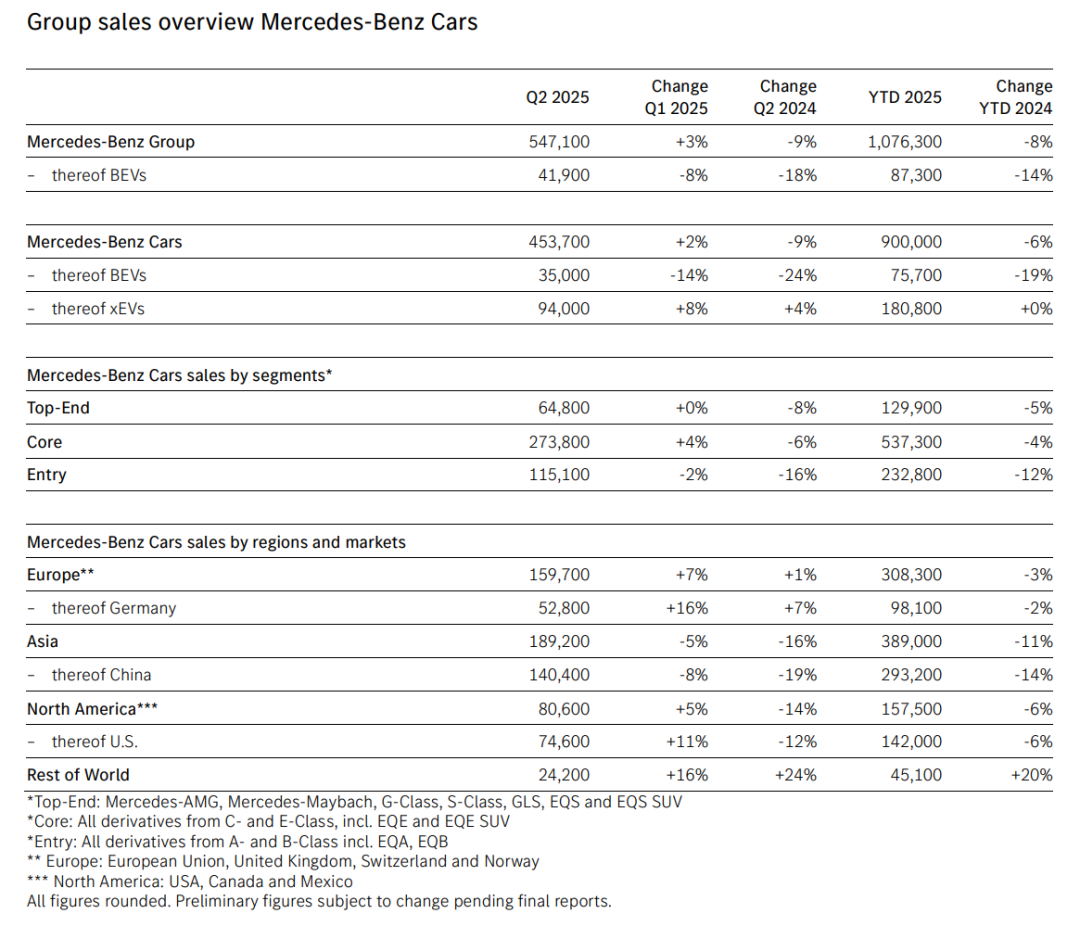
Mercedes is under pressure. In the first half of 2025, group revenue fell 8.6 per cent year on year to €66.377 billion, while net profit after tax dropped 55.8 per cent to €2.688 billion. Sales declined in all three core markets: China fell 14 per cent, the US 6 per cent and Europe 3 per cent. In the second quarter, China sales fell 19 per cent to 140,400 vehicles.
The pressure is not only cyclical. Mercedes has struggled to turn its luxury reputation into a clear advantage in China's electric and intelligent-vehicle market. After stepping back in March 2024 from its earlier 2030 all-electric plan and returning to a dual-track strategy for petrol and electric vehicles, intelligent driving has become one of the key routes to defend share.
Mercedes is now using a dual approach in China. It is working with Momenta on an assisted-driving system based on the flywheel large model for the new electric CLA, with training on local Chinese data, road tests involving more than 100 vehicles and large-scale simulation. The system is expected to support highway, urban and parking scenarios.
The Qianli investment is a longer-term platform bet. The article says the investment amount exceeds Mercedes' cumulative spending on Momenta. Together, the two partnerships give Mercedes both near-term technical deployment and longer-term R&D localisation.
Why Qianli rather than Huawei
Many observers ask why Mercedes did not simply choose Huawei. Huawei's assisted-driving technology is widely regarded as leading in China. Its intelligent automotive solutions business generated about $3.7 billion in revenue in 2024, up 474.4 per cent.
The issue is not only technical capability. It is control. Huawei's smart-selection model can involve deep participation in vehicle definition, hardware selection, smart-cabin and assisted-driving packaging, and even retail-channel influence. That model may work for some Chinese partners, but it is harder for a legacy luxury brand that wants to preserve its own brand identity and software control.
Reports have previously said Huawei proposed that Mercedes buy a small stake in its intelligent-car software and components company, but Mercedes showed limited interest because it wanted to retain control of group software operations and its premium positioning.
Qianli fits a different need. It offers speed, with its Qianli Haohan assisted-driving solutions moving from H1 to H9 levels and reaching mass production across the range in about six months. The H3 solution has reached Geely models around the roughly $14,000 level and even covers fuel cars, while the H9 solution uses dual NVIDIA Thor-U chips and has been deployed on Zeekr 9X.
Qianli's RLM large model uses base training, data specialisation and reinforcement learning to simulate extreme scenarios and build more human-like driving behaviour. In tests cited by the article, the system responds to pedestrians and irregular obstacles with smoother avoidance rather than abrupt braking, a characteristic that may suit Mercedes' definition of luxury driving.
Qianli also understands automakers. It is backed by Geely's industrial base of 3.38 million global annual sales and combines AI and automotive experience. Chairman Yin Qi founded Megvii, co-president Wang Jun was the first head of Huawei's automotive unit, and chief assisted-driving scientist Chen Qi previously worked on Huawei driving algorithms.
A control-friendly technology partner
For Mercedes, the attraction is clear. Qianli can provide advanced technology without taking over the brand, product definition or retail relationship.
That makes the deal part of a broader shift among global automakers in China. BMW, Audi and Mercedes are all turning to Chinese software, cabin and assisted-driving partners as German engineering meets China's faster intelligent-vehicle cycle.
The Qianli investment does not guarantee Mercedes will close the gap. It does show that the company has accepted a new reality: in China, smart-driving competitiveness will increasingly require Chinese technology partners, not only German engineering depth.