
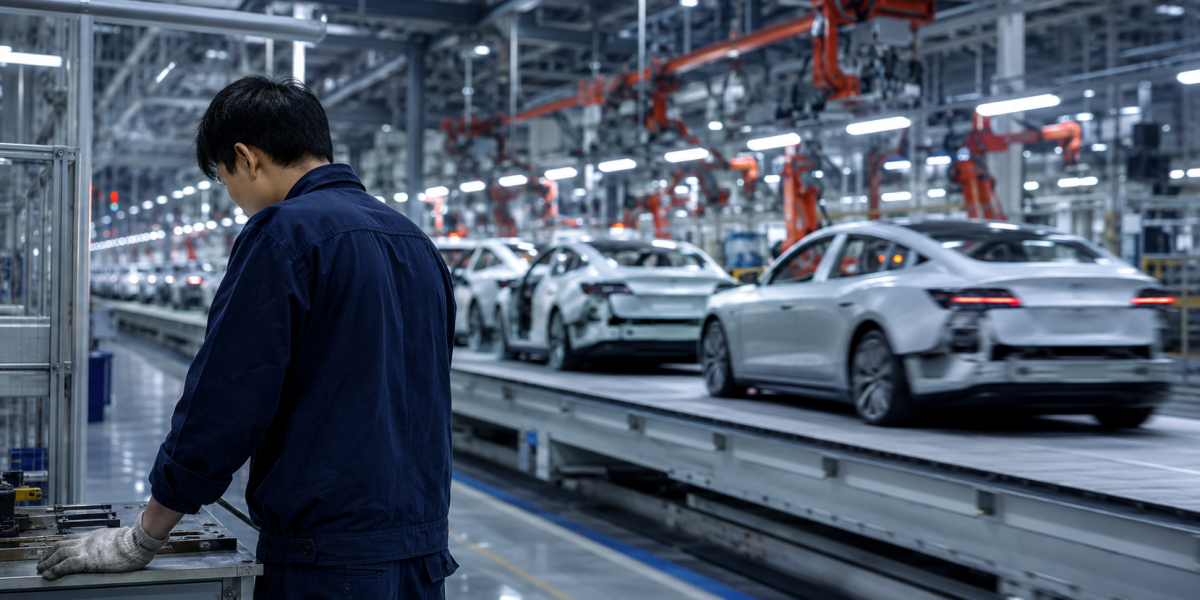
China's auto industry has become the world's largest new-energy vehicle battleground, but the industry's sprint is leaving many workers under pressure.
Growth numbers hide a human cost
Sales records, new-model launches and export milestones have become the public face of the sector. Behind them are factory workers, engineers, middle managers, dealership sales staff and suppliers carrying much of the cost.
The article uses a historical allusion about rushed delivery and hidden labour to describe a modern dilemma: when the industry treats sales numbers as the only fresh prize, it becomes easy to ignore the people asked to keep the system moving.
As "anti-involution" becomes a policy slogan, many workers are still left with forced choices, performance pressure and uncertain employment.
Factory workers face automation and layoffs
Automotive manufacturing is becoming highly automated. Several plants already have fully automated workshops in key processes, including Chery Jaguar Land Rover's all-aluminium body shop in Changshu, Beijing Hyundai's third-plant stamping workshop and critical processes at Xiaomi's auto factory.
Automation improves efficiency, but front-line workers often bear the direct cost of technical progress. The first half of 2025 brought a wave of global auto layoffs as companies responded to electrification costs, weaker demand and lower earnings.
Nissan has planned about 9,000 global job cuts. Volkswagen plans to cut more than 35,000 jobs by 2030. GM's autonomous-driving subsidiary Cruise is cutting roughly half its staff. Porsche plans about 3,900 job cuts by 2029, and Audi expects to cut about 7,500 positions in Germany by 2029.
The pressure is not limited to foreign automakers. Mercedes-Benz China began layoffs and staff talks in February, with a reported reduction of about 15 per cent. Social media also carries many reports of layoffs at Chinese new-energy start-ups, even when companies do not issue formal announcements.
Engineers are squeezed by faster cycles
Research engineers should be the people building core technology. Increasingly, many are being asked to support capital-market stories, launch schedules and marketing promises at a pace that leaves little room for deep development.
Vehicle launches and press events have become more frequent. At the 2025 Shanghai auto show alone, automakers and related exhibitors held 193 press conferences during the April 23-24 media days. Another 24 automaker press conferences had already been held that month before the show.
The presentations often promise L3 autonomous driving, full-scenario parking and vehicle-road coordination. Behind the slides, engineers face shrinking development windows and heavier performance evaluation.
Social media posts cited in the article describe programmes moving from new design to production in only 10 months, and from design freeze to production in eight months. Others describe an industry in an almost frantic state, with development cycles compressed faster than teams can absorb.
Middle managers are trapped between process and changing strategy
Middle managers once acted as the axle between executive strategy and front-line execution. Now they are caught between increasingly rigid processes and sudden changes in leadership priorities.
As automakers grow, approval systems become more complex. One middle manager cited in the article said a single equipment-purchase request needed signatures from eight departments and at least 20 days of review, even though market conditions can change far faster.
Strategic direction can also shift quickly. One day the instruction may be to focus entirely on electrification. The next may be to protect the petrol-car base. Soon after, intelligent vehicles may become the top priority. Middle managers must keep changing team direction while still meeting targets and maintaining morale.
Dealership sales staff become data workers
Car sales have moved from showrooms into livestreams, reshaping the work of 4S dealership staff. Salespeople who once relied on product knowledge and service skills are now expected to act as livestream hosts and short-video producers.
One dealership salesperson cited in the article said the target had moved from 60 livestreams and 100 videos per month to 100 livestreams and 100 videos per month from March, with performance penalties for missing targets.
To meet data requirements, some sales staff use gimmicks, giveaways or exaggerated promotions to attract viewers. Livestream activity does not always convert into real sales, and it can also undermine customer trust in pricing.
As 4S stores withdraw from networks or face falling profitability, the dealer-led sales model is weakening. Direct sales and e-commerce channels are replacing parts of the old system, creating career insecurity for many dealership employees.
Suppliers doubt payment-term reform will be enough
Supplier salespeople face another version of the squeeze: higher research standards, shorter development cycles, lower prices and thinner margins. Many component suppliers are being asked to deliver more quickly for less money.
Automakers recently announced that supplier payment terms would be shortened to 60 days. On paper, that should help. Traditional payment terms often exceeded 90 days, and smaller suppliers could be stretched to 120 days.
Yet many industry workers are sceptical. One widely supported online comment argued that delayed acceptance, delayed inspection, delayed invoicing and transferred obligations could make actual payment cycles even longer. Others worried that automakers could use the policy shift as a reason to demand further supplier price cuts.
Supplier sales teams are caught between automakers pressing down procurement prices and their own companies raising performance demands. They sit in the middle of an industrial bargaining contest with limited control over either side.
Anti-involution must reach workers
Policy language around anti-involution is growing stronger, and some automakers have started to step away from the most aggressive price tactics. But for workers inside the industry, the arrival point still feels distant.
China's auto success has been built on speed, pressure and scale. If the industry wants healthier growth, it must ask who has been paying for that speed. A market cannot become truly high quality if its front-line workers, engineers, managers, sales staff and suppliers remain disposable parts of the race.