
Changan Automobile's first-quarter results looked alarming at first glance. Revenue fell 4.26% year on year to about $4.554 billion, while net profit attributable to shareholders dropped 74.09% to roughly $49 million, the weakest first-quarter showing in five years. For some investors, the numbers appeared to point to a deepening earnings crisis.
A Profit Shock That Needs Context
That reading misses an important part of the story. Changan is not simply losing momentum. It is taking a deliberate step back, absorbing short-term profit pressure in order to prepare for a more forceful push into electric vehicles, higher-value models and overseas markets.
The sharp fall in reported profit was driven largely by the comparison with an unusually strong base a year earlier. In the first quarter of last year, Changan booked financial expenses of minus $150 million, effectively reflecting sizable foreign-exchange gains. In the latest quarter, financial expenses turned positive at about $44 million. That swing alone created a gap of nearly $194 million.
Other non-recurring items also moved against the company. Government subsidies and related gains fell 53.6% year on year to roughly $26 million. Taken together, these factors explain much of the decline in headline profit and make the drop look more severe than the underlying business performance suggests.
Stripping out the effect of foreign-exchange gains and losses, some analysts argue that Changan's quarterly net profit attributable to shareholders would have increased from a year earlier. More important, the company's gross margin rose to 14.08%, up 0.21 percentage points year on year. In a Chinese car market defined by weaker demand and relentless price competition, a rising gross margin suggests that Changan's core business remains intact.
The Shift Toward Higher-Value Models
Changan's product mix is also improving. The average selling price of its self-owned brands reached about $12,000 per vehicle, up 29.8% from a year earlier. That points to a larger contribution from higher-value models and suggests that the group's brand-upgrading strategy is beginning to show results.
The overseas business has become another increasingly important pillar. Changan sold 212,600 vehicles outside China in the first quarter, up 33.2% year on year. Overseas sales accounted for 38.1% of total volume, a jump of 15.5 percentage points from the previous year. From its plant operations in Thailand to channel expansion in Europe and Egypt, Changan's globalisation strategy is moving beyond simple exports toward a more durable international presence.
Still, the profit decline was not the only number that deserved attention. Operating cash flow fell to minus $1.609 billion, down 232.71% year on year. Accounts receivable rose from about $585 million to $1.630 billion, while accounts payable dropped from roughly $4.150 billion to $2.396 billion. That combination suggests Changan is being squeezed from both sides of the value chain. If sales fail to recover, cash pressure could become a more serious issue than the headline earnings decline.
From Scattered Resources to System Efficiency
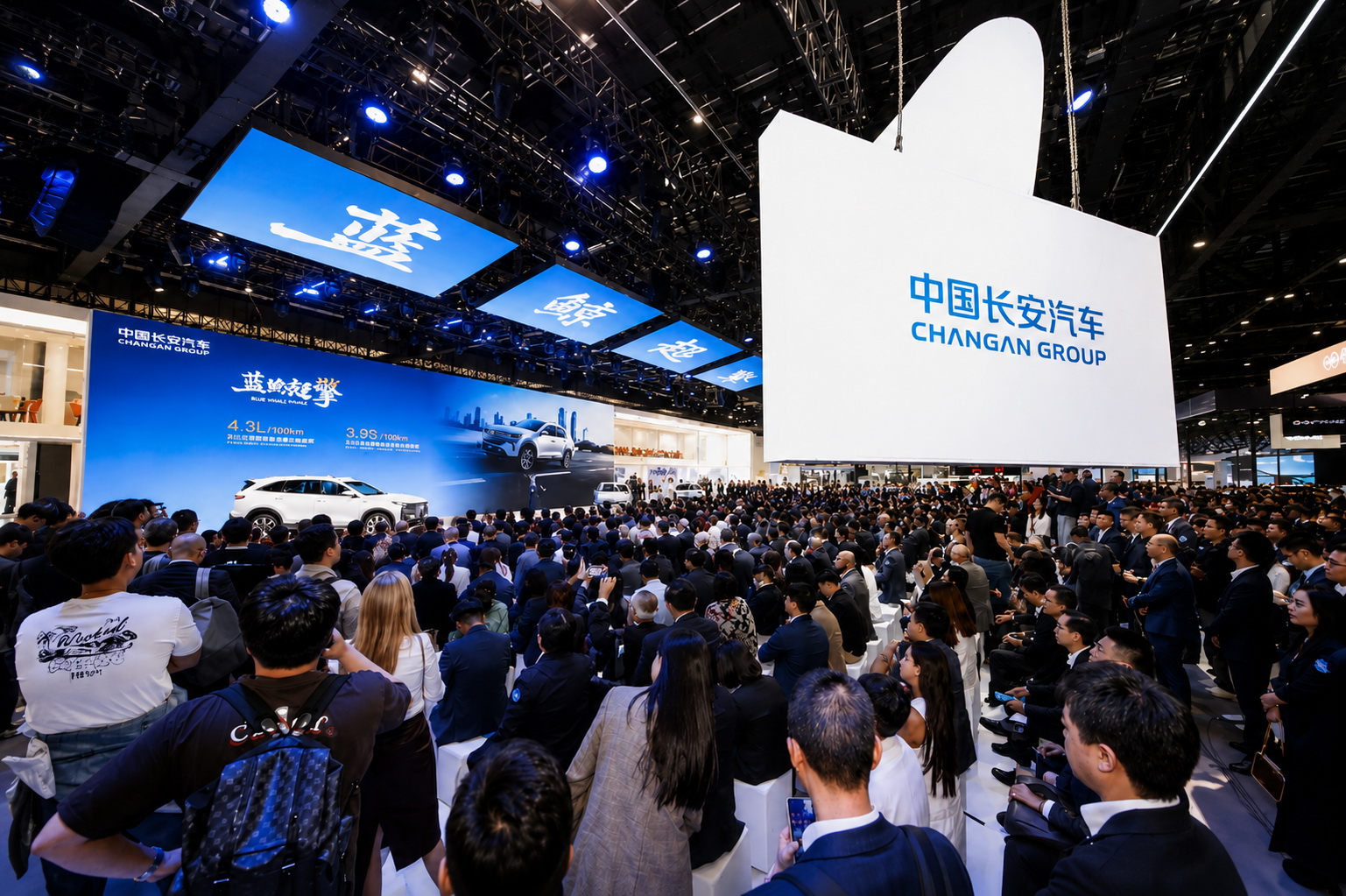
The first-quarter earnings swing is best understood as one signal of a deeper restructuring. On April 21, 2026, Changan Automobile Group unveiled its "1445" global strategy for 2030, setting out an ambition to become a world-class automaker. The plan targets 2.4 million new-energy vehicle sales, more than 1.5 million overseas sales, revenue of about $83.565 billion and a place among the world's top 10 automakers by 2030.
The most closely watched part of the plan is the strategic integration of Avatr and Deepal, Changan's two major new-energy brands. Both brands had previously operated with a high degree of independence, which helped them build distinct identities but also created duplicated resources and internal inefficiencies.
Chairman Zhu Huarong described the new structure as "independent front ends, shared middle and back ends". In practice, Avatr and Deepal will keep separate brand positioning, product design, user operations and market identities. Research and development, supply chains, manufacturing systems and data capabilities will be shared more deeply.
Changan expects the integration to cut common resource costs by 20% to 30%. The point is not to dilute the brands. It is to give them a stronger cost base and greater execution efficiency while preserving their separate customer appeal.
The group is also moving ahead with a more aggressive product rationalisation. Its future product matrix will be reduced to 36 models, cutting the number of vehicle lines by about 43%. Zhu has described the shift bluntly: Changan can no longer focus on volume first and profit later. From this year, it must give equal weight to scale, margin and efficiency.
Avatr, for its part, remains in a sensitive phase as it prepares for a Hong Kong listing. Some observers had worried that the integration with Deepal might disrupt that process. Avatr Technology president Chen Zhuo said after the launch of the Avatr 06T that the Hong Kong IPO plan remains on track and will continue through the regulatory process before a market window is chosen.
China's Price War Forces a Rethink
Changan's restructuring is not happening in isolation. It reflects a broader problem across China's auto industry: sales volumes are rising in some areas, but revenue quality and profitability are under intense pressure.
At the start of 2026, more than 16 major automakers and nearly 70 models were pulled into a fresh round of price cuts. Average discounts on new-energy vehicles reached 13.7%, while internal-combustion models saw cuts of 14.3%. Data from the China Passenger Car Association showed that the auto industry's profit margin fell to 2.9% in January and February, far below the 5.8% average for downstream industrial companies over the same period.
The cost structure has also become more difficult. Batteries and chips now account for 50% to 60% of the cost of intelligent electric vehicles. Suppliers of core upstream components have continued to capture profits, while automakers have been left with a shrinking share of the margin pool. The partial rollback of China's new-energy vehicle purchase-tax exemption from January 1, 2026 has added another layer of cost pressure.
What was once an occasional decision to sell at thin or negative margins has become a persistent industry condition. Changan's response is to reduce duplication, focus its product portfolio and strengthen the businesses that can support both volume and profitability.
The Race for Survival Is Getting Tougher
China's auto market is entering a decisive phase. At Changan's global strategy event, Zhu Huarong said the global vehicle market could reach 100 million units by 2030, while the threshold for entering the top 10 global automakers may rise to annual sales of 8 million to 10 million vehicles.
Changan sold 2.913 million vehicles in 2025. That was enough to clear the basic line for survival in a consolidating industry, but it remains well short of the scale likely to define the next group of global leaders.
That is why the company's first-quarter moves matter. Cost cutting, brand integration, product focus and overseas expansion are not defensive gestures alone. They are part of a deliberate crouch before a harder jump. Changan is accepting a period of profit pain in an effort to secure a place in the next stage of the global auto industry.