
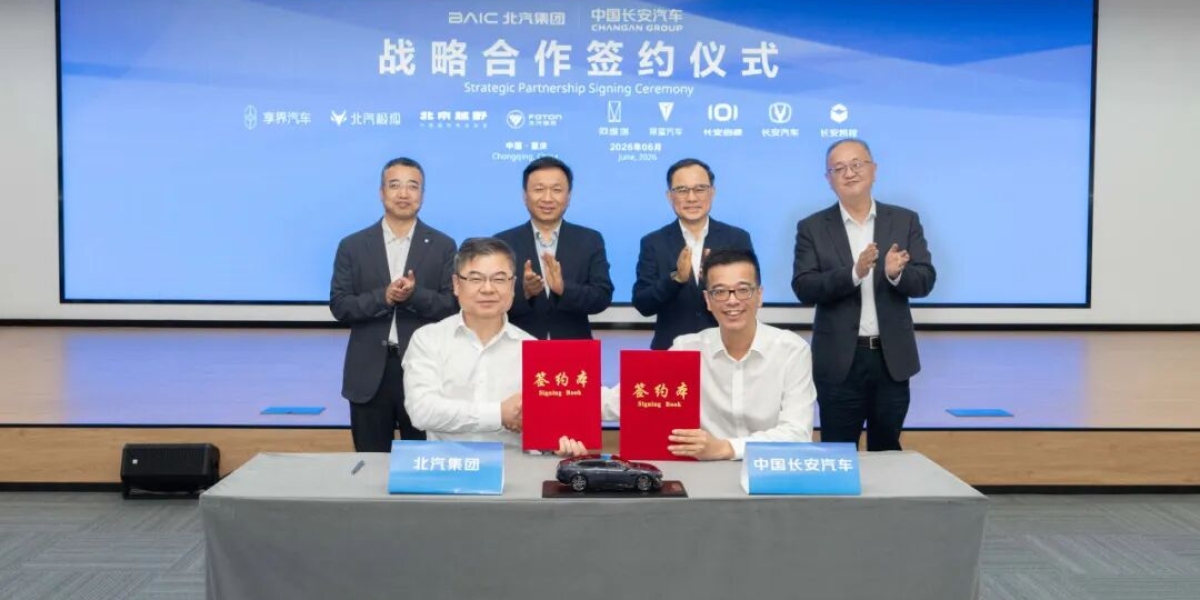
Strategic partnerships have become routine in China's car industry, from supply-chain coordination to overseas distribution and shared platforms.
More than another strategic handshake
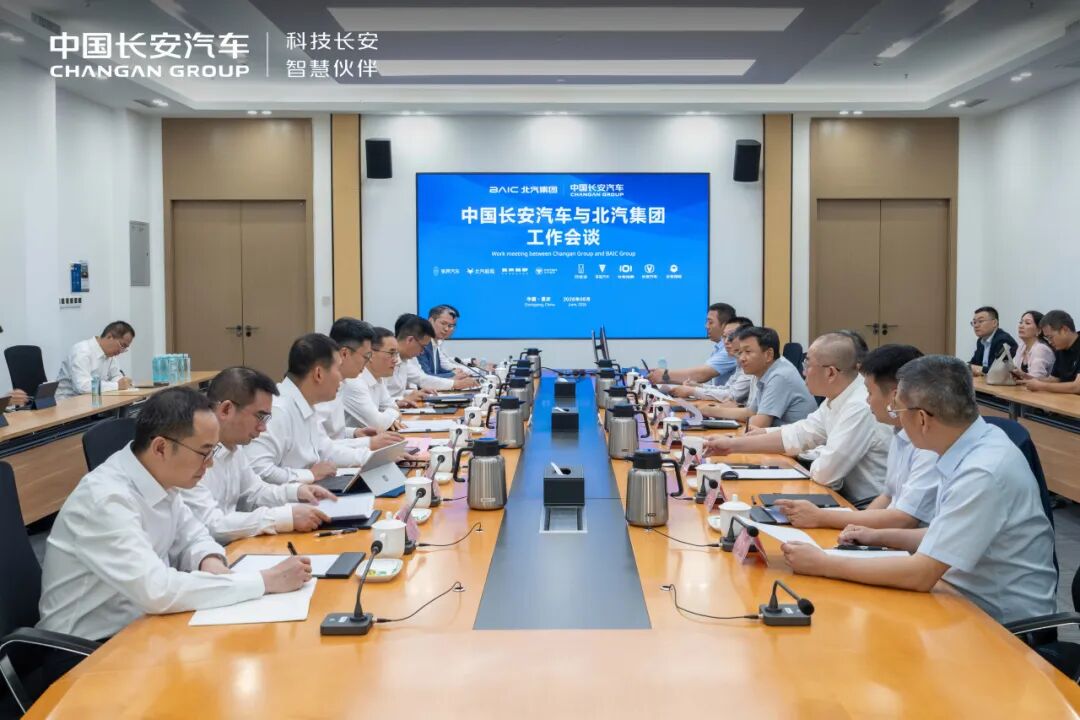
Yet the agreement signed by Changan Automobile and BAIC Group in Beijing on June 13 carries unusual weight.
The companies said they would cooperate in forward-looking technologies and emerging industries, green and low-carbon development, industrial and supply chains, and overseas market expansion. On the surface, it reads like another broad corporate alliance. The distinction is that Changan and BAIC are the only two carmakers in China to have received production access for Level 3 conditional automated driving.
Changan's Deepal SL03 uses its self-developed Tianshu intelligent-driving system. BAIC's Arcfox Alpha S uses Huawei ADS. One is testing in the complex, congested road environment of Chongqing; the other is focused on major expressway corridors around Beijing. Their cooperation could become a northern-southern meeting point in China's effort to define L3 deployment.
Why L3 access matters
Level 3 is separated from familiar Level 2 driver assistance by a legal and technical boundary. In Level 2, the driver remains fully responsible even when assistance systems are active. In Level 3, within defined operating conditions and when the system is active without issuing a takeover request, the manufacturer begins to bear corresponding product responsibility.
China's Ministry of Industry and Information Technology has set a high bar. Steering, braking, power supply and control systems must use double redundancy so that a single-point failure does not prevent a safe fallback. Vehicles must pass closed-course testing, public-road testing and simulation validation, with hundreds of thousands to millions of equivalent kilometres and no major safety incidents.

This is not a feature that can be created through a simple software update. The vehicle must be redesigned around hardware architecture, redundancy, sensors, control logic and data recording.
On December 15, 2025, the ministry announced China's first production-access approvals for L3 automated-driving models, with Changan Deepal SL03 and BAIC Arcfox Alpha S both included. Their technical paths are highly different, which makes cooperation attractive and difficult at the same time.
Two routes into conditional automation
The Deepal SL03 uses Changan's own Tianshu system and has undergone 5 million kilometres of road testing. It relies on multi-sensor fusion using 4D imaging millimetre-wave radar, high-definition cameras and ultrasonic radar. The pilot is focused on Chongqing's complex traffic environment and is limited to designated sections such as inner-ring expressways and Yudu Avenue. Operation is restricted to single-lane automated driving in congestion on highways and urban expressways, with a top speed of 50km/h.

The value of this route is city complexity. Changan is trying to prove that a self-developed L3 system can work in dense, demanding road conditions rather than only on cleaner highway routes.
The Arcfox Alpha S takes another approach. It uses Huawei Qiankun ADS 3.3, three Hesai AT128 lidar units and 34 high-performance perception components, creating all-around environmental sensing. Key systems such as steering, braking and power supply use aviation-inspired double redundancy. The permitted top speed reaches 80km/h, and the pilot area is limited to Beijing's core highway corridors, including the Beijing-Taipei Expressway and Daxing Airport Expressway.
That is a higher-sensing, higher-redundancy route designed to show the performance ceiling of current production advanced driver assistance. Together, the two programmes cover different sides of China's L3 challenge: complex urban congestion in the south-west and higher-speed highway operation in the north.
The hard walls around data sharing
The most obvious strategic opportunity is data. In theory, Changan could contribute low-speed congestion data from Chongqing, while BAIC could contribute highway operation experience from Beijing. Together, they could accelerate the transition from limited-route pilots to broader L3 coverage. They could also push for clearer insurance rules, road-right policies and accident-determination frameworks.
In practice, three barriers stand in the way.
The first is technical incompatibility. Changan's system is built around a different sensor and software architecture from Arcfox's lidar-heavy Huawei solution. Data formats, labelling methods and algorithm interfaces may differ substantially. Turning those datasets into a shared resource would require extensive standardisation work.
The second barrier is regulation and safety. L3 production vehicles are required to carry automated-driving data recording systems, but rules on data ownership, retention, cross-company access and legal procedure remain incomplete. Large-scale data sharing between two state-linked groups would require a clear compliance path.
The third barrier is Huawei. The Arcfox Alpha S derives its core L3 capability from Huawei ADS, and the ownership and usage rights for intelligent-driving data are governed by agreements between BAIC and Huawei. BAIC cannot freely dispose of all related raw data. Any deeper sharing involving that system would likely require Changan, BAIC and Huawei to negotiate together.
That makes data sharing a strategic direction rather than a guaranteed outcome. State-owned enterprise partnerships in China can produce strong announcements and slow execution. The value here will depend on whether the companies can move beyond signing ceremonies into technical and regulatory coordination.
Financial pressure makes cooperation more practical
The business context explains why the two companies are looking for partners. Changan sold 2.913 million vehicles in 2025, up 8.5% and the highest level in nearly nine years. New-energy sales exceeded 1.109 million vehicles, up 51%. Revenue reached about $22.84 billion, up 2.67%. Yet net profit attributable to shareholders fell from about $1.02 billion to about $568 million, down 44.34%.
The reason is familiar across China's car industry: scale is rising, but profits are being absorbed by investment. Changan's 2025 research and development spending reached about $1.75 billion, up 24%, equal to 7.67% of revenue. It plans to keep annual R&D spending above 5% of revenue during the next five-year planning period. Its Deepal, Qiyuan and Avatr new-energy brands, along with deeper cooperation with Huawei and CATL, have built scale without yet delivering enough margin.
BAIC BluePark faces sharper pressure. In 2025, revenue reached about $3.89 billion, up 92.53%, while annual sales rose 84.06% to 209,600 vehicles. The Arcfox brand sold 161,000 vehicles, up 99%. Yet the company still posted a net loss attributable to shareholders of about $636 million, narrowed from a loss of about $968 million in 2024. Its full-year gross margin recovered to 0.43%, still below the industry average.
BAIC is therefore in a delicate position: revenue is rising quickly, losses are narrowing and cash flow has improved, but profitability remains distant. Arcfox is using value-for-money positioning to lift sales, while Huawei-linked models have strengthened brand attention. The front-loaded investment burden remains heavy.
The wider market adds urgency. In the first quarter of 2026, China's auto-industry sales profit margin was only 3.2%, while total industry profit fell more than 18% year on year. Few companies can afford to carry the multi-billion-dollar cost of L3 automated driving alone.
A pragmatic path through an expensive race
That is why the most meaningful parts of the Changan-BAIC agreement may be less dramatic than full data integration. Joint procurement of batteries, chips and other core parts can improve bargaining power. Shared capacity can reduce manufacturing redundancy. Coordinated R&D can reduce duplicate spending in autonomy and next-generation platforms.
The partnership does not guarantee a new industry order. Changan and BAIC still have different systems, different technology partners and different commercial priorities. Yet their agreement marks a useful step toward shared development in higher-level automated driving, where cost, regulation and safety are becoming too large for isolated efforts.
For China's L3 market, the central question is whether these two approved players can turn complementary pilots into common standards. If they can, the alliance may influence not only their own products, but the rules by which China's next generation of automated vehicles reaches public roads.