BYD’s Australia Expansion Accelerates as Monthly Sales Approach 9,000 Units
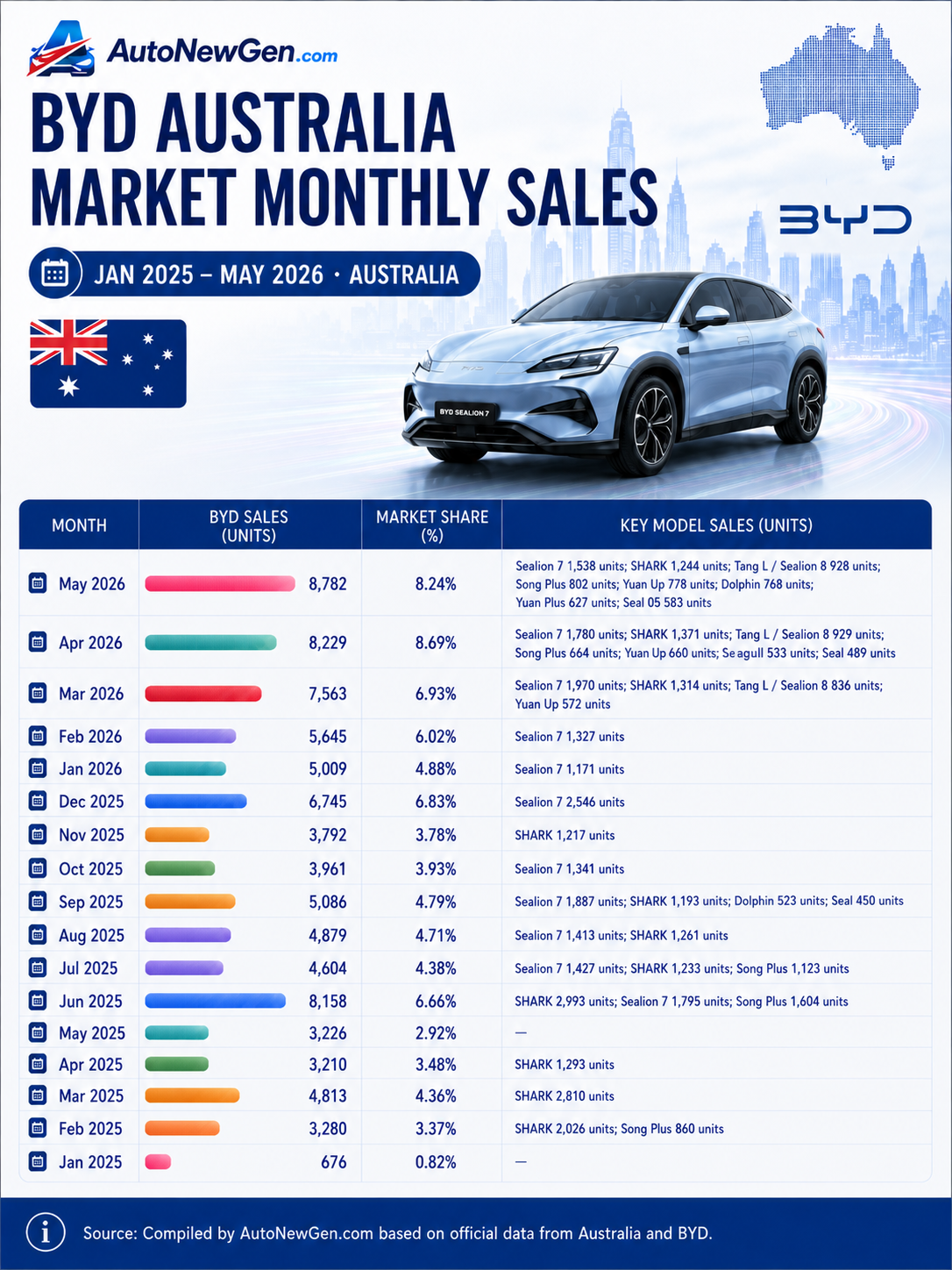
Australia has emerged as one of BYD’s fastest-growing overseas markets, with monthly deliveries rising to 8,229 units in April 2026 and peaking at 8,782 units in May 2026, according to compiled registration data covering January 2025 to May 2026.
With a population of just under 30 million, Australia now ranks among BYD’s most important export destinations, though still well behind China’s domestic market. The country has also become one of the company’s most consistent high-growth right-hand-drive markets.
Demand driven by income levels, policy structure, and fuel costs
The expansion is being supported by a combination of structural factors.
Australia’s relatively high household income levels—estimated at several times those in many emerging markets—have supported strong demand for mid- to upper-tier electric vehicles. At the same time, under the China–Australia Free Trade framework, Chinese-made EVs face no import tariffs, allowing BYD to price competitively against both Japanese incumbents and Western brands.
Fuel costs have also remained a persistent tailwind. Elevated petrol prices, driven in part by global energy volatility, have continued to accelerate the shift toward electrified powertrains.
Rather than a single driver, analysts describe the market as a convergence of pricing competitiveness, policy openness, and cost-of-ownership economics.
Model mix led by Sealion 7, Shark and Sealion 8
BYD’s Australian sales remain relatively concentrated in a small number of high-volume nameplates.
In May 2026, the best-selling model was the Sealion 7 with 1,538 units, followed by the Shark pickup at 1,244 units. The locally designated Sealion 8 (Tang L) contributed 928 units, while the Song Plus (802 units) and Yuan Up (778 units) also maintained steady volumes.
Smaller EVs such as the Dolphin (768 units) and Yuan Plus (627 units) followed, while the Seal (583 units) continued to play a niche role in the lineup.
In April 2026, the Sealion 7 reached an even higher level at 1,780 units, alongside Shark (1,371 units) and Sealion 8 (929 units), suggesting early volatility typical of a rapidly scaling import market.
Premium positioning shows early traction
One of the more notable developments is the early performance of higher-end and hybridised models.
The Shark pickup, positioned as a lifestyle-oriented utility vehicle, has consistently ranked among BYD’s top two sellers in Australia. Meanwhile, the Sealion series has become the backbone of volume growth.
A smaller but notable contribution comes from performance-oriented models such as the Denza B8 (locally associated with Fangchengbao Bao 8), which recorded 318 units in April 2026—a relatively high figure for a premium SUV segment entry in an early-stage market.
A structurally open but increasingly competitive market
While BYD’s growth in Australia has been rapid, analysts caution that the market is also becoming more competitive, with Tesla, Toyota, and emerging Chinese brands all expanding their electric lineups.
The trajectory from 2025 into 2026 suggests steady penetration rather than exponential disruption. Monthly sales have climbed from 676 units in January 2025 to sustained levels above 5,000–8,000 units in 2026, indicating that BYD is transitioning from early adoption to broader mainstream acceptance.