
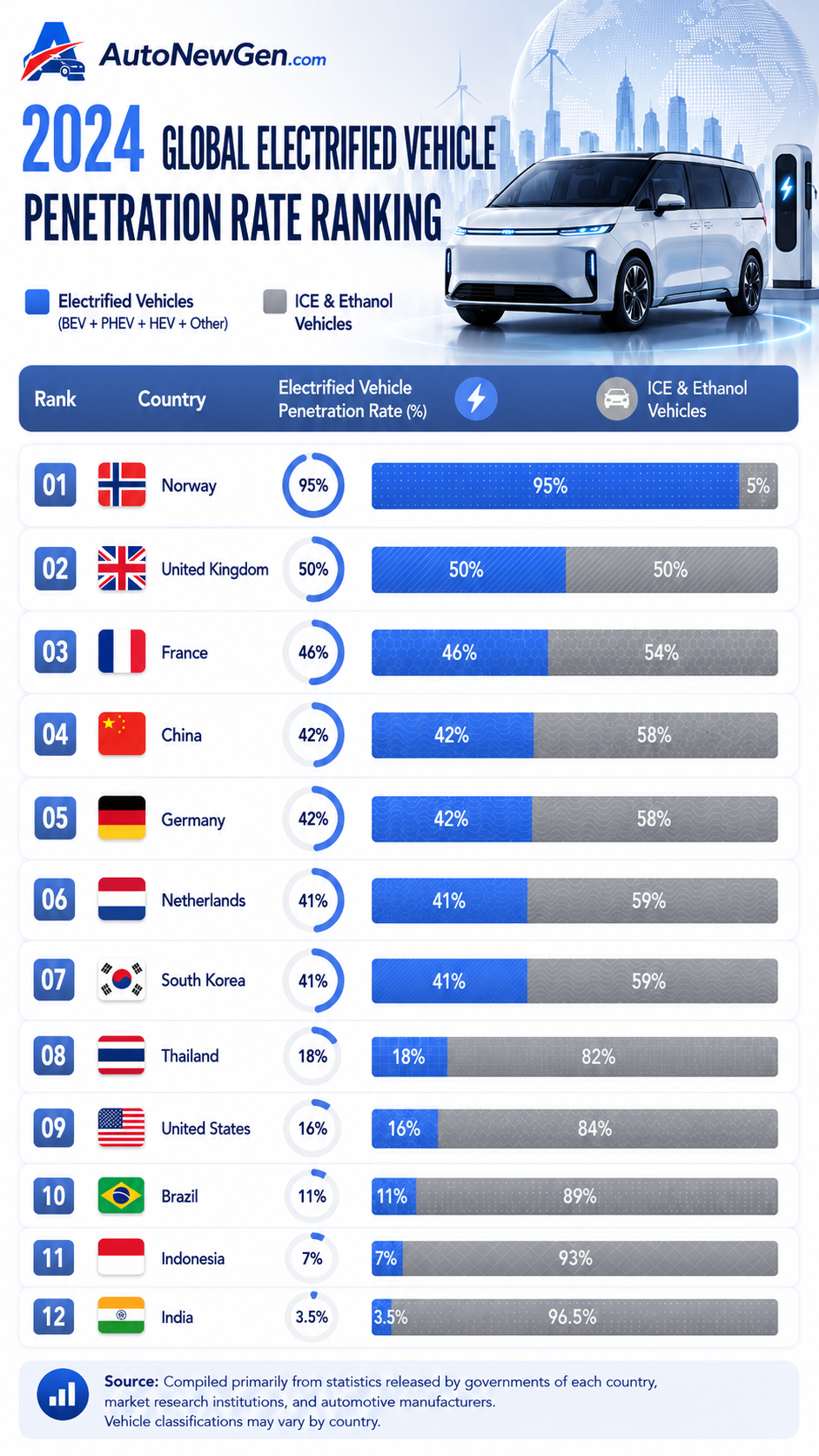
The global automotive industry continued its transition toward electrification in 2024, although the pace of adoption varied significantly across major markets. Norway remained the clear global leader, with electrified vehicles accounting for an estimated 95% of new vehicle sales, reinforcing its position as the world’s most advanced automotive market in terms of electrification.
The United Kingdom ranked second, reaching a 50% penetration rate and becoming one of the first large automotive markets where electrified vehicles represented half of all new car sales. France followed closely at 46%, while China and Germany both recorded penetration rates of 42%, highlighting the growing mainstream acceptance of electric and hybrid technologies across Europe and Asia.
China’s position deserves particular attention. While its penetration rate trails Norway and the UK, China remains by far the largest electrified vehicle market in absolute terms. With annual vehicle sales exceeding 23 million units, even a 42% penetration rate translates into a larger volume of electrified vehicle sales than any other country. The country’s combination of scale, manufacturing capacity and intense domestic competition continues to reshape the global automotive landscape.
Elsewhere, the Netherlands and South Korea both reached 41%, reflecting strong consumer demand and sustained investment in charging infrastructure and electrified powertrains. Thailand emerged as the leading market in Southeast Asia, achieving an estimated 18% penetration rate as Chinese automakers expanded local production and strengthened their regional presence.
The United States, despite being the world’s second-largest automotive market, recorded a penetration rate of just 16%. While electrified vehicle adoption continues to grow, the transition remains slower than in China and several European markets. Infrastructure availability, regional policy differences and consumer preferences continue to influence adoption rates across the country.
Emerging markets such as Brazil, Indonesia and India remain at an early stage of the electrification cycle, with penetration rates below 12%. However, these markets collectively represent some of the largest long-term growth opportunities for automakers as battery costs decline and charging networks expand.
The data highlights a widening divide between markets where electrification has become mainstream and those where internal combustion engine vehicles still dominate. Nevertheless, the overall direction is clear: electrified vehicles are steadily gaining market share across the world, and the transition from conventional powertrains is continuing to accelerate.