
China’s NEV Export Surge Reshapes the Global Manufacturer Ranking in May 2026
China’s passenger vehicle export landscape continued to shift rapidly in May 2026, with both established automakers and fast-growing NEV specialists reshuffling the global competitive order. According to data compiled from the China Passenger Car Association (CPCA) via Yiche, total exports—including complete vehicles and CKD units—remained highly concentrated among a small group of leading manufacturers, while electric vehicle exporters continued to gain structural influence.
The latest Top 20 Manufacturers by Passenger Vehicle Exports chart highlights not only volume leadership, but also the widening divergence between traditional high-volume exporters and new energy-focused challengers.
Chery Maintains Overall Export Leadership, But BYD Dominates NEVs
In the overall passenger vehicle export ranking, Chery Automobile retained its dominant position with 179,285 units exported in May 2026, reaffirming its long-standing reliance on overseas markets as a core growth engine. The brand continues to benefit from a diversified product portfolio and a well-established presence in emerging markets across Latin America, the Middle East, and parts of Europe.
BYD ranked second overall with 155,944 units, but its significance extends beyond total volume. In the NEV segment specifically, BYD became the clear leader, also recording 155,944 NEV exports, effectively confirming that its overseas shipments are now almost entirely electrified.
Geely completed the top three with 84,152 units, maintaining steady global expansion momentum across both conventional and electrified product lines.
NEV Export Leadership Is Becoming a Separate Competitive Layer
A key structural takeaway from May’s data is the separation between total export leadership and NEV export leadership.
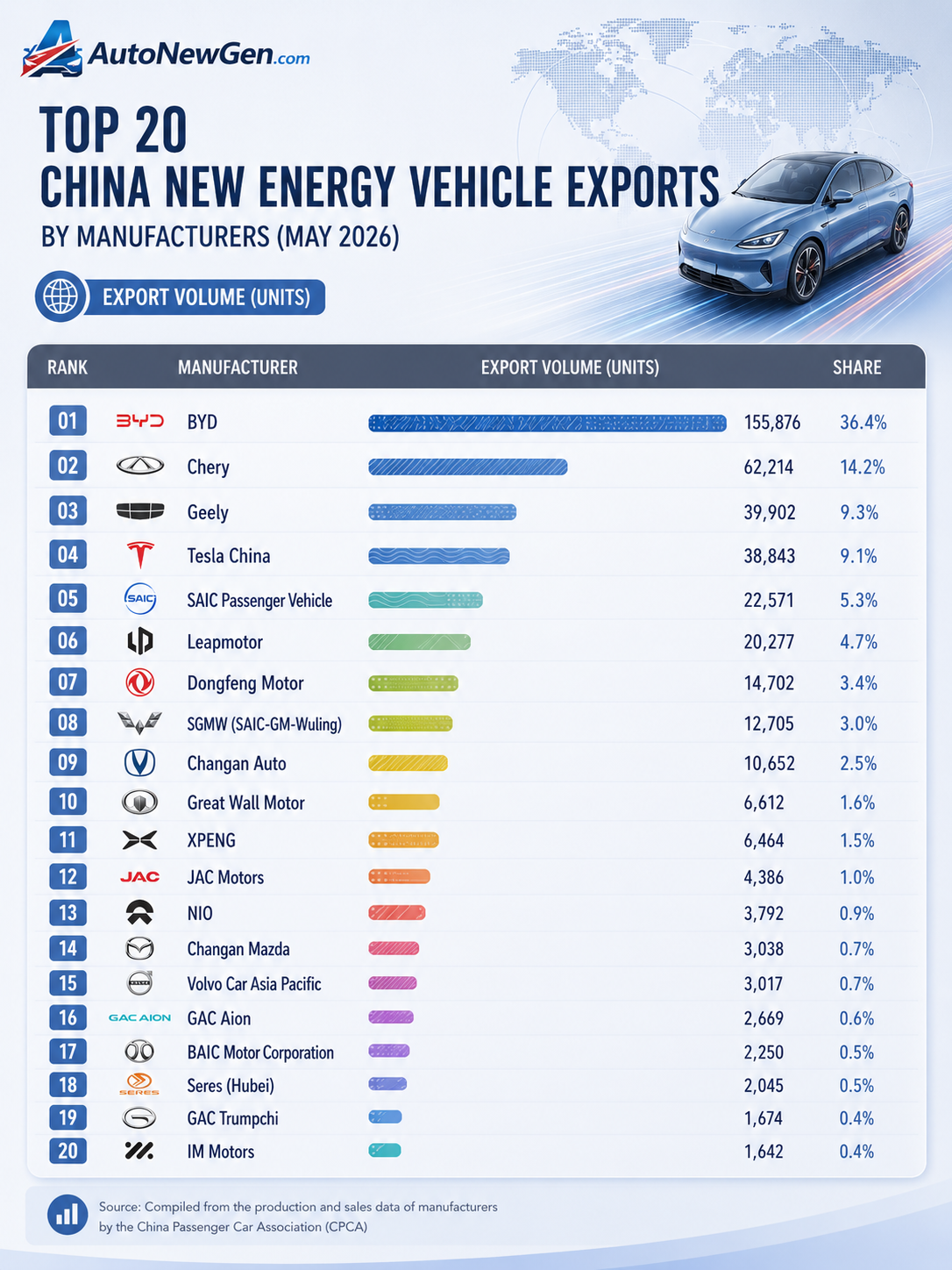
In the NEV-focused ranking, BYD led with 155,944 units, followed by Chery with 62,398 units, and Geely with 39,811 units.
This gap highlights a clear bifurcation in China’s export model: while Chery remains dominant in total volume, BYD has effectively established itself as the global benchmark for electrified exports.
The chart included in the article reinforces this divide, showing NEV-heavy exporters increasingly occupying higher-value positions within the global ranking system, despite not always leading in total shipment volume.
Fastest Growing Exporters Signal a New Second Tier of Competitors
Beyond the top-tier incumbents, the most dynamic shift is occurring among mid-sized and emerging manufacturers. Among companies exporting more than 5,000 units, several recorded extraordinary year-on-year growth rates.
Leapmotor posted +451.3% YoY growth with 16,510 additional units. Ruilan expanded by +356.5% with 4,898 units. Dongfeng Motor rose +197.5% with 13,014 units.
In the NEV segment, Dongfeng Motor surged +516.0%, Leapmotor +451.3%, and Geely +429.0%, reflecting accelerating electrification across both private and state-backed players.
Structural Shift: From Scale Leaders to Electrification Leaders
The divergence between export volume leaders and growth leaders reflects a broader structural transformation in China’s automotive export ecosystem.
Chery’s leadership demonstrates the continued importance of scale and diversified overseas operations. However, BYD’s NEV dominance signals a more important long-term shift: electrification is becoming a defining export advantage rather than a domestic-only trend.
Meanwhile, Leapmotor and Dongfeng illustrate how pricing strategy and state-backed electrification efforts are reshaping the mid-tier global competition landscape.
Chart Interpretation: A Fragmented but Rapidly Electrifying Export Landscape
The accompanying infographic visualizes a fragmented but accelerating export hierarchy. While the top positions remain relatively stable, the middle tier shows high volatility, with sharp growth differentials and shifting market shares.
The separation between total exports and NEV exports highlights a dual-track structure in China’s automotive export model: legacy ICE-driven scale on one side, and NEV-driven expansion on the other.
This structure is expected to persist as global markets continue to diverge in electrification readiness.
Conclusion: China’s Export Model Is Entering a NEV-Driven Phase
May 2026 reinforces a key transition point: China’s automotive export growth is increasingly driven by electrification rather than conventional volume expansion.
While Chery retains leadership in total exports, BYD’s NEV dominance and the rapid rise of Leapmotor and Dongfeng indicate that the next phase of global competition will be defined by technology mix, electrification depth, and overseas positioning.
The Top 20 ranking is evolving from a simple export list into a structural map of how China’s automotive industry is being reshaped for global competition in the electrified era.