
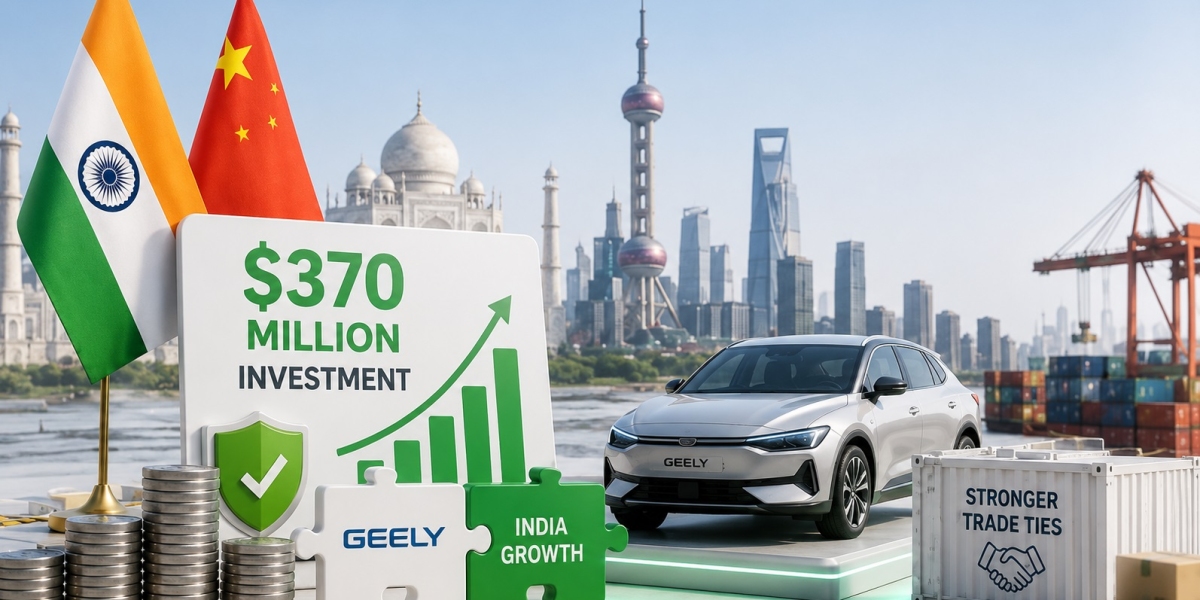
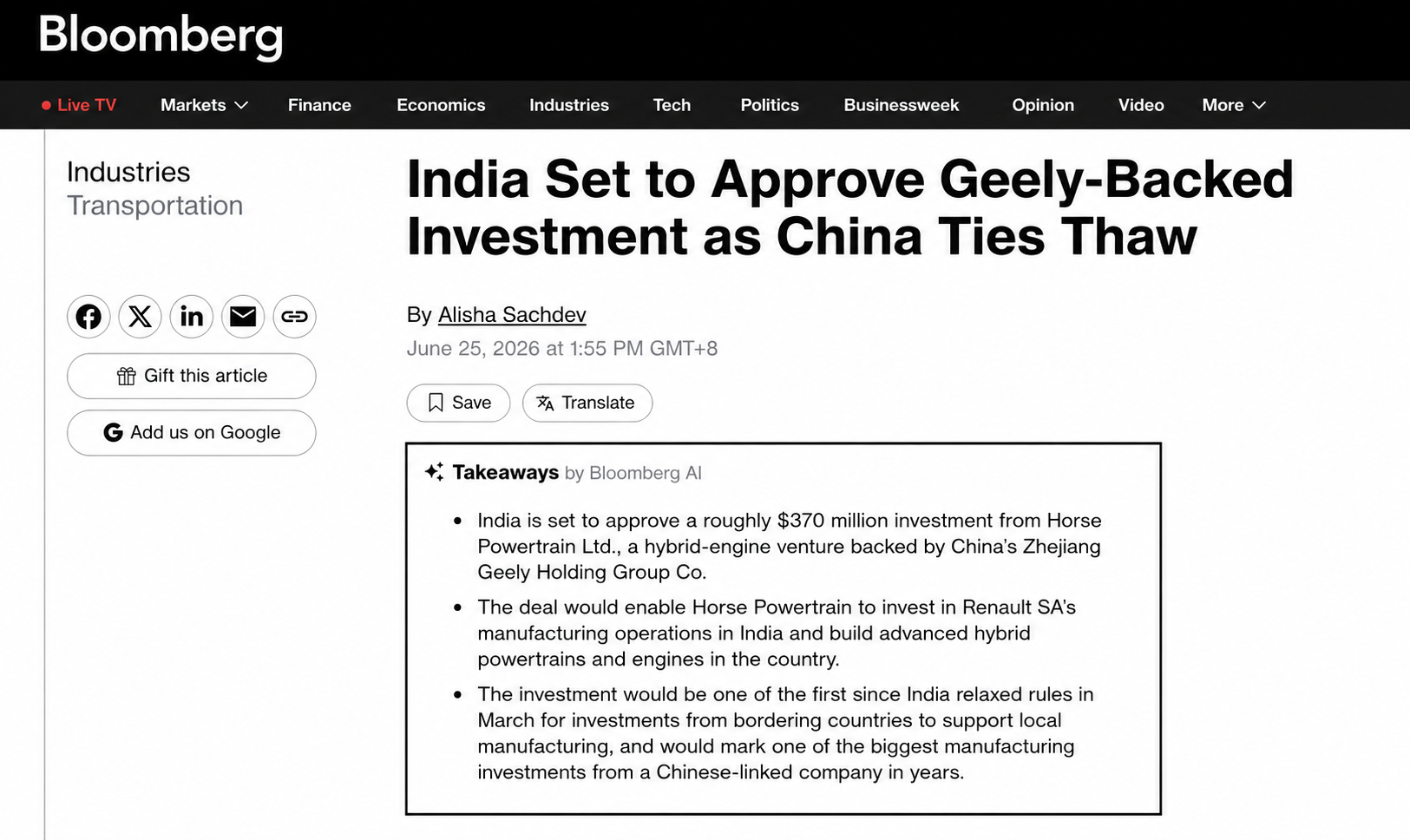
India is preparing to approve a $370 million manufacturing investment by Horse Powertrain Ltd., marking one of the country's most significant approvals involving Chinese-linked automotive capital in recent years.
The decision signals a carefully managed shift in New Delhi's industrial policy, as policymakers seek to strengthen domestic manufacturing while selectively reopening the door to foreign technology and investment.
The proposed project would allow Horse Powertrain — jointly owned by France's Renault and China's Zhejiang Geely Holding Group, with Saudi Aramco as a minority shareholder — to establish local production of advanced hybrid powertrains and engines at Renault's manufacturing facility in Chennai. The components will initially supply Renault and Nissan vehicles produced in India before potentially expanding to third-party automakers.
A Carefully Controlled Opening After Years of Restrictions
The investment is expected to become one of the first major manufacturing projects approved since India eased investment rules for neighboring countries in March 2026. The policy adjustment followed years of strict scrutiny introduced in 2020, when New Delhi required government approval for investments originating from countries sharing a land border with India.
While the revised framework does not represent a broad reopening to Chinese investment, it reflects a more pragmatic approach toward projects that contribute directly to India's manufacturing ambitions, technology transfer objectives and supply-chain resilience.
Officials have increasingly emphasized that overseas investment should help localize production, reduce import dependence and strengthen India's position within global industrial supply chains. The Horse Powertrain proposal aligns closely with those priorities.
Hybrid Technology Becomes a Strategic Priority
The Chennai project would manufacture advanced hybrid powertrains and internal combustion engines, technologies that continue to play an important role in India's automotive market despite the government's long-term electrification ambitions.
Hybrid vehicles have attracted renewed attention as automakers look for lower-emission solutions that avoid many of the infrastructure challenges associated with full battery-electric vehicles. Local production of these systems could reduce India's reliance on imported components while creating a domestic supplier base for increasingly sophisticated powertrain technologies.
The investment may also position India as a future export hub for hybrid propulsion systems, depending on how production expands over the coming years.
Horse Powertrain Reflects a New Model of Global Automotive Partnerships
Horse Powertrain was established in 2024 as a joint venture combining Renault's combustion-engine operations with Geely's powertrain business. Renault and Geely each hold a 45% stake, while Saudi Aramco owns the remaining 10%.
The company operates 18 manufacturing facilities worldwide and employs approximately 19,000 people, focusing on engines, hybrid systems, transmissions and related technologies designed to support global automakers during the industry's transition toward lower-emission mobility.
Unlike many traditional automotive joint ventures, Horse positions itself as an independent supplier capable of serving multiple manufacturers rather than exclusively supporting its shareholders.
Geopolitics Still Shapes Investment Decisions
The approval would carry significance beyond the automotive sector. Relations between India and China remain sensitive following years of diplomatic tensions and tightened investment screening. As a result, projects involving Chinese shareholders continue to undergo extensive government review.
The proposed investment suggests New Delhi is willing to distinguish between strategic manufacturing projects and broader concerns over foreign ownership, provided investments support domestic production and operate within clearly defined regulatory boundaries.
Industry analysts see the move as evidence that India is balancing national security considerations with the practical needs of building a globally competitive manufacturing base. Advanced automotive technologies remain difficult to localize without international partnerships, particularly in areas such as hybrid propulsion, engine development and precision manufacturing.
India's Supply-Chain Strategy Is Becoming More Selective
The project also illustrates how India's industrial strategy is evolving beyond attracting assembly operations toward developing deeper manufacturing capabilities. Building advanced powertrains locally could strengthen supplier networks, create higher-value engineering jobs and improve the country's long-term competitiveness in automotive production.
For global automakers, India is becoming an increasingly attractive production base as companies diversify manufacturing footprints beyond single-country supply chains. The government's willingness to approve carefully structured investments involving multiple international partners may encourage additional cross-border industrial collaborations.
For Geely, the investment offers another avenue to expand its global manufacturing footprint without directly entering India's passenger vehicle market. For Renault, it reinforces India as one of its most important production centers outside Europe.
A Measured Signal Rather Than a Policy Shift
The Horse Powertrain proposal should not be interpreted as a broad normalization of Chinese investment into India. Regulatory scrutiny remains stringent, and future approvals are likely to remain highly selective.
Yet the project demonstrates that New Delhi is prepared to make room for overseas capital when it advances strategic manufacturing objectives, accelerates technology localization and reduces dependence on imported automotive components.
As governments around the world seek to rebuild resilient automotive supply chains, India's approach increasingly reflects a broader trend: geopolitical caution is reshaping investment decisions, but industrial competitiveness continues to require carefully managed international cooperation.