
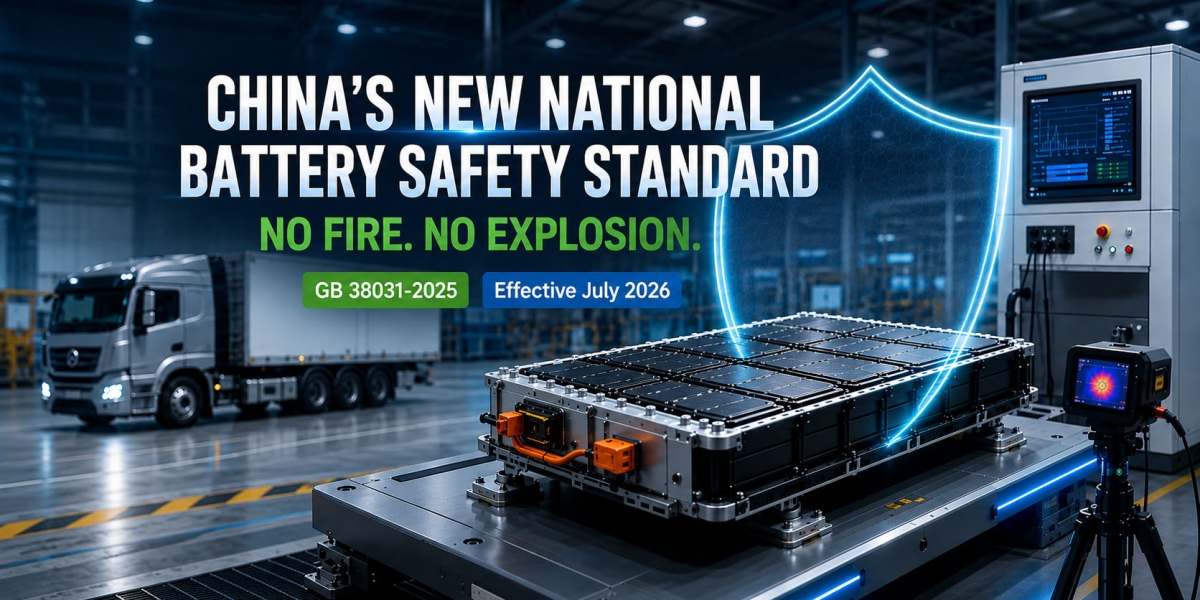
China is preparing to enforce what may be its toughest safety regime yet for electric-vehicle batteries, shifting the industry’s obligations from giving occupants time to escape toward preventing fires from breaking out in the first place.
Beijing Moves From Warning Drivers to Preventing Fires
The new national standard, formally known as Safety Requirements for Power Batteries Used in Electric Vehicles (GB 38031-2025), takes effect on July 1, 2026. Its central requirement is direct: after thermal runaway in a battery cell, the pack must not catch fire or explode.
The Five-Minute Escape Rule Is Being Replaced
China’s previous standard required vehicles to provide a warning at least five minutes before a fire, giving passengers a window to leave the car. The new rule goes much further. It seeks to block combustion itself, requires smoke to stay out of the passenger compartment, and extends the observation period to two hours.
The regulation also adds bottom-impact testing and safety checks after repeated fast-charging cycles. That brings two common real-world risk scenarios — underbody damage and frequent high-power charging — into the mandatory testing framework.
New Models Face the Rule First
From July 1, 2026, newly submitted vehicle models must comply with the standard. Existing models already on sale will receive a one-year transition period.
The industry has had time to prepare. In a sector survey conducted two years earlier, 78% of 36 automakers and battery companies said they had already mastered technologies designed to prevent fire and explosion. By the time enforcement begins, leading players such as CATL, BYD and Geely are expected to be better placed than smaller rivals to absorb the change.
The New Standard Does Not Eliminate Every Risk
The regulation does not mean EV batteries can never burn. The test focuses on whether a battery pack can isolate the thermal runaway of a single cell. Severe highway crashes, heavy underbody impacts or other accidents can damage multiple cells at once, releasing energy on a scale far beyond that of a single-cell short circuit.
Other failures, such as cooling-system leaks or external wiring short circuits, also fall outside the core battery-cell scenario addressed by the new standard.
Compliance Costs May Reshape the Market
Even without guaranteeing absolute safety, the new rule raises the technical threshold for battery makers and automakers. For consumers, it should improve everyday confidence in EV safety.
For the industry, the impact could be more structural. Large companies began preparing for the standard years ago and can spread compliance costs across broader research, engineering and production systems. Smaller battery suppliers face a tougher equation: more tests, higher validation costs and less room for error. Some may find the new safety bar difficult to clear.