
Trade barriers can slow industrial change. They rarely stop it when consumers decide the product on the other side is cheaper, newer and better aligned with the market.
That is the message emerging from Europe’s car market, where Chinese passenger-car brands overtook Japanese marques in monthly sales for the first time in May 2026. The milestone was not driven by a single model or a brief discounting campaign. It reflected a broader shift in technology, product cadence and pricing power that has been building for years.
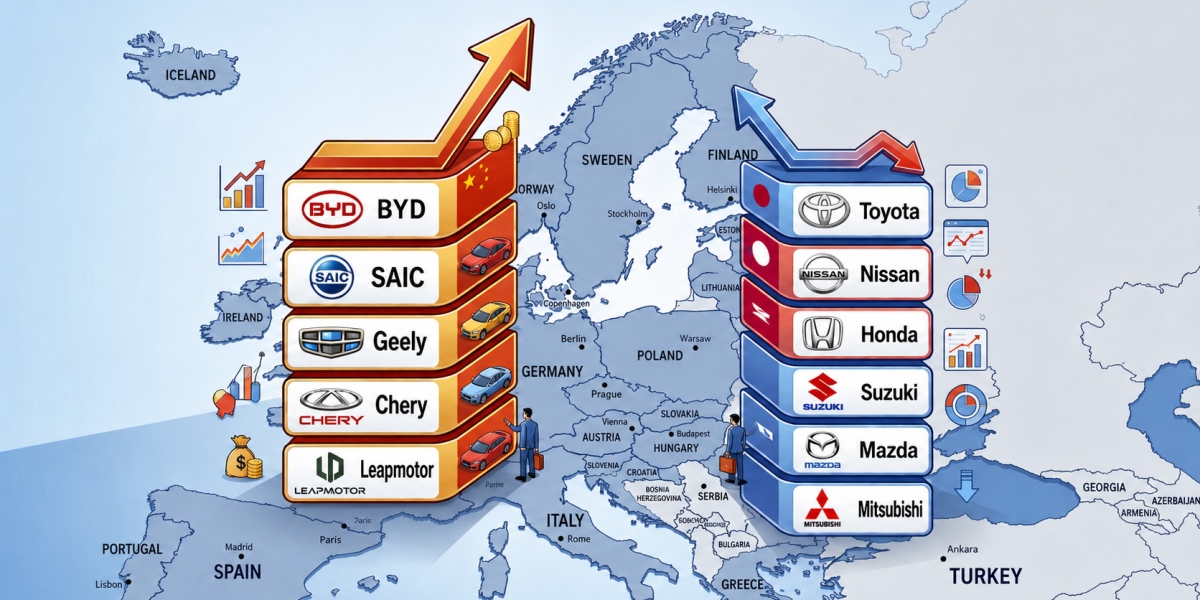
According to figures from the European Automobile Manufacturers’ Association, five Chinese carmakers — BYD, SAIC, Geely, Chery and Leapmotor — sold 138,410 vehicles across 31 European countries in May, up 65% from a year earlier. Six Japanese groups — Toyota, Nissan, Suzuki, Mazda, Honda and Mitsubishi — sold 130,424 vehicles over the same period, down 3% year on year. Chinese brands were ahead by roughly 6%.
The reversal was swift. In April, Japanese automakers still held a narrow lead, with 127,064 vehicles sold against 125,864 for the Chinese group. One month later, the balance of power had shifted.
For Europe, the birthplace of the modern car industry and a market where Japanese brands have spent decades building loyalty, the result carries unusual weight. It raises a larger question: how did Chinese carmakers move from challengers to front-runners in one of the world’s most mature automotive markets?
How the Reversal Happened
The headline figures — 138,410 Chinese-brand sales versus 130,424 Japanese-brand sales — capture two very different growth curves.
Over the past two years, Japanese automakers have struggled to build momentum in Europe. Nissan exceeded its year-earlier monthly sales only twice. Suzuki managed it five times, Mazda seven. Chinese groups followed a different trajectory. SAIC recorded 17 year-on-year monthly gains, while BYD, included in the data from July 2025, had already posted 11.
BYD has become the central force in that advance. In the first half of 2026, its overseas passenger-car sales reached 789,367 vehicles, up about 70% from a year earlier. In June, overseas deliveries accounted for 44% of BYD’s total sales, a 20-percentage-point increase from the previous year.
Europe has become one of the clearest tests of that expansion. BYD sold 31,575 vehicles in the region in May, a 141.4% year-on-year surge that lifted it to 13th place among automotive brands in Europe. Its Atto 2 small SUV, with 10,232 units sold, became the best-selling Chinese model in the region.
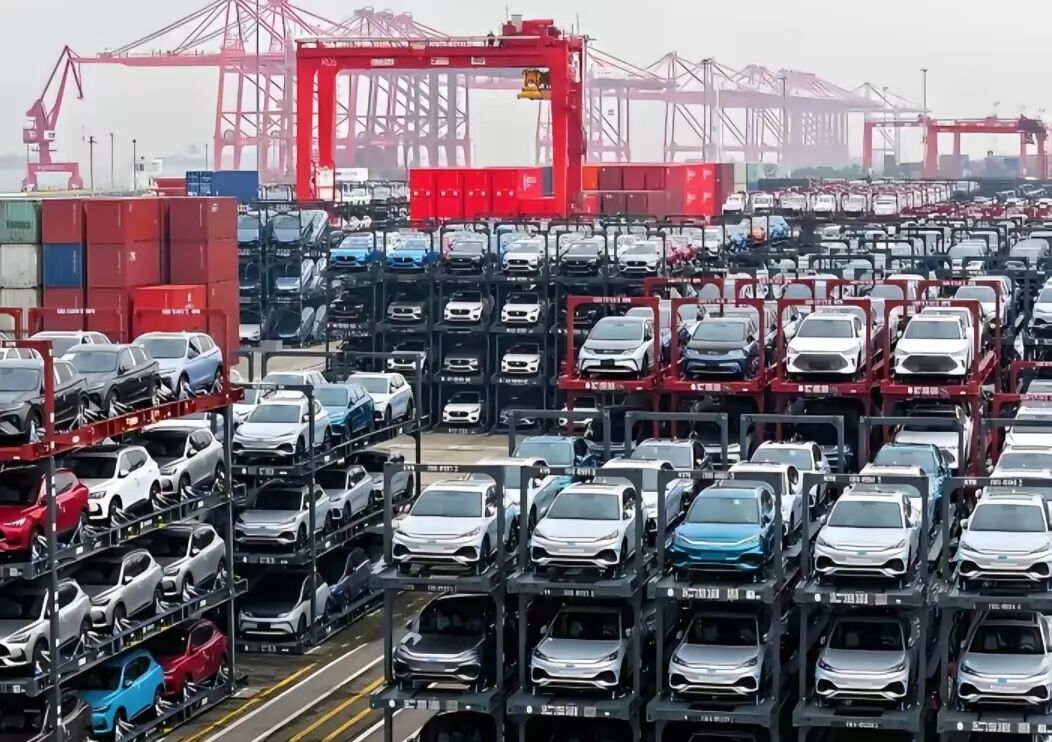
Chery has also emerged as a serious contender. Its European sales reached 30,043 vehicles in May, giving it a 2.6% market share. Through Jaecoo, Omoda, Chery and Ebro, the group has built a multi-brand structure that lets it cover different price bands without relying on a single badge. From January to May, Chery sold 138,843 vehicles in Europe, including the UK.
SAIC’s MG brand sold 30,292 vehicles in Europe in May, up 15.3% from a year earlier, and retained its position as the top-selling Chinese brand in Europe for an 11th consecutive year. Geely, supported by Volvo’s brand equity and technology base, increased its European sales by 7.9%. Leapmotor, backed by a tie-up with Stellantis, grew 465.1% year on year, making it one of the fastest-rising new entrants.
Together, the five Chinese groups now represent several models of expansion: established state-backed manufacturers, privately run exporters, new-energy specialists and companies using acquisitions or industrial partnerships to gain European access. The Japanese camp, by comparison, saw all six major brands fall year on year in May.
Chinese brands took a record 10.7% share of the European market in May 2026. A year earlier, their share was about 5%. Doubling share in 12 months is rare in a region where brand loyalties, dealer networks and regulatory rules usually change slowly.
Why Japanese Brands Lost Ground
Japan’s weakness in Europe is not a lack of engineering. It is a mismatch between the technology Japanese carmakers spent years refining and the vehicles European consumers and regulators are now rewarding.
Japanese groups built strong reputations around fuel-efficient hybrids. That strategy worked for years, especially for buyers who wanted lower running costs without relying on public charging. Europe’s policy direction has shifted faster. Purchase incentives, emissions rules and fleet targets now favour battery-electric cars and plug-in hybrids far more directly.
Germany restarted its new-energy subsidy programme in January, offering up to 6,000 euros for battery-electric vehicles and up to 4,500 euros for plug-in hybrids. Italy expanded support, and Sweden restored subsidies for lower-income households. Japanese brands, with limited electric line-ups in Europe, have been poorly positioned to capture those benefits.
Chinese automakers took the opposite route. They concentrated product launches in battery-electric and plug-in hybrid segments, then moved quickly when policy and tariffs changed. In the first quarter of 2026, China exported 198,300 battery-electric vehicles to Europe, up 94.6% year on year. Plug-in hybrid exports reached 106,000 vehicles, up 152.4%. From January to April, the value of China’s plug-in hybrid exports to the EU exceeded battery-electric exports for the first time, with plug-ins rising from about 30% of the mix in the same period of 2024 to more than 55%.
The shift was not accidental. After the EU imposed additional anti-subsidy duties of up to 35.3% on Chinese-made battery-electric vehicles in autumn 2024, Chinese manufacturers redirected more exports toward plug-in hybrids, which were not covered by the tariffs at the time. In May, plug-in hybrids accounted for roughly 60% of BYD’s sales in Germany. The Seal U became Europe’s best-selling Chinese plug-in hybrid that month.
This flexibility has become one of the industry’s defining divides. Japanese automakers are still highly credible in conventional hybrids. Chinese brands are faster at matching regulation, incentives and consumer demand with fresh electrified models.
Price remains the other advantage. Even after anti-subsidy duties, which can lift the total tariff burden on some Chinese-built electric cars to as much as 45.3%, Chinese vehicles remain competitive. Price-comparison data show BYD’s Dolphin Surf Boost starting at 26,990 euros in Germany, about 3% below the Renault 5 E-Tech. In mainstream compact SUV segments, similarly equipped Chinese models can undercut German rivals by about 20,000 euros.
The European consumer response is straightforward. In a market moving toward electrification, buyers are rewarding brands that offer a wide range of new-energy vehicles at accessible prices. Chinese carmakers have met that demand. Japanese brands have been slower to adjust.
The Tariff Challenge Is Only Starting
Passing Japanese automakers in one month is a symbolic win. Sustaining that lead will be far harder.
In October 2024, the EU formally imposed five-year anti-subsidy tariffs on Chinese-built battery-electric vehicles. On top of the standard 10% import duty, BYD faces an additional 17.0%, Geely 18.8% and SAIC 35.3%. For some models, the combined tariff burden can reach 45.3%.
Plug-in hybrids have been the main tool Chinese carmakers used to offset that pressure. That shelter may not last. In June 2026, Germany’s Handelsblatt reported that the EU had completed policy preparations to extend anti-subsidy duties to Chinese-made plug-in hybrids, pending approval by member states. If the measure is adopted, one of the most important loopholes in China’s European strategy will close.
Brussels is also moving beyond tariffs. In March 2026, the EU proposed an Industrial Accelerator Act that would define “EU-made” vehicles through strict local-content requirements, including 70% of the value chain being completed in the bloc and foreign ownership capped at 49%. For Chinese carmakers, that would put the export-led model under a level of pressure not seen before.
The response is already visible. BYD’s Hungarian plant is expected to begin production in the fourth quarter of 2026. Chery has signed a memorandum of understanding to use Nissan’s Sunderland plant in the UK for contract manufacturing. Leapmotor will share Stellantis capacity in Spain. SAIC has laid out plans for a factory in Galicia, Spain.
Industry estimates suggest Chinese automakers’ overseas plant footprint and planned capacity have expanded roughly sixfold from five years ago. By 2030, Chinese groups are expected to have about 3mn units of overseas capacity worldwide.
Local production can reduce exposure to import tariffs and help carmakers meet Europe’s tightening industrial-policy rules. The first companies to scale production inside Europe could gain both tariff relief and access to local incentives, turning manufacturing geography into a competitive weapon.
From Selling to Europe to Building in Europe
China’s car export boom is still expanding. He Yi, a senior official at the China Association of Automobile Manufacturers, has forecast that Chinese vehicle exports could exceed 10mn units in 2026. Some industry forecasts suggest Chinese brands could lift their European market share from about 10% today to 16% by 2030, squeezing European, Japanese and Korean manufacturers at the same time.
The May breakthrough in Europe was the result of several forces converging: early investment in new-energy technology, disciplined cost control, rapid product development and a willingness to adapt export strategy when policy shifted. It was not a simple story of tariffs failing. It was a story of industrial speed meeting a market in transition.
The next phase will be more complex. Sales growth alone will not be enough. Chinese carmakers will need stronger brands, deeper dealer and service networks, European manufacturing capacity, regulatory credibility and a larger voice in technical standards.
Overtaking Japanese automakers in Europe marks a turning point. Holding that position will require something more difficult: turning export success into a durable European industrial presence.