
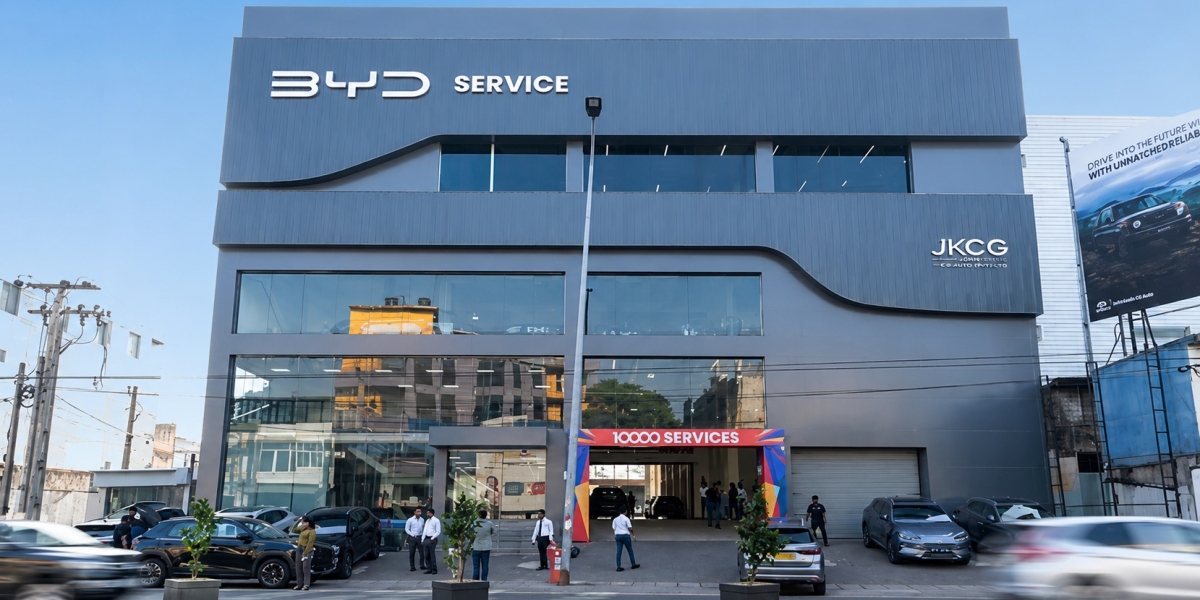
BYD’s rapid rise in Sri Lanka is entering a more difficult phase: turning early sales momentum into a durable electric-vehicle ecosystem in a market still rebuilding after years of import restrictions.
The Chinese carmaker has become one of the dominant names in Sri Lanka’s new-car market, accounting for about 31.1% of brand-new passenger vehicle registrations and 63.3% of new electric-vehicle registrations, according to company data cited by The Island Online. The figures underline how quickly Chinese brands can reshape smaller right-hand-drive markets once import channels reopen and consumers are given a broader choice of electrified models.
Yet BYD’s next challenge in Sri Lanka is less about winning showroom traffic than proving it can support vehicles over their full life cycle. For buyers in emerging EV markets, the question is not only whether an electric car is cheaper to run, but whether batteries, software, diagnostics, crash repairs and spare parts can be handled locally with the same confidence as conventional vehicles.
From Sales Breakthrough to Service Test
BYD, represented in Sri Lanka by authorised distributor John Keells CG Auto, is expanding its aftersales, technical and customer-support operations as the country pushes deeper into electrified mobility. The effort reflects a broader shift in the global EV contest: Chinese manufacturers are no longer judged only by price, range or battery technology, but by their ability to build trusted service networks outside China.
That point matters in Sri Lanka because the market has reopened after a long period of disruption. Vehicle imports were heavily restricted for years as the country dealt with a foreign-exchange crisis. When demand returned, electric and plug-in models gained attention quickly, helped by lower running costs and growing consumer awareness of new-energy vehicles.
For BYD, the opportunity is clear. Sri Lanka gives the company a foothold in South Asia beyond the region’s largest auto markets, while also offering a test case for how Chinese EV makers can build credibility in countries where charging infrastructure, technician training and parts supply remain uneven.
A Network Built Around Confidence
The company’s strategy is centred on service capacity. BYD opened what was described as Sri Lanka’s largest service centre in 2024 and plans to add a major paint and accident-repair facility in 2026. That expansion is designed to address one of the most common concerns among first-time EV buyers: what happens after a collision, battery issue or electronic fault.
Electric vehicles require a different aftersales model from petrol and diesel cars. High-voltage battery systems, thermal management, advanced driver-assistance hardware, electronic control units and over-the-air software functions all demand specialised equipment and trained technicians. A weak service network can quickly erode confidence, even when the vehicles themselves are competitive.
BYD’s Sri Lankan technical team currently has 33 members, all of whom have received specialised training, according to the report. The company is also assessing whether Sri Lanka could become a potential technical training hub for South Asia, a move that would give the market a role beyond local sales and position it as part of BYD’s regional support architecture.
Six Cities Now, More to Come
BYD’s 3S network — covering sales, service and spare parts — now spans six major cities in Sri Lanka. The company plans to extend that network to three more cities, widening access for customers outside the capital and reducing the risk that EV ownership becomes concentrated in a small urban corridor.
For a market such as Sri Lanka, national coverage could prove decisive. EV adoption often begins in large cities, where incomes are higher and charging access is easier. Sustained growth depends on whether service and maintenance can reach secondary cities, where buyers may be more cautious and resale values can be shaped by perceptions of long-term support.
That is why BYD’s infrastructure push may be more important than its early registration share. A high market share can be won quickly in a supply-constrained market. A durable brand position requires parts availability, repair speed, technician depth and the confidence that an EV will remain serviceable years after purchase.
A South Asian Test Case for Chinese EVs
BYD’s Sri Lanka expansion also points to a wider pattern in the global auto industry. As Chinese carmakers move deeper into Asia, Latin America, the Middle East and Europe, the competitive battleground is shifting from export volumes to local ecosystems. The winners will be the companies that can make EV ownership feel routine, not experimental.
That is especially true in smaller markets, where a single brand can rise quickly but can also face reputational pressure if service capacity fails to keep pace with sales. For BYD, Sri Lanka offers a chance to show that its overseas growth model can include training, repairs, parts distribution and regional technical capability — not just vehicle shipments.
The company’s early dominance gives it a strong platform. Its next task is harder: convincing Sri Lankan buyers that the country’s EV transition is backed by the infrastructure needed to make electric cars a practical long-term choice. In that sense, BYD’s latest move is not simply an aftersales expansion. It is a test of whether China’s EV export leaders can turn market share into trust.